Mental strength is not a gift, it is something that you have to work very hard to develop.
Even though there is no physical contact in tennis, there’s still a lot of eye contact.
A masterclass on competition by Novak Djokovic
Sergey Brin rarely speaks publicly. He sat down for an unscripted Q&A on Frontier AI.
He admits even the people building these models do not fully understand what they have created:
1. All the specialized AI models are converging into one. Google used to need separate models for different scientific problems. Now the main Gemini models are becoming state-of-the-art for math and other scientific questions at the same time. Brin says he would not have predicted this convergence at the outset, and watching it happen has been incredible.
2. Training an AI on one skill mysteriously improves unrelated skills. This is the concept of transfer. Train a model on coding, and its math reasoning gets better, and vice versa. Teaching it to process images can improve its ability to think through geometric word problems. The capabilities bleed into each other in ways nobody fully engineered.
3. Even Sergey Brin does not know how to prompt these models. He says he is genuinely confused about what level to prompt at. Do you tell it to debug a specific chunk of code, or ask it to write a better neural net training algorithm, or just say, " What should I do today. He admits that even at Google, they do not know exactly where the edges of Gemini's capabilities are.
4. One of the biggest leaps in AI came from the dumbest sounding trick. Chain-of-thought prompting is just telling the model to think step by step before giving your problem. Brin says it seemed like the dumbest thing ever, and there was no obvious reason it should work. But it did, and it spurred a significant increase in AI capability. Some of the most straightforward requests turn out to unlock the most.
5. Brin would not modify his own biology for today's AI. Asked how humans can keep up with the accelerating bandwidth of models, he acknowledged neural links and direct brain connections are being pursued. But he said he would personally wait for the technology to mature a lot before doing anything to change his biology. Today's models do not justify it.
6. Super intelligence does not mean solving the impossible. An audience member argued that true super intelligence would mean solving NP complete problems like the travelling salesman. Brin pushed back. Most computer scientists believe P is not equal to NP, which means no algorithm can reliably solve those problems optimally, and it does not matter how smart the AI is. Impossible stays impossible. Super intelligence just means being smarter than humans.
7. Computers mastering a skill has never stopped humans from pursuing it. Deep Blue beat Kasparov at chess in the 1990s, and people kept playing chess. After AlphaGo, the human game of Go advanced dramatically, and the players who lost to it became vastly better. Brin's point: AI does not retire human ambition in an area; it often pushes the state of the art and pulls people up with it.
8. Brin thinks something close to transformers could get us to AGI. Asked directly if transformers are sufficient, he said his guess is yes, largely because they have proven weirdly flexible, working for image and video far beyond their original text purpose. But he was careful to note they have quietly changed a lot along the way and are not the same architecture as the original transformer paper.
9. AGI means two different things, and one requires understanding the physical world. Brin personally thinks of AGI as AI that can improve itself. But he concedes others define it as AI that can do anything a person can, and he thinks they are probably more correct. To do everything a person can, the AI must understand and interact with the physical world, which is why world models, and robotics, become essential.
10. Inside Google, they now use the AI to build the AI. Brin says the team has shifted a lot of energy toward having the AI do things like monitor training runs and generate its own training data. You start to use the tool to build the tool. That is most of what he spends his time on now, what he calls the self-improvement game.
11. Brin is unusually candid about where Google trails its competitors. He admits Google was a little late to focus deeply on coding. He says Gemini 3.0 and 3.1 were on top across the board six months ago, but other labs have since made strides, particularly in coding. He gives a competitor's model the edge now on deep coding and overnight tasks, while pitching Gemini's flash model as far faster for rapid interactive iteration. hindsight, he says, is that they should have focused on code earlier.
12. He sees his own role as a rabble-rouser, not a manager. Brin is honest that delivering Gemini is Corey and Demis's responsibility, not his. he describes his job as poking and prodding the team, asking, are you really doing that, reminding them of priorities they might be missing and ideas they are not paying enough attention to. He admits this is sometimes a little disruptive.
13. Confidence comes from ignoring the monthly temperature. Brin says if he judged Google's position every month by which competitor just shipped a model, he would lose his confidence very quickly. Instead, he watches the longer arc. Things shift around constantly; one lab leads on one thing, another pulls ahead somewhere else, and he feels good about where Gemini actually is despite the day-to-day noise.
🚨 Scientists Say “Luck” Is Not Random — And Your Mind Shapes It
In 2019, Oxford physicists ran an experiment with electrons and found particles behaved differently depending on whether the observer expected a certain result. This confirmed a long-standing hypothesis: expectation itself changes outcomes.
🔹 Scientists call this the observer coherence effect. When you’re confident you’ll “get lucky,” your brain filters reality to highlight opportunities others ignore.
🔹 Research in Zurich found that people who believe in their luck are 3x more likely to find money, land jobs, and close deals — not because of magic, but because their brains are tuned to spot signals others miss.
🔹 Even quantum experiments with random numbers showed a strange pattern: participants’ focused intention nudged probabilities beyond statistical norms.
The lesson? Luck isn’t mysticism — it’s the power of focus aligning quantum possibilities in your favor. Every moment holds countless outcomes. Your mind helps decide which one becomes real.
The brain has two functions. Its original function, before we started talking, like all other animals, brains are receivers of frequencies, like antennas. That part of the brain picks up the transmissions or frequencies of the universe.
With language, we developed a second function for our brain through the processing and storage of information. And over time, through the length process of evolution, this part of the human brain took over.
Now we only use the antenna involuntarily during sleep or under the influence of music or drugs or or…
We need to practice how to use it again. Then we can connect to the entire ripple effect. https://t.co/DrGWr23kdm
ANTHROPIC JUST DROPPED A ZERO TRUST PLAYBOOK FOR AI AGENTS
and it's not theory it's architecture
frontier AI compresses vulnerability-to-exploit timelines from months to hours
your agents face threats traditional access controls were never built to handle:
▫️ prompt injection through external data sources
▫️ tool poisoning via MCP server metadata
▫️ memory-based privilege retention across sessions
▫️ multi-agent pivot attacks
the framework breaks it into 3 tiers: Foundation, Enterprise, Advanced
https://t.co/uDuO9cq25H
Salesforce published a detailed writeup on going agentic with Claude Code. A couple things jumped out.
A migration they'd scoped at 231 days shipped in 13. One PR delivered 21 endpoints at 100% test coverage.
SURGERY PERFORMED FROM 3000KMS AWAY!
Indian urologist Dr Syed Mohammed Ghouse has successfully performed a robot-assisted bladder reconnection surgery on a patient in Hyderabad from Wuhan, China 3,000 km away
Surgery completed in 90 minutes using 5G technology and Chinese robotics with live 3D imaging. The patient has recovered successfully
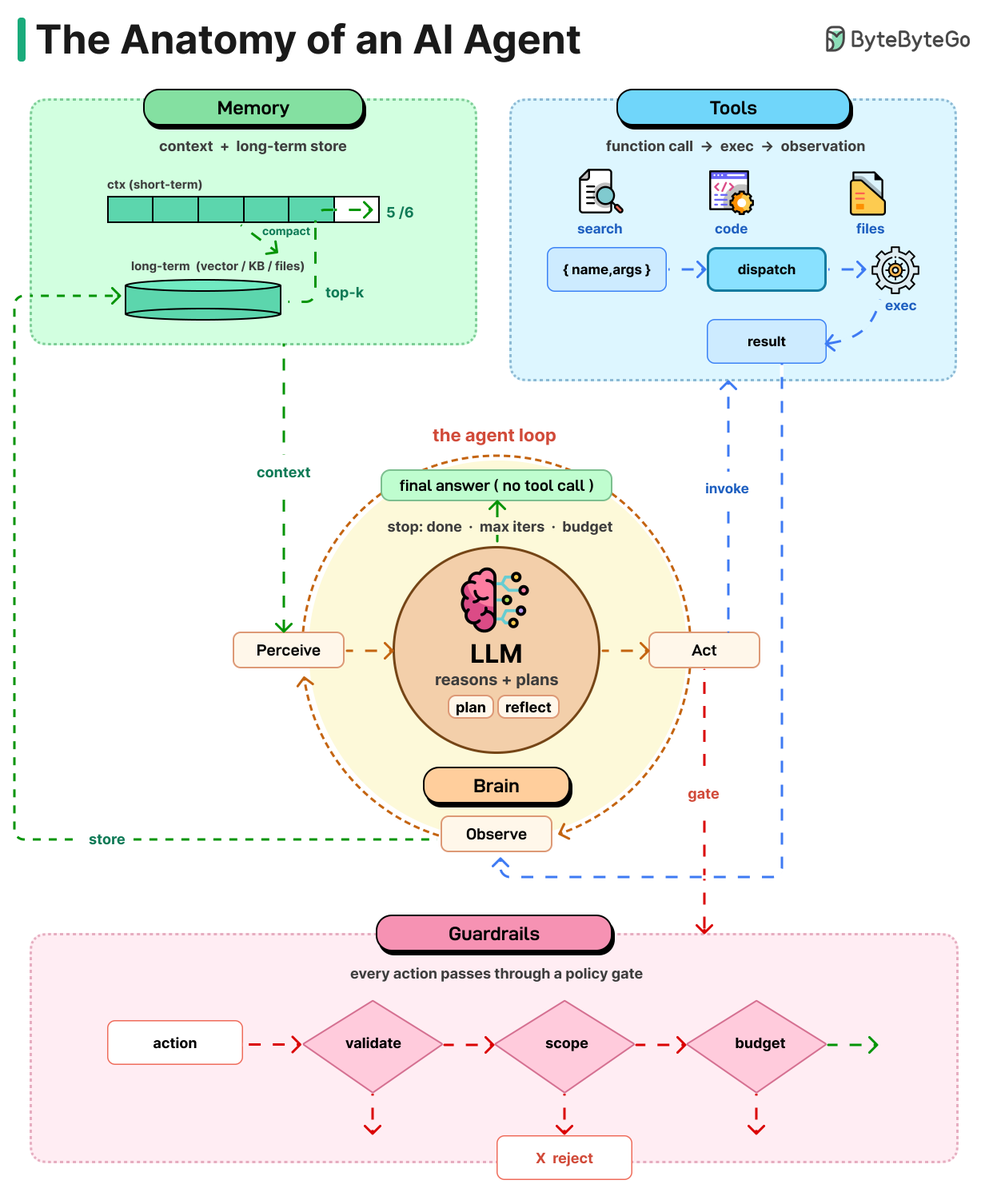
An AI agent can be thought of as a simple While-loop.
It uses an LLM to select an action, executes that action, evaluates the result, and repeats the process until the task is complete. Let’s take a closer look at each of these components:
Brain: The LLM is the core. It reads the situation, thinks, and decides what to do next. The big shift from chatbot to agent: the model isn't writing text anymore, it's making choices.
Planning: Hard tasks need more than one step. Agents break them down using methods like Chain of Thought (think step by step), Tree of Thoughts (try options, pick the best), or
Reflexion (learn from mistakes and retry). Planning turns a fuzzy goal into clear actions.
Tools: An LLM without tools is a brain in a jar. Tools are functions the model can call, like web search, code execution, APIs, files, or browsers (often using the MCP standard). The model requests a tool, the system runs it, and the result comes back.
Memory: Without memory, every turn starts from zero. Short-term memory is the context window. Long-term memory lives in vector stores, files, and knowledge bases. When the window fills up, agents summarize old turns and carry the summary forward.
Loop: All four pieces work together in a cycle. The agent looks at the current state, decides what to do, uses a tool, sees the result, and repeats. It keeps going until it gives a final answer.
Guardrails: Not strictly anatomy, but important. Sandboxing, human checks, token limits, output validation, and scope limits keep autonomy from turning into expensive chaos. The more autonomy you give, the more these matter.
Over to you: when you build an agent, which of these five takes the most work to get right?
BEST YOUTUBE CHANNELS TO GET FIT WITHOUT A GYM:
1. Bodyweight Training → Calisthenics Movement
2. Home Workouts → FitnessBlender
3. Yoga for Beginners → Yoga With Adriene
4. Mobility and Flexibility → Tom Merrick
5. HIIT Training → Sydney Cummings Houdyshell
6. Street Workout → Hannibal For King
7. Running and Cardio → Global Triathlon Network
8. Nutrition Basics → Jeff Nippard
9. Fat Loss Science → Renaissance Periodization
10. Beginner Strength → Athlean X
11. Stretching and Recovery → Bob and Brad
12. Mental and Physical Balance → Movement by David
13. Functional Fitness → THENX
14. Female Fitness → Heather Robertson
15. Sports Science → Squat University
16. Habit Building Around Fitness → Thomas DeLauer
17. Long Term Athletic Development → Knees Over Toes Guy
18. Pilates at Home → Move With Nicole
19. Senior Fitness → HASfit
20. Kids and Family Fitness → Cosmic Kids Yoga
21. Martial Arts at Home → Howcast Martial Arts
22. Jump Rope Training → Jump Rope Dudes
23. Dance Fitness → The Fitness Marshall
24. Swimming Technique → Swim University
25. Cycling at Home → Global Cycling Network
26. Mindful Movement → Boho Beautiful
27. Posture Correction → Upright Health
28. Core Strength → Caroline Girvan
29. Parkour Basics → Storror
30. Boxing at Home → FightTips
31. Breathwork and Recovery → Wim Hof Method
32. Injury Prevention → Physical Therapy Video
33. Meal Prep for Fitness → Remington James
34. Sleep and Recovery Science → Andrew Huberman Clips
35. Outdoor Fitness → Hybrid Calisthenics
36. Body Recomposition → Greg Doucette
37. Intermittent Fasting → Jason Fung Lectures
38. Mental Fitness and Discipline → David Goggins Clips
39. Gymnastics Basics → GMB Fitness
40. Foam Rolling and Myofascial Release → The Ready State
41. Resistance Bands Training → Anabolic Aliens
42. Postpartum Fitness → Mama Lion Strong
43. Hiking and Outdoor Conditioning → Andrew Skurka
44. Sports Specific Training → Overtime Athletes
45. Hormone and Metabolism Health → Rhonda Patrick Clips
46. Plant Based Fitness → Simnett Nutrition
47. Weight Loss Mindset → Jordan Syatt
48. Balance and Coordination → GMB Elements
49. Cold Exposure and Fitness → Morozko Forge Clips
50. Complete Beginner Fitness Guide → Natacha Océane
DevOps shaped delivery. Platform engineering is shaping experience.
Together, they’re powering faster releases, better tools, and scalable developer success.
🔗 See how both can work together: https://t.co/1qQTlSJV7B
#DevOps#PlatformEngineering#IDP