Lecturer in IR, work for Troy University (@TROYUnews) in Seoul; tweets are my own. Sŏngun Korea; NE Asian security (WMD, missiles, cyber). RT ≠ endorsement
Dear @usairforce, @USNavy, @USArmy@USMC: Greenland is part of Denmark, a NATO ally. If Trump orders the military to attack Greenland without congressional approval, that would be an illegal order. You will disobey the illegal order.
Your oath is to the Constitution, not Trump.
Why is North Korea sending troops to aid Russia? Today on Speaking Globally, we continue our conversation with @dpinkston about the threat North Korea and Russia pose to the global world order.
Listen wherever you get you podcasts.
https://t.co/tyROimuMDz
Wow. @SenatorRounds just said that China’s Salt Typhoon hack has given the Chinese Communist Party the ability to spy on any American who uses a mobile phone:
“They have access to every single one of our major telecommunications companies. They have broken in. They can read your texts and they can listen to your conversations.”
@HFXforum #HFX2024
@elonmusk Imagine the industrial-scale looting that will take place when the pro-crime GOP & its organized crime kingpin have the full reins of power. As the gini coefficient worsens, petty crime & drug use will increase. Meanwhile, oligarchs like Musk will ramp up influence operations.
@Doug_Bandow Right....I'm old enough to remember the only time NATO's Article 5 was invoked. It's also a misrepresentation to suggest that citizens in democracies support collective security institutions to launch unprovoked wars for imperialist conquest.
Come join @KoreaEconInst for discussion on US-ROK space, cyber, & defense industrial cooperation, next Wed., Nov 13, 10:00AM-12:30PM, lunch provided!
https://t.co/ut685E80V2
A nuclear state’s greatest responsibility is to keep its warheads secure. Since Russia invaded Ukraine in February 2022, it has put approximately 30 percent of its estimated 5,580 warheads in an untenably precarious position. Early in the war, concerns that the invasion increased the danger of a nuclear detonation or accidental explosion focused on the risk to Ukraine’s four nuclear power plants and Russia’s threats to intentionally escalate the conflict past the nuclear threshold. But the more Ukraine seeks to hit targets inside Russia, the clearer it becomes that Russia’s unwillingness to adequately secure the nuclear arsenals it has stored in its west—which are now within striking distance of Ukrainian missiles and drones and even Ukrainian troops—poses a dire risk - @ForeignAffairs https://t.co/gI7YDWVxH6
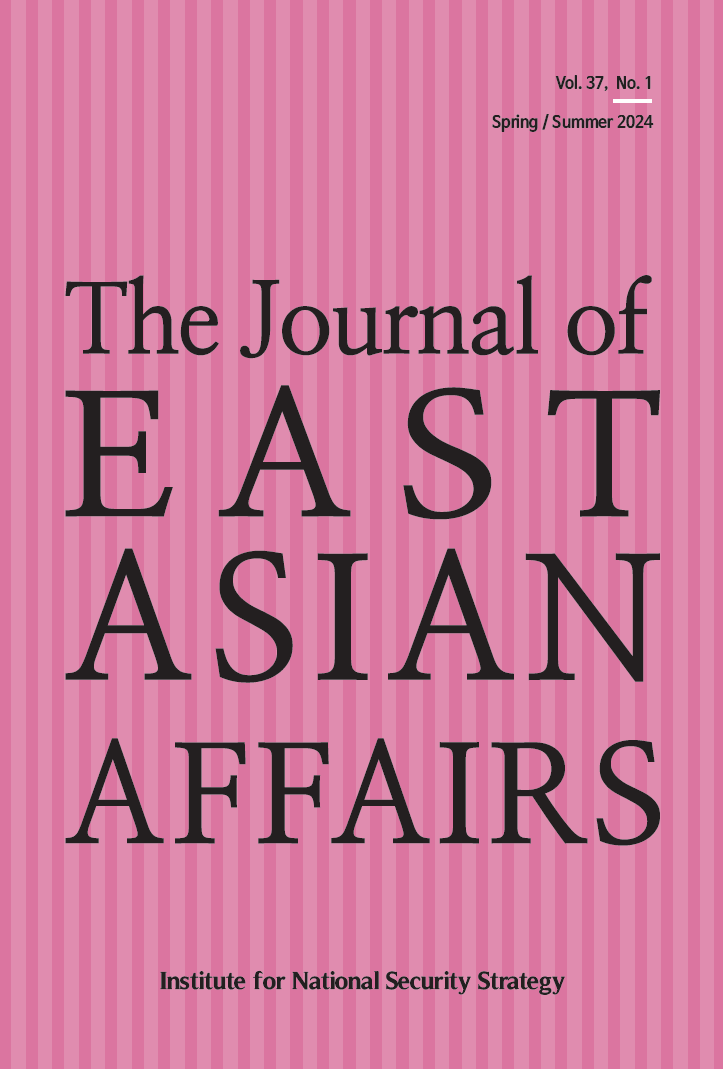
*Please share widely* New issue available of free-to-access Journal of East Asian Affairs @JOEAA_INSS, the English-language journal of South Korea’s Institute for National Security Strategy (INSS).
(I am executive editor, with INSS Director Han Sukhee as publisher and Mason Richey as editor-in-chief)
Articles well worth your time from:
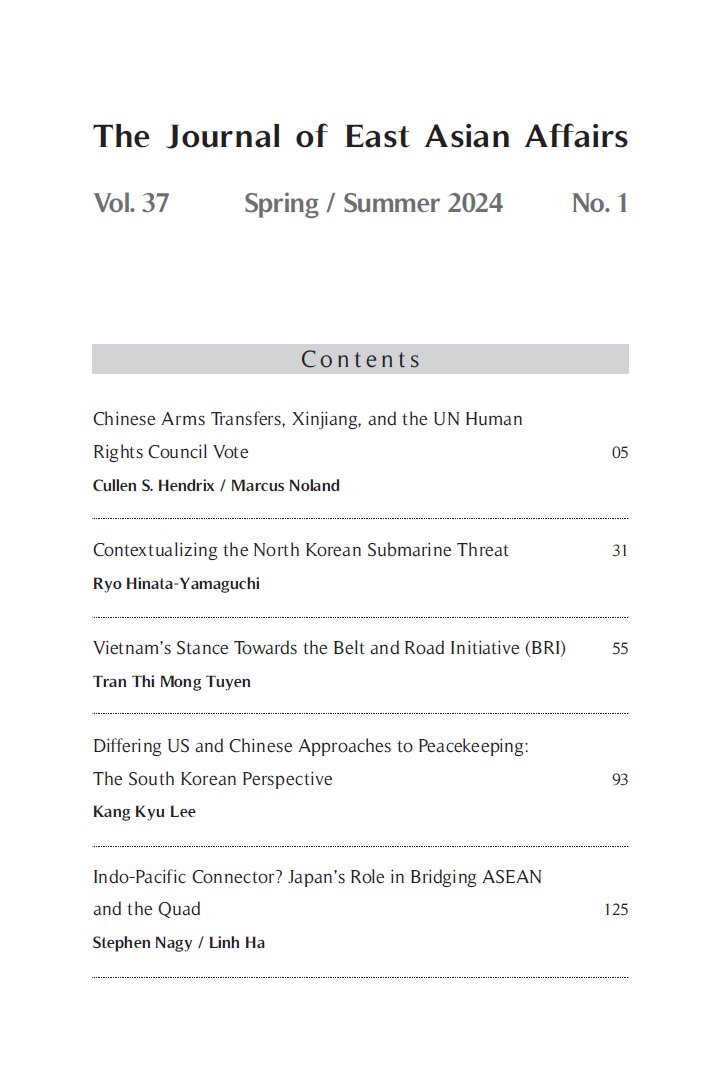
-Cullen S. Hendrix @cullenhendrix and Marcus Noland @marcus_noland (Peterson Institute for International Economics @PIIE) finding that rather than BRI participants, it was countries receiving Chinese arms that supported China on UN Human Rights Council Xinjiang votes.
-Ryo Hinata-Yamaguchi @tigerrhy (Tokyo International University @IR_TokyoIU) looking at concerning developments in North Korea’s submarine capabilities.
-Tran Thi Mong Tuyen (National Chengchi University, Taipei) on Vietnam’s stance towards the Belt and Road Initiative (BRI).
-Kang Kyu Lee @kangkyulee (Korea Institute for Defense Analyses @KIDA) drawing lessons for South Korea from China’s and the Us’ involvement in peacekeeping operations.
-and, Stephen Nagy @nagystephen1 and Linh Ha (International Christian University, Tokyo) on Japan’s important role as a connector between ASEAN and the Quad.
If you’re interested in submitting an article for consideration, please do so. INSS’s profile and free-to-access means it’s a great place to share your insights, and accepted articles receive a generous 1 million KRW honorarium.
Editorial board:
Ghulam Ali, Sichuan University of Science and Engineering
Cai Cuihong, Fudan University
Renato Cruz de Castro, De La Salle University
Ja lan Chong @ChongJaIan, National University of Singapore
Thomas Christiansen @TCEuropean, LUISS
Jonathan Chow @jontchow, Wheaton College
Chun In-bum @InBum_Chun , Lieutenant General (ret.), ROK Army
Moamen Gouda @DrMoamenGouda, Hankuk University of Foreign Studies
John Hemmings @JohnHemmings2, Pacific Forum
Boris Kondoch, Far East University
Tereza Novotna @TerezaANovotna, Free University of Berlin
Jagannath Panda @jppjagannath1, Institute for Security and Development Policy
Dan Pinkston @dpinkston, Troy University
Lee Sangho, Daejeon University
Lauren Richardson @Lauren_ANU, Australia National University
David Tizzard @Hesp365, Seoul Women's University
Advisory board:
Ahn Cheong-hee, Advisor at Kim and Chang, ROK Ambassador (ret.) to the European Union
Sven Biscop, Egmont Institute
Nicola Casarini, Instituto Affari Internazionale
Danielle Chubb @danielle_chb , Deakin University
June Teufel Dryer, University of Miami
Kim Hyun-wook @hki729 , Korean National Diplomatic Academy
Keiji Nakatsuji, Ritsumeikan University
Emil Kirchner, University of Essex (emeritus)
Park Jae-jeok, Yonsei University
Haruko Satoh, Osaka School of International Public Policy
https://t.co/WBcMpr6KcA
The new issue of the Journal of East Asian Affairs is hot off the presses. It's a free, open-access journal that you can download from the web. @JOEAA_INSS
*Please share widely* New issue available of free-to-access Journal of East Asian Affairs @JOEAA_INSS, the English-language journal of South Korea’s Institute for National Security Strategy (INSS).
(I am executive editor, with INSS Director Han Sukhee as publisher and Mason Richey as editor-in-chief)
Articles well worth your time from:
-Cullen S. Hendrix @cullenhendrix and Marcus Noland @marcus_noland (Peterson Institute for International Economics @PIIE) finding that rather than BRI participants, it was countries receiving Chinese arms that supported China on UN Human Rights Council Xinjiang votes.
-Ryo Hinata-Yamaguchi @tigerrhy (Tokyo International University @IR_TokyoIU) looking at concerning developments in North Korea’s submarine capabilities.
-Tran Thi Mong Tuyen (National Chengchi University, Taipei) on Vietnam’s stance towards the Belt and Road Initiative (BRI).
-Kang Kyu Lee @kangkyulee (Korea Institute for Defense Analyses @KIDA) drawing lessons for South Korea from China’s and the Us’ involvement in peacekeeping operations.
-and, Stephen Nagy @nagystephen1 and Linh Ha (International Christian University, Tokyo) on Japan’s important role as a connector between ASEAN and the Quad.
If you’re interested in submitting an article for consideration, please do so. INSS’s profile and free-to-access means it’s a great place to share your insights, and accepted articles receive a generous 1 million KRW honorarium.
Editorial board:
Ghulam Ali, Sichuan University of Science and Engineering
Cai Cuihong, Fudan University
Renato Cruz de Castro, De La Salle University
Ja lan Chong @ChongJaIan, National University of Singapore
Thomas Christiansen @TCEuropean, LUISS
Jonathan Chow @jontchow, Wheaton College
Chun In-bum @InBum_Chun , Lieutenant General (ret.), ROK Army
Moamen Gouda @DrMoamenGouda, Hankuk University of Foreign Studies
John Hemmings @JohnHemmings2, Pacific Forum
Boris Kondoch, Far East University
Tereza Novotna @TerezaANovotna, Free University of Berlin
Jagannath Panda @jppjagannath1, Institute for Security and Development Policy
Dan Pinkston @dpinkston, Troy University
Lee Sangho, Daejeon University
Lauren Richardson @Lauren_ANU, Australia National University
David Tizzard @Hesp365, Seoul Women's University
Advisory board:
Ahn Cheong-hee, Advisor at Kim and Chang, ROK Ambassador (ret.) to the European Union
Sven Biscop, Egmont Institute
Nicola Casarini, Instituto Affari Internazionale
Danielle Chubb @danielle_chb , Deakin University
June Teufel Dryer, University of Miami
Kim Hyun-wook @hki729 , Korean National Diplomatic Academy
Keiji Nakatsuji, Ritsumeikan University
Emil Kirchner, University of Essex (emeritus)
Park Jae-jeok, Yonsei University
Haruko Satoh, Osaka School of International Public Policy
https://t.co/WBcMpr6KcA
SCOOP:
Remember the baseless conspiracy being pushed on here last week about Tim Walz abusing a former student?
Turns out, it came from Russia...
https://t.co/YCejpBjzVa
The conversation between Vladimir Putin and CIA Director William Burns took place in Moscow in the fall of 2021, as detailed by American journalist Bob Woodward in his new book War.
Burns was informed that Putin would speak with him over the phone. Yuri Ushakov, Putin’s chief foreign policy adviser, escorted Burns to an office near the Kremlin, then left him alone in the room.
The phone rang, and Burns immediately recognized Putin’s voice. Putin began by recalling Burns’s time as U.S. ambassador to Moscow 14 years earlier, then seemed to wait for Burns to deliver his message, likely having been briefed by Nikolai Patrushev on the upcoming discussion.
Burns intended to be direct with the Russian president.
“We are alarmed that you are seriously considering a major invasion of Ukraine. That would be a mistake. If you do that, here’s what we’re going to do,” Burns said, detailing the instructions given by President Biden, the intelligence on Russian troop movements, and the serious measures the U.S. was prepared to take in response.
Putin did not interrupt and appeared to listen closely as Burns outlined the consequences.
“We are going to unite the West and impose tough, devastating economic sanctions. Ukraine is a sovereign state, and we will continue to support it. We are also adjusting our military posture in Europe. This is not a threat, but a statement of what we will do in response. You should know that the repercussions will far exceed those you faced in 2014. The United States will ensure that Russia is cut off from SWIFT, isolate you diplomatically, and help Ukraine defend itself.”
Putin’s response was lengthy and echoed the familiar themes Burns had heard before: Putin’s beliefs about Ukraine and his confidence in Russia’s ability to exert control. “Ukraine is weak and divided. It’s not a real country. Russia’s interests demand that we control Ukraine’s choices,” Putin stated.
The Russian president completely dismissed President Zelensky as a legitimate leader and reiterated his grievances about the Ukrainian government’s legitimacy and NATO’s potential expansion. He claimed that ethnic Russians in Ukraine faced discrimination and persecution.
Throughout, Putin’s tone was neither defensive nor apologetic, and he did not dispute Burns’s description of Russia’s preparations for conflict.
To Burns, it seemed that Putin genuinely believed his assertions about Ukraine, and that his appetite for risk had grown.
Burns posed a question: “With an army of 180,000 to 190,000, how do you plan to control a country of 44 million people who do not want to be ruled by Russia? How will you manage that?”
Putin did not respond.
As Burns departed Russia, he sent a cable to President Biden from his plane, stating, “I am left with a very strong impression that Putin has already decided to go to war.”
United24
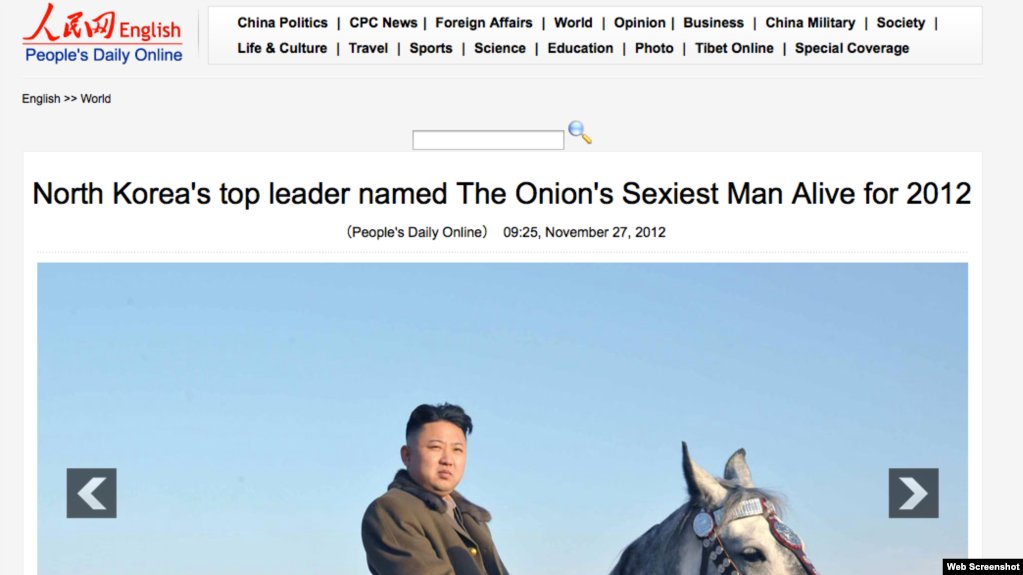
Back in 2012, Chinese state media outlet The People's Daily ran a 55-page photo spread on its website under the headline "North Korea's top leader named The Onion's Sexiest Man Alive for 2012."
It quoted The Onion's spoof report: "With his devastatingly handsome, round face, his boyish charm, and his strong, sturdy frame, this Pyongyang-bred heartthrob is every woman's dream come true."
"Blessed with an air of power that masks an unmistakable cute, cuddly side, Kim made this newspaper's editorial board swoon with his impeccable fashion sense, chic short hairstyle, and, of course, that famous smile"
https://t.co/1jCiboX7BF
https://t.co/oeM9lwXzbB