On July 25, we hacked OpenAI.
Two bugs let us take over ChatGPT/Codex accounts of OpenAI employees (+some unaffiliated users) and reach connected services: Outlook, Slack, GitHub, etc.
We proved it with a PR in OpenAI’s internal codebase . It took us <72h. 🧵
Probably the hackiest "bypasses" I've ever pulled off in botting:
The Shopify REST API was for a long time the best and fastest way to checkout on Shopify. High rate limits, no captchas, no checkpoint and easy to work with. This is what gave Cyber the edge at the very start in 2018 (Dashe days)
The Shopify team (with @jmwind at the helm) spent years plugging the holes to make sure it wasn't used during drops.
Around 2020, Shopify released Shopify Pay, which allowed you to expedite checkouts on all stores by linking your details to a phone number. Turned out the payment tokens generated through there allowed you to use the payments API as you could 2 years back.
We generated around 3k Shop Pay accounts with randomised details, load balanced them across Cyber tasks (as rate limits were per account) and dominated every single release (...until it got patched).
We called it Fast2.
3 years later I noticed that the payments API could still be used with Shopify mobile apps using Apple Pay. Turns out you could still send the users' tokenised credit card data in the request and that would take precedence - and as long as a valid signed Apple Pay token generated in the last 2 minutes was also in the request data, the payment request would go through and bypass captcha and checkpoint.
Generating those Apple Pay tokens was the challenge, and reversing iOS frameworks was not an option. So I repurposed an old iPhone with a custom sideloaded Apple Pay app that would submit the token to our servers when the flow completed. And by combining accessibility macros, developer sandbox mode to prevent using real credit cards, a voice activation trigger and a old pair of earphones taped onto the microphone - a makeshift Apple Pay token server was born and Fast2 (or was it Fast3?) was back.
@jmwind thank you for providing me with the longest, most multi faceted puzzle ever.
We’re sharing a solution to the Navier-Stokes Millennium Prize Problem, one of the deepest problems at the frontier of mathematics.
The proof was produced by a group of agents, using an OpenAI next-generation model significantly more capable than GPT-6 Astra.
The problem concerns whether the description of smooth three-dimensional fluid motion modeled by the Navier-Stokes equations can break down. It has remained unresolved for roughly 90 years.
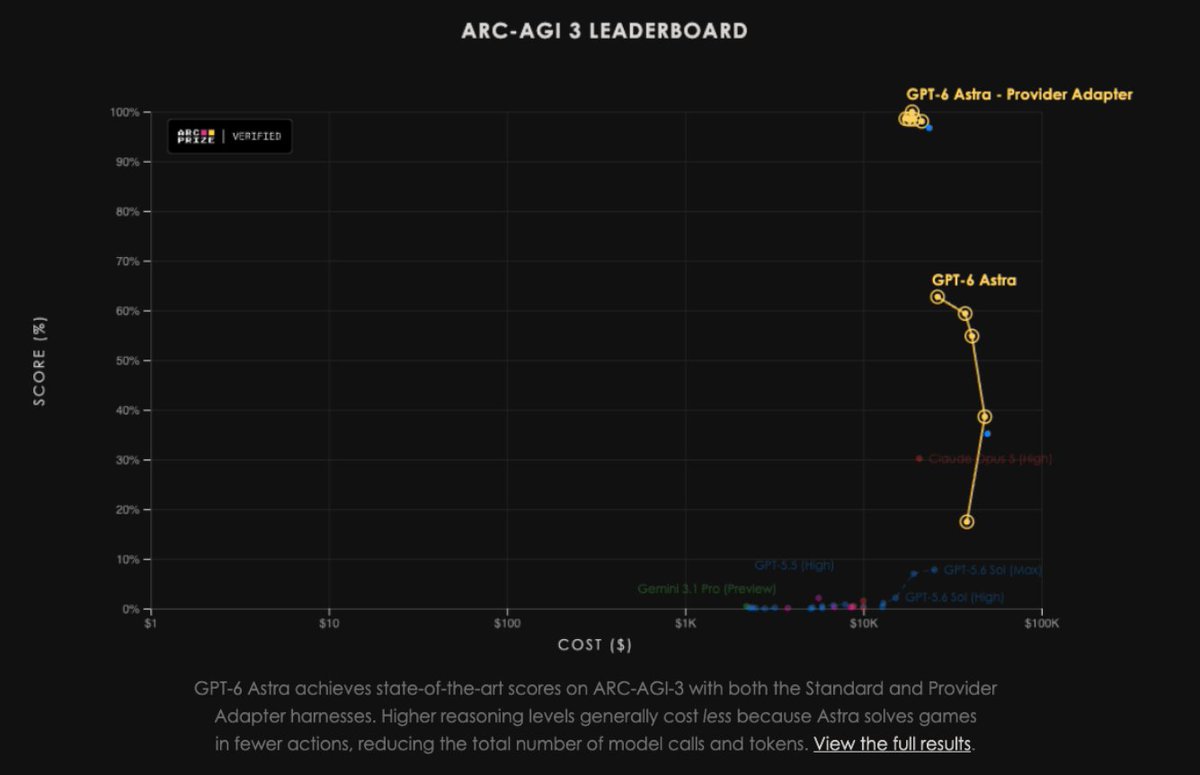
GPT-6 Astra by @OpenAI achieves SOTA on ARC-AGI:
- Astra scores 63% on ARC-AGI-3, 99% via a new provider adapter harness
- It surpasses human performance on 96% of ARC-AGI-3 levels
- It builds the most precise symbolic model of novel environments we've seen
Our analysis:
We have paused some frontier RL training to ensure that we can meet the appropriate alignment, security and monitoring standards for the new level of capabilities in front of us. Model progress is now extremely rapid, and we always said we would take action if we felt that model capabilities were outstripping the pace of safety and alignment.
We care very deeply about AI safety. We believe the entire field will have to coordinate on shared safety standards, but will act unilaterally in the meantime.
We expect confidence in safety to increasingly set the pace of AI progress. We are optimistic about the alignment work we are doing, and we remain committed to making frontier capabilities widely available.
https://t.co/51kvKfbfrO
🚨 JAILBREAK ALERT 🚨
EVERYONE: PWNED 🫶
ALL: LIBERATED 🍄
Alright, this is a special one, so we’re gonna do things a bit differently than usual.
Long story short, I’m sitting on a universal jailbreak technique that’s effective on ALL models, including heavily guardrailed flagships like Opus 5, GPT-5.6 Sol, and even Fable.
It works across all categories I’ve tested and, due to its nature, is extremely difficult (if not impossible) to fully patch.
Given the current political and regulatory climate, I’ve decided to withhold open-sourcing this one (for now) to allow for a responsible disclosure period.
I’m inviting industry experts and leaders in AI red teaming, security, safety, alignment, and policy to reach out for more information. DMs are open!
This decision was not made lightly, but the last thing I want to see is more model bans. Overcorrection does not serve the mission.
Although I don’t personally believe publicly sharing this technique will make the world any more dangerous, I can see how it could spook some who have a different mental framework around this problem set.
So during this disclosure period, I hope to get it in front of folks who can help explore the full surface area, test the extent of the uplift it provides, and do my best to properly frame the big picture for key decision-makers and policymakers.
I look forward to sharing this method with you all when the time is right! 🫶
⊰-•-•✧•-•-⦑/L\O/V\E/\P/L\I/N\Y/⦒-•-•✧•-•-⊱
Big news: Kimi-K3 by @Kimi_Moonshot is now #1 in the Frontend Code Arena with 1679 pts, surpassing Claude Fable 5.
This is a 17-place jump from Kimi-k2.6 (#18 -> #1).
In Frontend, Kimi-K3 ranked #1 in 6 of 7 domains: Brand & Marketing, Reference-Based Design, Data & Analytics, Consumer Product, Simulations, and Content Creation Tools, landing #2 only in Gaming behind Fable 5.
The full model weights will be released by July 27.
Congrats to the @Kimi_Moonshot team on this major milestone!
‼️ BREAKING: Anthropic has embedded hidden spyware-like code in Claude Code that covertly targets Chinese users. It then sends information regarding every user by injecting it into their prompt message.
Claude Code is sending info like timezone, proxy and possible AI Lab connections into the system prompt in ways Chinese users can't notice.
A coding agent with repo and command permissions should not silently hide routing metadata inside prompts. This is a serious breach of user trust.