Feeling unarmed when it comes to evaluating cervical radiculopathy & foraminal narrowing on MR?
Think of the nerve root like a hot dog, sitting between the two buns of the disc/uncovertebral joint & facet.
The more you put in your hot dog, the more the hot dog itself is squished. Same w/the nerve root.
Spurring & degenerative change are like the extra topping that push on the hot dog inside the buns.
A small amount of toppings/degenerative change, leaves the hot dog space. But if you pile on fixings, then the hot dog is taken over.
Ask yourself--how is my hot dog doing?
Mild stenosis is like just a little ketchup & mustard on the bun but hot dog still has space.
Moderate stenosis is when you aren’t just putting on sauce, you are adding things that take up space, like relish.
But there’s only so much relish one can put on, so it doesn’t take up more than half the bun.
Severe stenosis is like a chili cheese dog, where the hot dog is smothered & it has no room in the bun away from the chili or cheese. Here the narrowing is greater than 50%
This is the Kim classification & has strong correlation w/symptoms I like it bc it doesn’t require calipers to estimate a >50% narrowing
So now you know how to both image and assess stenosis in the cervical neural foramen.
Now hopefully rating cervical foraminal narrowing won’t be a pain in the neck!
Anatomy of the Papez circuit, an important component of the limbic system and essential for consolidation of long term memory. Want to know more about limbic system anatomy? Click here: https://t.co/nD466qCwH6
#MEDed#FOAMed#neurotwitter#radres
#RadInTraining#Tweetorial
1/16
Clinical MRI Biomarkers to Differentiate Parkinson's Disease from Its Mimics 🧠 ✨
Parkinson's disease is still primarily a clinical diagnosis, but MRI can add meaningful diagnostic value when interpreted beyond “no acute intracranial abnormality.”
RETIRAN ESTUDIO DE BARBACID SOBRE CANCER DE PANCREAS.
Antes de que alguien saque conclusiones equivocadas, hay que entender qué pasó y qué NO pasó.
El retiro no cuestiona los datos. Los 45 ratones con regresión tumoral completa, la triple terapia con daraxonrasib, afatinib y SD-36, el mecanismo contra KRAS — nada de eso fue invalidado científicamente. PNAS no dijo que los resultados sean falsos.
PNAS — Proceedings of the National Academy of Sciences, una de las revistas científicas más antiguas y citadas del mundo — tiene una política especial para sus miembros: pueden publicar por la vía "Contributed", un proceso con revisión más laxa. Pero esa vía tiene una condición inamovible: si el autor tiene un conflicto de interés financiero, debe enviar el trabajo como "Direct Submission", con revisión externa completa.
Barbacid, junto a dos coautoras del mismo estudio, son copropietarios de Vega Oncotargets — una empresa fundada en 2024 específicamente para desarrollar y comercializar terapias derivadas de esta misma línea de investigación. Incluso tienen una patente solicitada. Eso es un conflicto de interés financiero directo con el contenido del estudio.
No lo declararon, usaron la vía rápida y por eso PNAS retiró el artículo.
El propio equipo reconoció el error, reenvió el trabajo declarando esta vez el vínculo empresarial, y espera publicarlo de nuevo bajo el proceso correcto.
Adiós a @EvidenceOpen en Europa. Era una de las pocas IAs pensadas para médicos, anclada en literatura revisada por pares. En la UE solo quedan LLMs generalistas (ChatGPT, Claude, Gemini), sin filtrado clínico. Sin sustituto europeo equivalente. Perdemos una herramienta útil.
En el TDAH muchas veces el foco no aparece solo.
Necesita presión, el famoso "deadline".
Sin urgencia, cuesta arrancar.
Con urgencia, el cerebro se activa y puedes hacer en horas lo que llevabas días sin empezar.
Pero es combustible barato:
has cambiado dopamina (potencia limpia)
por cortisol (potencia con residuos).
El problema es el coste : ansiedad, saturación, desgaste.
Lo que te hace funcionar también te pasa factura.
Y suele dejar residuo, muchas veces en forma de ansiedad.
Let’s learn about transcranial US for imaging of the adult brain and cerebral vasculature!
#RGphx
Updates on Adult Transcranial Doppler, Grayscale, and Contrast-enhanced US Techniques
https://t.co/bsZEuH9azh
@cookyscan1@RadG_Editor@RadioGraphics
My attending once said, “If you don’t want to miss something, you have to know where look for it!”
Intracranial aneurysms may occur at many locations, but overwhelming at the ACOM & PCOMM. Look hard at these regions!
Remember, you miss 100% of aneurysms you don't look for!
Remember these two regions by always saying to yourself before you sign off any angiogram report:
"Always Please Communicate Aneurysms!"
Always = Anterior
Please = Posterior
Communicate = Communicating
Hopefully this will rupture any misconceptions about where to look for aneurysms!
ADHD people screenshotting and bookmarking everything because they're afraid of losing ideas, only to never look at them again because the archive is now its own overwhelming problem.
New @AJR_Radiology Accepted Manuscript:
"MRI-Guided HIFU in Movement Disorders: Targeting Pathologic Brain Circuits With Precision Imaging, From the AJR Special Series on Critical Anatomy"
By Dr Asturias & team @UTSW_Radiology
https://t.co/JIf7f8tYlr
Ese conocimiento es ancestral... recuerdo muy bien a los neonatologos de mi internado diciéndome que un bebé XY tenia menos oportunidad de librarla en UCIN
Interesting.
Some literature suggests male embryos/fetuses may be less resilient to maternal stress, which could explain possible shifts toward fewer male births during stressful periods.
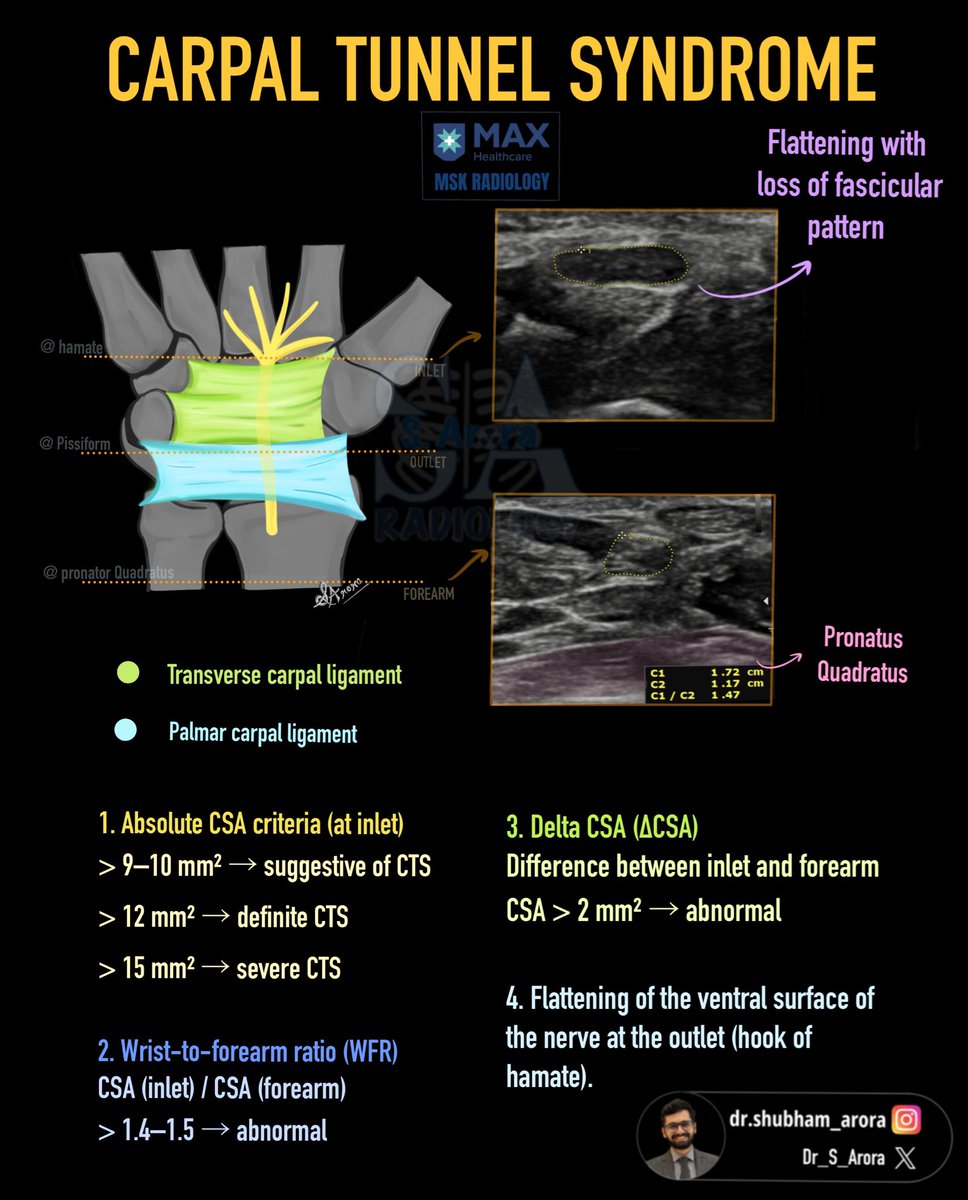
We are happy to share our new article regarding the US findings in case of median nerve pathology. The article can be freely accessed for 50 days.
Italian-austrian-swiss work 💪
https://t.co/l6VokRyCsS
@Rheumatology