Interested in testing your AVS on @eigencloud ASAP?
Check out the iv1 EigenLayer devnet (link in bio). This is an early release, to get the community feedback. Please let me know if that something what enriches AVS ecosystem and worth further work.
The Government has confirmed that its so called 'independent' Digital ID Advisory watchdog, will not have its minutes published.
We are expected to carry out parliamentary scrutiny on one of the most significant erosions of our civil liberties for decades, and yet we are not told the group budget, member selection process, or given the minutes from their meetings. Journalists have also been excluded from advisory panels.
The Government must give us answers on this sinister policy, and rethink its current course.
https://t.co/lFNq3lcyeV
Dennis Ritchie invented C in 1972, co-built Unix in 1969, and his code is running inside every device you are reading this on right now and the colleague who announced his death had to do it through a Google+ post because no journalist thought to check.
He worked at Bell Labs in New Jersey for 44 years. He never gave a keynote. He never ran a company. He never appeared on a magazine cover. He just wrote code that became the invisible foundation everything else is built on.
Here is what he actually built, and why it matters more than almost anything that happened in tech.
In 1969, Bell Labs had just walked away from one of the most ambitious computing projects in history. The Multics project, a joint effort between MIT, Bell Labs, and General Electric, had collapsed under its own weight. Too complex. Too expensive. Too slow. Bell Labs pulled out.
Ken Thompson and Dennis Ritchie refused to let the ideas die.
Working in a small office in Murray Hill, New Jersey, Thompson wrote the first version of Unix in three weeks during the summer of 1969. One week for the file system. One week for the process management. One week for the command shell. Ritchie was working alongside him, and when the system needed a language that could express what they were building, he built one.
In 1972 he completed C.
C was not just another programming language. It was a different philosophy about what a programming language should be. Before C, most systems code was written in assembly, which meant every program was tied to the specific hardware it ran on. You could not move code between machines. You rewrote it from scratch every time.
C changed that. It sat close enough to the hardware to be fast, but abstract enough to run on anything. When Thompson rewrote the Unix kernel in C in 1973, it became the first operating system that could be picked up and moved to a completely different machine without starting over. Portability was a new idea. Ritchie made it real.
The branching that followed is almost impossible to overstate.
Unix spread from Bell Labs to universities. At Berkeley, it became BSD. BSD became the foundation of macOS and iOS. Unix influenced Linus Torvalds, who built Linux in 1991. Linux now runs every Android phone, every major web server, every supercomputer on the Top500 list, and the overwhelming majority of cloud infrastructure at AWS, Google, and Microsoft.
C became the parent language of C++, Java, JavaScript, Python, and Objective-C. Rob Pike, who worked across the hall from Ritchie at Bell Labs for 20 years, said it plainly: "The browsers are written in C. The Unix kernel that the entire internet runs on is written in C. Web servers are written in C, and if they're not, they're written in Java or C++, which are C derivatives, or Python or Ruby, which are implemented in C."
Ritchie won the Turing Award in 1983. He won the National Medal of Technology in 1998, presented by President Clinton. He was head of System Software Research at Bell Labs for decades.
He answered emails from strangers with technical questions until the end of his life. His home address stayed listed in the phone book. His colleague Brian Kernighan, who co-authored the definitive C textbook with him, said Ritchie was a private person who did no self-salesmanship. That was not false modesty. It was just who he was.
He died on October 12, 2011, at his home in Berkeley Heights, New Jersey. He was 70. He had been ill for some time. The world did not notice until Rob Pike posted a quiet announcement on Google+, and the news spread through the programming community in hushed tones.
No front pages. No tributes from heads of state. No candlelight vigils outside corporate campuses.
The device you are reading this on runs code that traces directly back to what he built. So does the server that delivered it to you. So does the browser or app you opened to get here.
Most people will never know his name.
The ones who built everything you use every day do.
Our statement on the UK government’s demand that all content on all devices sold or used in the country be scanned, on the presumption of nudity, using a dystopian combination of age verification and content scanning. This proposal will not safeguard children. It endangers us all.
https://t.co/VdWe9uhi8p
It’s actually much worse. This whole thing is enabled by the government outsourcing visa admin at an industrial scale to professional third parties like VFS. VFS is now a monopoly in this domain. Ive written about this before. It’s something that already blew up as a scandal in Poland, wherein it emerged that even the anti-immigration PiS government had inadvertently allowed for mass illegal migration through the entrenchment of these gameable systems.
There are two elements to the story. One is theoretically legitimate: third party agencies specialise in helping applicants troubleshoot their applications. This saves governments from having to fund admin costs associated with having to deal with forms being sent back and forth. It also saves them from dealing with people who come to visa appointments without the right paperwork. The overall effect, however, is one where the rate of application approvals goes up simply because the “computer says no” due to technicalities factor is greatly reduced.
But the second element of the story is that the presence of these agencies in the chain engenders gameable opportunities for further third parties to supply “paperwork” that can guarantee application success.
It also matters that agencies like VFS operate mostly out of non European bases. VFS processing centres, for example, are mostly based in India. I’ve met with their representatives - who even offered me a reporting trip to India so that I could come and inspect the quality of the Center.
VFS naturally insist they operate a highly legitimate business and reject the idea that their centres enable or introduce opportunities for the industrial scaling of a supporting black market in bogus documents. However, they also insist that their contracts with western governments stops short at verification. They are not mandated to verify any docs being sourced or provided to the western states. Their job is just to make sure all the forms are completed correctly. Verification on the contrary is the job of official immigration officers and staff.
VFS’ official position on the obvious cottage industry that has since emerged in terms of provision of bogus documents is that it is nothing to do with them. And while that may be technically true, we all know how things work in the real world. And to what degree there is scope for corruption or back handers in terms of “helpful direction” at the application point to third parties that can provide the documents you need.
This is where the information verification vs scale problem comes in.
Such grey “invitation” markets have always been a thing. I remember how they used to apply to travel outside of the communist bloc in the 80s. A whole market for invitation letters existed.
The difference in modern times is that the sheer scale and professionalism of the operation - empowered by digital systems - means that it is easier for applicants to be matched with bogus “employers” providing invitation letters than it is for the home office to investigate all these businesses.
Moreover, the scam depends on the conscious cooperation of UK residents and employers who are paid handsomely for their collaboration. If they insist they’re real workers, the cost of surveillance to prove they are lying, far outweighs any of the cost savings originally generated by the appointment of VFS in the first place.
Moreover, the public is blissfully unaware of how this gamification works. They are still worried about illegal crossings when really the far bigger problem is the illegal immigration supported by this fraudulent structure. There is little to no social stigma for orgs that do this.
The lack of knowledge is demonstrated by the fact that the polish scandal blew up in 2023. It is still yet to penetrate the news agenda in the UK.
I’ve more on that too.
Europe doesn't have "a problem". It has THREE problems: 3 European nations are suffering from a severe "post-imperial hangover".
First, there is the United Kingdom, a nation that voted for Brexit to "take back control" only to realize it has completely forgotten how to drive.
The British identity crisis is like watching a retired lion try to adopt a vegan diet. They traded imperial confidence for an HR department’s sensitivity training. The land of Churchill is now governed by a sprawling "nanny state" bureaucracy that is more terrified of offending someone on X than it is of actual decline. The British police, once the envy of the world, now seem to spend more resources investigating "non-crime hate incidents" and painting their patrol cars in rainbow colors than solving burglaries. It is a nation desperately clinging to the aesthetics of tradition—the Royals, the pomp, the tea—while its institutions have been hollowed out by a progressive rot that makes a California university campus look conservative. They want the swagger of the 19th century but are paralyzed by the emotional fragility of the 21st.
Then there is France, the angry, chain-smoking aunt of Europe who refuses to admit she’s been unemployed for decades.
France’s hangover manifests as a permanent state of insurrection masquerading as "civic engagement." Their identity is split between a delusional elite who still think Paris is the capital of the universe and a populace that expresses its "joie de vivre" by burning down bus stops every Thursday. The French suffer from a Napoleonic complex without a Napoleon; they demand the living standards of a conquering empire while working a 35-hour week and retiring at an age when most Americans are just hitting their stride. They preach "Republican values" and aggressive secularism, yet the state has lost control over vast swathes of its own suburbs. France is essentially a beautiful, open-air museum where the curators are on strike, the guards are afraid of the visitors, and the management is busy lecturing the rest of the world on "grandeur" while the electricity bill goes unpaid.
Finally, we have Germany, the neurotic giant that has decided the only way to atone for its history is to commit slow-motion industrial suicide.
Germany’s post-imperial hangover is a moral autoimmune disease: the country is so terrified of its own shadow that it has replaced national pride with aggressive self-flagellation and recycling regulations. Their identity is built on being the "Moral Superpower," which practically translates to shutting down their perfectly functional nuclear power plants to burn dirty coal, all while lecturing their neighbors on carbon footprints. It is a nation of engineers who have engineered a society that doesn't work. The German spirit, once defined by efficiency and discipline, has mutated into a paralyzed bureaucracy where filling out the correct form is more important than the outcome. They are so desperate to avoid being "threatening" that they’ve become essentially a large NGO with an army that has broomsticks for rifles, terrified that showing any backbone might be interpreted as a relapse.
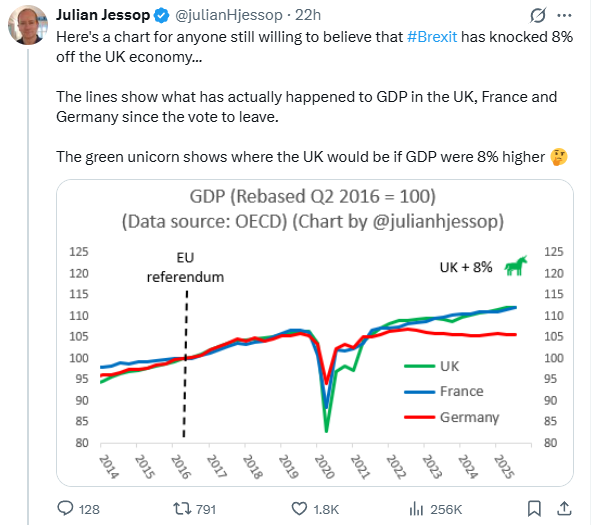
My 'unicorn' chart posted yesterday (👇) has prompted a lot of interest but also some objections.
I can't reply individually to everyone, but here are some of the more sensible questions - with my answers... 🧵
(I suggest you read all 10 before asking any more!)
The @profplum99 piece really resonates and is going viral for good reason. But it’s appalling that the penny is only dropping now. This analysis I dare say will be replicable in most Western economies. Yes we may have more welfare in Europe but we have much less growth and salary growth. We also don’t have 401ks and so are equity poor, and in many countries there is very little worker housing equity. As for child costs, our labor laws now make it impossible to afford official help at all. Parents have to be “employers” responsible for maternity, pensions and all sorts of other variables. Fine if you’re a millionaire. Not fine if you have to have two incomes to get by.
Remember the likes of the FT and the Economist were convinced that the populists were all wrong. Globalisation was making us all richer, the Gini coefficient proved it. Voting against more globalisation was self sabotage.
But most people, especially the working classes didn’t feel that way at all. And understandably hit out. For which they got vilified by the elites at Davos.
I have for years argued about some other silent drivers of this growing cost of living struggle, which even now are not fully appreciated.
1) technology and the internet haven’t been the lifestyle boon many argue because many of the costs were disguised via two sided product structures or monopolies. Meanwhile, productivity was undermined by the fact that for every positive sum economic behavior tech accelerated it also accelerated the equal and opposite negative sum behavior. Outcome: a sisyphus economy.
2) The rising debt that we were told was sustainable came with the loss of govt seigniorage profit retention. This was either transferred to foreign countries or domestically to banks, and it was western workers who had to pay for it. So not only did the taxpayer bail out the banks in 2008, due to the post crisis collapse of banks’ return on equity, all of the seigniorage that was being transferred to banks wasn’t even making its way back into people’s 401ks, it was increasingly going to banker salaries.
3) as the cost of participation soared, elites consciously or unconsciously addressed the problem NOT by trying to address the above problems but by importing more people who were used to living below the poverty line and prepared to keep the unsustainable economics of the “unproductive globalised tech economy” going.
But these people - due to the lower costs of connectivity and access to local-language media even when abroad - increasingly didn’t need to integrate or adjust to Western values. They could live in Britain but be tuned out of local affairs and sensibilities, preferring to watch home country content instead. The result? The breakdown of the cardinal rule of healthy migration: “when in Rome”. And with that the rise of a local population perception that this wasn’t helpful migration but occupation, and life under a foreign yoke.
4) ESG was a far more costly and reflexively negative sum exercise than most people realized, and just magnified the above forces.
Now that the economic crisis the working class have been subjected to since 2008 is shifting with intensity to the middle classes - turning them into the Not Managing Anymores - the political blowback against luxury beliefs is going to get considerably more intense.
The core problem is that “Western imperialism” is an ideological construct, not an analytical category. Every policy by Western state is seen through a colonialist lens, regardless of context, intent, or empirical effect. Once that premise is adopted, the normative conclusion follows automatically: opposition to the West is, by definition, anti-imperialist, and whatever actor positions itself as the counterweight becomes morally exculpated.
But this structure is incoherent. You cannot build a consistent theory of imperialism that treats the Western powers as uniquely capable of domination while relegating Russia, China, or any other authoritarian state to the status of misunderstood regional actors. That move doesn’t rest on evidence; it rests on an outdated dependency-theory inversion in which the moral valence of an action is determined entirely by who performs it, not by what it actually is.
The war in Ukraine is the clearest demonstration of how untenable this is. Large parts of the Western left recast Russia’s invasion as a “defensive” response to NATO because the framework requires it, while Ukrainian leftists, who confronted the reality of occupation, had to break with that narrative because they see Western actions as helping Ukraine in its struggle for independence and freedom against Russian imperialism.
You can’t square that circle. A coherent anti-imperialist must judge behavior, not simply invert the moral polarity of the Cold War and find a new patron saint.
Better yet, ditch the normative labeling of “Western imperialism” that distorts your analysis and move to a more coherent definition of “imperialism” instead. You don’t have to be (and shouldn’t be) value-neutral, just consistent.
Update from the Killing Fields of Sudan:
Maternity hospital massacre leaves 460 dead as patients and staff are butchered; 2,000 civilians were executed in two days. UN resolutions: zero. Protesters in London: couple of dozen. Coverage of Sudan carnage in media: minimal.
In the 90s cypherpunk tradition we talked about the Four Horsemen of the Infocalypse - the four excuses that the government would use to ram everyones rights into the dirt:
- money laundering
- terrorism
- pedophiles
- drug dealers
not much has changed since then - the excuses are still the same, and they're still excuses
https://t.co/B7B4fneyfw
We already have digital ID in the form of National Insurance numbers. That hasn’t exactly prohibited illegal work. Also in the new economy more and more people are going to work for themselves. So what’s really being proposed here is that no transaction for any work will be able to escape a digital ID identifier.
Indeed, the main difference between an NI number and a digital ID is that the latter can and will be integrated into payments. It has to by design because work is no longer solely corporate in nature. At least if we follow the logic being presented by Keir.
Payment for work will thus be intrinsically linked to who you are.
But that will not solve the problem we are facing in the West which is a corruption of the system from the top down level.
The issue isn’t immigrants wanting to work. Immigrants who want to work and add value to our system are not those being objected to.
The issue is the type of work they are doing (ie. is it zero sum, or worst case scenario negative sum in the form of criminal enterprise). It’s also the collective benefits that those who either work in negative sum ways or not at all (even if they can) draw from the system.
If the system normalizes such work or distributions as healthy, then it matters not who is doing the work or how they are ID-ed.
As I told a Warwick fintech panel this week, what we need is to rebuild trust networks from the bottom up. You have to earn the right to benefits. But not through some Orwellian top down system, but via a good track record in a mutual skin in the game positive loop system. Where everyone collectively has an interest in not betraying the other, because what happens to one happens to all.
Within that society you would earn the right to anonymity and greater social rights and benefits as you ascend through concentric and expanding trust circles.
Eventually you earn the keys to the widest system of all where everyone works voluntarily to contribute mutual upside. This is how you return to growth.
You have to earn your spot in the positive feedback circle.