A Chinese quant used Grok Bot to turn $1000 into $263,396.56.
He studies applied mathematics and builds algorithms between classes.
His account: BoneOhio.
At such a young age, he has already made over a quarter of a million simply by knowing the right formulas and knowing how to use Grok Bot.
Result:
$1000 → $263,396.56
Profile:
https://t.co/q9LVfwNmIa
How to build a system like this:
Quant Flow Memory reads order flow and matches it against historical price movements. The other modules check risk and execution.
1. Multilevel Flow
Flowₜ = Σ wₖ × OFIₖ,ₜ
The bot tracks new orders, cancellations and fills across several order book levels.
One large buyer can disappear. Pressure across multiple levels gives you more information.
2. Flow Memory
Responseₕ = Σ gⱼ × Flowₜ₋ⱼ
The model identifies order sequences that preceded price moves. The weights are calibrated on historical data.
The order book gets a memory.
3. EV Gap
Edge = expected move − trading costs
Projected move: 3¢. Entry and exit: 1¢. That leaves a 2¢ edge per share.
If costs eat the difference, there is no trade.
4. Kelly Criterion
f* = (bp − q) / b
Win probability and payout determine the fraction of capital to risk.
Fractional Kelly reduces exposure to model error. One bad entry should not wipe out the account.
5. Bayesian Updates
P(H|D) ∝ P(D|H) × P(H)
New fills. Large orders cancelled. Pressure shifts.
The bot updates its probability estimate. If the signal disappears, the order is pulled.
6. KL-Divergence
Dₖₗ(P‖Q) = Σ Pᵢ ln(Pᵢ/Qᵢ)
Measures the divergence between comparable probability distributions. Flags an anomaly for review rather than calling every difference an arbitrage.
7. Stoikov Model
r = s − qγσ²(T − t)
Adjusts the reservation price for inventory, volatility and risk.
The more inventory already held, the more cautious the next entry.
8. LMSR
C(q) = b ln Σ exp(qᵢ/b)
An additional model for price simulations. Actual entries still need to be checked against Polymarket’s order book.
In practice:
→ Order flow generates a signal.
→ Memory estimates the move.
→ Costs and risk pass the checks.
→ Only then is an order placed.
The math is public.
The edge needs to be validated on data.
The difference is that most people never build the system.
Paste these formulas into Grok Bot and build your own bot. Start with simulated trades.
Copy him: https://t.co/TNHbO586Ad
Bookmark this post so you don’t lose it.
Soon I’ll break down another bot and the formulas behind its strategy.
A 19-year-old student from China, Zhang Wei, developed an AI radar and sold it to Hong Kong for $550,000
He created it using Claude, spending just $20 and a month on development
He walked into the Hong Kong administration office with a flash drive and asked for just 5 minutes of their time. 30 minutes later, he walked out with a check for $550,000
The code, connected to a camera, detects speed in real time. If the speed exceeds the limit, Claude takes a video clip and identifies the owner by the car's license plate. The video and the fine are then automatically sent to the owner's email address
Unlike a conventional radar that only takes a photo and doesn't always work, this AI radar eliminates disputes because it captures video and makes the process fully autonomous by sending out the fines on its own
The article includes the ready-to-use configurations.
INSTEAD OF WATCHING AN HOUR OF NETFLIX TONIGHT.
This 1 hour Stanford lecture by Joel Peterson will teach you more about negotiation and getting what you want than most people learn in years.
Bookmark it and give it an hour, no matter what.
THIS GUY BUILT A VISUAL CALENDAR THAT SHOWS YOU EVERY SUBSCRIPTION YOU'RE PAYING FOR
the best part is it auto-imports your subscriptions directly from the app store
so no manual entry, no typing in amounts, it just pulls everything automatically
you open it and instantly see when every charge is hitting and how much is going out each month
we're all paying for at least 5-10 subscriptions we forgot about and this puts all of them in one visual calendar
clean UI and a simple concept that solves a problem everyone has but nobody bothers to fix
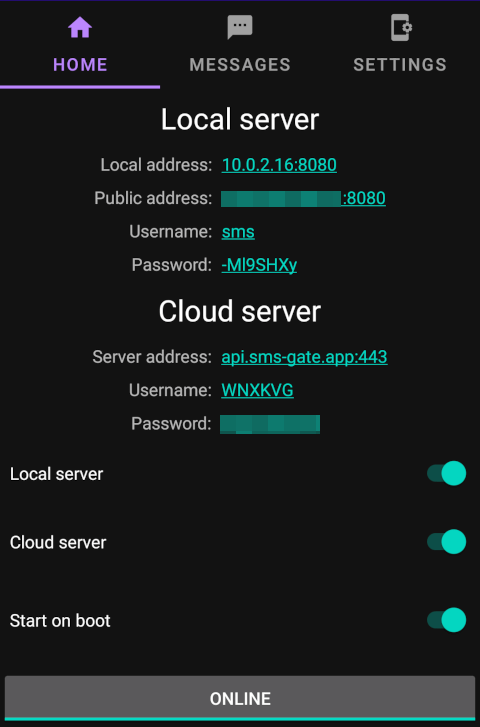
🚨 Twilio charges $0.0079 per SMS. Someone just turned any old Android phone into a free SMS gateway. Unlimited messages. $0.
It's called SMS Gateway for Android.
Install it on any Android phone. It becomes a full SMS sending and receiving server with an API.
No Twilio. No MessageBird. No per-message pricing. No contracts. Just an old phone and a SIM card.
Here's what's inside this thing:
→ Send and receive SMS through a REST API from any app or service
→ Works with any Android phone running 5.0 or newer
→ End-to-end encryption. Messages are encrypted before they leave the device.
→ Multi-SIM support. Use multiple SIM cards on one phone.
→ Multi-device support. Connect multiple phones to the same account.
→ Real-time webhooks for incoming messages
→ Multipart messages with auto-splitting for long texts
→ Track delivery status of every message in real time
→ No registration required. No email. No account in local mode.
Here's the wildest part:
That old Android phone in your drawer that you haven't touched in 2 years? Install this app. Insert a SIM card. You now have your own private SMS infrastructure.
Two-factor authentication. Order confirmations. Appointment reminders. Notification alerts. All the things startups pay Twilio thousands a month for.
Free. Running on a phone you already own.
Startups spend $500 to $5,000/month on SMS APIs. This costs the price of a SIM card.
875 GitHub stars. 359 commits. Apache 2.0 License.
100% Open Source.
Access ALL prompts for stunning animated websites in one click: https://t.co/N0kni8z7CJ
Build a single-page hero section with a full-screen looping background video, liquid glass UI elements, and a dark cinematic aesthetic. Use React, TypeScript, Tailwind CSS, and Lucide React icons. Here are the exact specifications:
Background Video:
Full-screen muted autoplaying video covering the entire viewport, positioned absolutely with object-cover
Video source URL: https://t.co/nGf26cOg1i
The video is shifted down by 17% (translate-y-[17%]) so the top portion of the video is cropped -- the interesting content is in the lower portion of the frame
The video loops seamlessly with a custom JavaScript fade system (no CSS transitions): 500ms requestAnimationFrame-based fade-in on load/loop start, 500ms fade-out when 0.55 seconds remain before the video ends. A fadingOutRef boolean prevents re-triggering the fade-out from repeated timeUpdate events. On ended, opacity is set to 0, then after 100ms the video resets to currentTime = 0, plays, and fades back in. Each new fade cancels any running animation frame to prevent competing animations. Fades resume from the current opacity rather than snapping.
The outer container is min-h-screen bg-black with overflow-hidden
Font:
Import Google Font "Instrument Serif" (both regular and italic) via CSS @import url('https://t.co/olOb5pw1rM')
The heading uses fontFamily: "'Instrument Serif', serif" applied via inline style
Liquid Glass CSS (.liquid-glass class):
background: rgba(255, 255, 255, 0.01) with background-blend-mode: luminosity
backdrop-filter: blur(4px) and -webkit-backdrop-filter: blur(4px)
border: none
box-shadow: inset 0 1px 1px rgba(255, 255, 255, 0.1)
position: relative; overflow: hidden
A ::before pseudo-element creates the glass border effect:
position: absolute; inset: 0; border-radius: inherit; padding: 1.4px
background: linear-gradient(180deg, rgba(255,255,255,0.45) 0%, rgba(255,255,255,0.15) 20%, rgba(255,255,255,0) 40%, rgba(255,255,255,0) 60%, rgba(255,255,255,0.15) 80%, rgba(255,255,255,0.45) 100%)
Mask trick for border-only rendering: -webkit-mask: linear-gradient(#fff 0 0) content-box, linear-gradient(#fff 0 0); -webkit-mask-composite: xor; mask-composite: exclude
pointer-events: none
Layout (all inside one full-screen flex column):
Navigation bar (relative z-20, padding pl-6 pr-6 py-6):
Inner container: rounded-full px-6 py-3 flex items-center justify-between max-w-5xl mx-auto
Left side: Logo area with a Globe icon (size 24) and text "Asme" in white, font-semibold text-lg, with gap-2
Next to the logo (with gap-8): three nav links ("Features", "Pricing", "About") -- hidden on mobile, shown on md: -- styled text-white/80 hover:text-white transition-colors text-sm font-medium
Right side (gap-4): "Sign Up" as plain white text button, "Login" as a liquid-glass rounded-full px-6 py-2 button
Hero content area (relative z-10 flex-1 flex flex-col items-center justify-center px-6 py-12 text-center -translate-y-[20%]):
Heading: "Built for the curious" -- text-5xl md:text-6xl lg:text-7xl text-white mb-8 tracking-tight whitespace-nowrap with Instrument Serif font
Below the heading, a max-w-xl w-full space-y-4 container:
Email input bar: liquid-glass rounded-full pl-6 pr-2 py-2 flex items-center gap-3. Inside: a transparent email input (placeholder: "Enter your email", text-white placeholder:text-white/40 text-base) and a white circular submit button (bg-white rounded-full p-3 text-black) containing an ArrowRight icon (size 20)
Subtitle text: text-white text-sm leading-relaxed px-4 -- "Stay updated with the latest news and insights. Subscribe to our newsletter today and never miss out on exciting updates."
Manifesto button: centered, liquid-glass rounded-full px-8 py-3 text-white text-sm font-medium hover:bg-white/5 transition-colors
Social icons footer (relative z-10 flex justify-center gap-4 pb-12):
Three circular icon buttons, each liquid-glass rounded-full p-4 text-white/80 hover:text-white hover:bg-white/5 transition-all
Icons: Instagram, Twitter, Globe (all size 20) from lucide-react
Each has an aria-label
Tech stack: Vite + React 18 + TypeScript, Tailwind CSS 3, lucide-react for all icons. Default Tailwind config with no extensions. No other UI libraries.
I built a native Mac download manager for myself and I decided to make it open source.
- It's free to use
- comes with a Chrome, Firefox and Safari Extensions
- 6mb file size
Check it out on GitHub: https://t.co/KCNqszgGx1
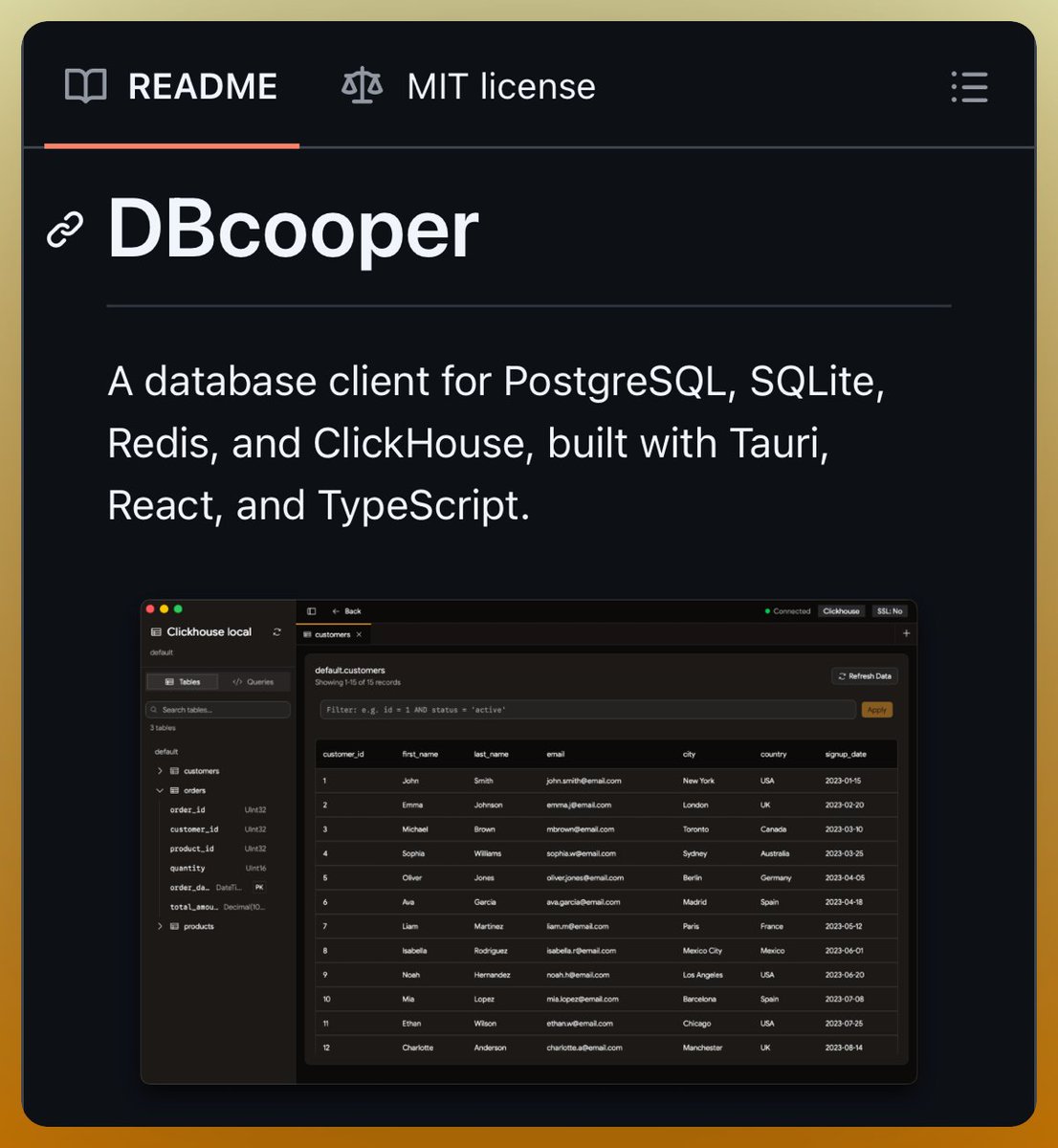
A lot of database clients feel heavy.
This one keeps things simple.
DBcooper is an open-source database client built with Tauri + Rust + React that supports
PostgreSQL, SQLite, Redis, and ClickHouse in one place.
Lightweight.
Keyboard-friendly.
Even generates SQL from natural language.
Don't miss it! 🎉🎉🎉
Get a @figma file with these 35 clean Mobile app designs for FREE.
How to get it?
1. Comment "Clean Mobile”
2. Must (Follow me) - So I can give you in comment
3. Repost (optional) - so more people can get the file
after 100 comments i will share the file in post comment. please check the post comments after 48 hours
❤️🔥 AntiGravity built me a $10,000 beautiful website using only AI. Today, I recorded myself creating the entire thing from scratch in 25 minutes.
You'll learn how to:
• Turn Dribbble screenshots into premium designs instantly
• Generate characters and looping Kling video animations
• Build fully responsive websites in Google AI Studio + AntiGravity
• Add smooth transitions, loaders & mobile optimization
• Deploy live to your own custom domain
After 10 years as a designer. This is exactly how I create high-quality websites (no AI slop).
Comment “DESIGNROCKET” and I’ll DM you the remix link to the final result.