@MuMD0G@LeighGiangreco I think the case for protected bike lanes is stronger when you accept that…1) everyone makes mistakes, and 2) many people break the laws they don't value.
for car drivers that's speed limits (most break them) and for bike riders it's stop signs…Pedestrians, don't walk signs…
@colinokeefe@cruickshank yeah, I was referring less to visible poverty and more to things like property crime, violent crime, trash on the streets, etc.
for one anecdote, I spent a couple months in NYC recently and the feeling of greater safety, cleanliness and less stress vs seattle was palpable
@colinokeefe@cruickshank I get that it's easy for people to point to inefficiency everywhere (Michael lewis' book the 5th risk was excellent in this regard)
But I do think the quality of life argument carries weight. it's amazing how much less background stress there is in other major cities vs seattle
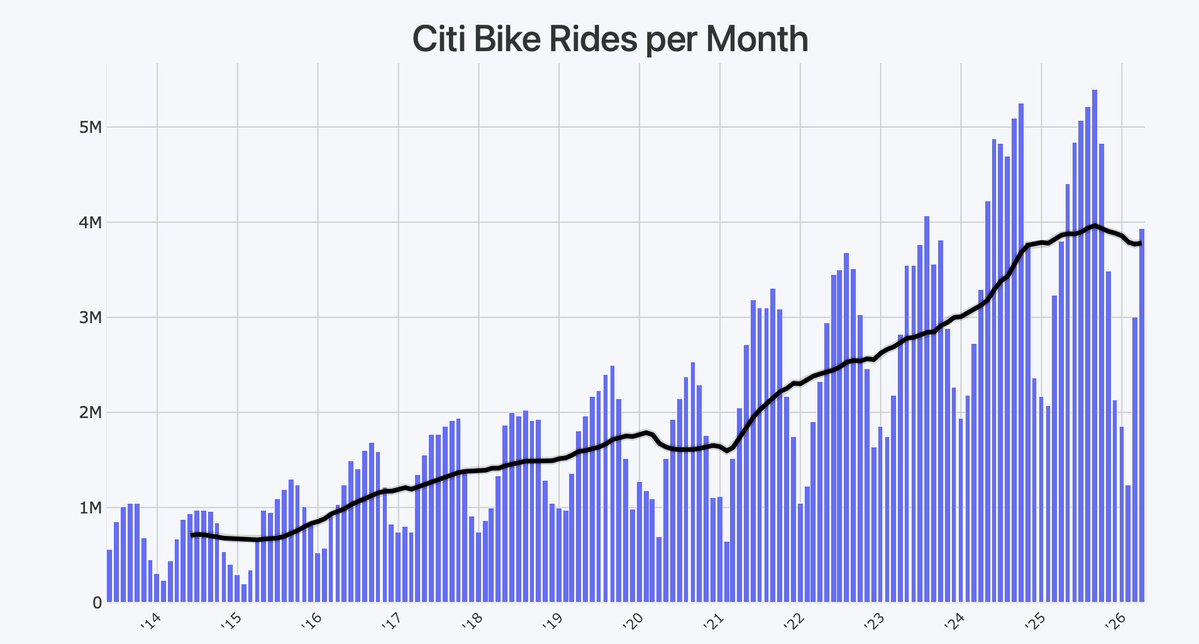
@NoMoreBikeLanes@chase_swiss@WorldFullofJunk@QuintonLucasKC 20 years ago almost no one other than bike messengers biked around manhattan. Now citibike serves 5m rides per month with an excellent safety record. You can hate all you want but the data disagrees with you.
Seattle had a historic population boom from 2010-2016 - grew by about 25%. Despite a lot of construction, the cost of rent exploded upward; I think the policy failure was to attack unaffordable housing costs by artificially boosting wages vs driving down the cost of housing.
People seem to be misinterpreting why Seattle is fucked. Seattle is not fucked because they over-regulate big business or because of the “millionaire’s tax.” They’re fucked because they overregulate small and mid-sized businesses which caused a massive localized inflationary spiral that is forcing out big businesses because labor costs are too high
Seattle massively over regulated the service sector by imposing gargantuan minimum wages on restaurants and delivery apps + implementing a zillion other regulations that caused service sector costs to soar. Seattle’s housing prices are actually *declining* but their inflation rate has been 1-1.5 points higher than the national average despite reduced housing costs. This is caused mainly by food service prices rising at 7% a year due to Seattle’s minimum wage policies and excessive service sector regulations. Inflation in Seattle is now 5% and nominal wage growth is 3%, meaning real wages fell 2% in the last twelve months
High local inflation forced big companies to pay artificially high wages because highly paid corporate workers expect wages to keep up with living costs. On top of that, Seattle has a payroll tax that almost exclusively applies to huge companies. Those big companies are therefore paying insane wages to do business in Seattle, whereas if they relocated, they could pay people the same real wages relative to local cost of living and save tens of millions a year in corporate labor costs alone
But here’s the thing: Because Seattle overregulated their small and midsize businesses, those businesses are now operating on razor thin margins and are reliant on highly paid corporate workers who can pay exorbitant prices in order to stay in business. So when a corporate office relocates out of Seattle, all of the local restaurants collapse because they no longer have a customer base who can afford the prices they have to charge due to Seattle’s regulatory environment
What this means is that as corporations cut payroll in Seattle the entire city’s service sector is imploding, which has resulted in localized stagflation. Their whole labor market is quickly evaporating and now they have 5.5% unemployment, 5% inflation, and -2% real wage growth.
None of this has anything to do with the “millionaire’s tax” because the companies are leaving before the people do. Why would companies care about a tax on ultra high incomes that doesn’t impact their cost of doing business?
@SwannMarcus89 Seattle had a historic population boom from 2010-2016 - grew by about 25%. Despite a lot of construction, the cost of rent exploded upward; I think the policy failure was to attack unaffordable housing costs by artificially boosting wages vs driving down the cost of housing.
@AlphaDogJDK@McClellanOsc by 'third world' you mean Paris, Copenhagen, Berlin and Amsterdam?
bikes are by a large margin by far the most effective and most space-efficient way to get around the city.
2.13 million citibike rides last December.