Sir, I am preparing for a talk on how biomarkers can help with deescalation of antibiotics. Can you recommend some articles/resources?
@BradSpellberg@ABsteward
Everyday is new low here...
Ayurveda referral for thrombocytopenia, stroke, brachydactyly (calls it some issue with the umbilicus ‘dharan’).
What else I am left to see in the hospital🙈
@TheReal_YRJ Please provide more clarity on this voluntary update to this latest ColorOS. What happens if we don't? What advantages do we get if we do etc etc
@VinayakSoni07 Should I get the ps5 considering prices are still stable or do I wait for the official launch of ps5 pro? Currently having a ps4 slim since 7 years
The suppressed report that concluded there is no protective or safe level of alcohol consumption, now published. It was commissioned by US Congress
Report https://t.co/XmmsSo9q3q
Editorial https://t.co/8NuqBwkugM
"Despite the study’s adherence to its mandate, its findings were sidelined.”
@TransferChecker Earlier this account was run by a Brentford die hard fan with value tweets. Seems he has sold the account to some random person who posts low value tweets aiming just for payout.
I’ll start by saying that Aaron is a friend, a remarkable educator, & reliably wise. But here, as w/discussion of guidelines, nuance & context help.
IMO, guidelines raise the bar if you don’t know enough to know when to deviate from them. I can’t imagine treating 10+ types of cancer every day, & if I’m outside of my limited range of expertise, following guidelines will help me deliver SOC in a competent way.
But if you have deeper knowledge, you know that guidelines are a witch’s brew of strong evidence, weak data, & faith-based bias. Ideally, you won’t follow them slavishly & can deviate based on your good judgment & insight.
I acknowledge that guidelines can lead ppl to be dissuaded from deviating, but I think you can effectively inoculate yourself from legal issues by documenting your sensible judgment well & communicating/aligning with the patient (I see tons of deviation from guidelines, data, & even optimal judgment that is sanctioned as a pact with the patient to justify irrational over-treatment; I’d even argue that it’s a cornerstone of practice at many centers).
I think the problem of medicine is that it exults rule-following, & ideally people like Aaron can help keep physicians from just becoming sheep and absolving themselves of thought. I’ve also tried to do this over the years. I don’t think it’s a requirement that being a physician means subjugating judgment to rule-following.
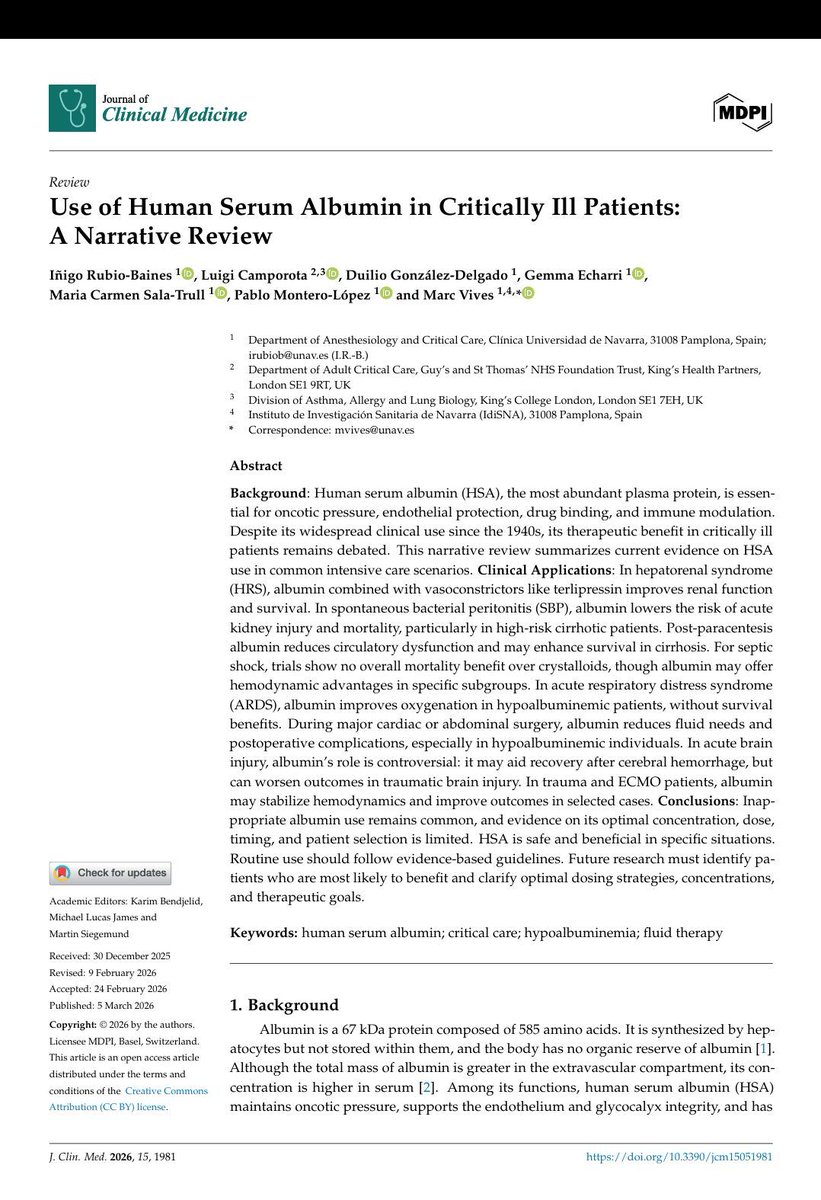
💧 Albumin in the ICU: life-saving drug… or expensive myth?
We’ve been using it since the 1940s.
Yet in 2026 we still don’t fully agree when it actually helps.
🧠 First principle
Albumin is NOT just a volume expander.
It does much more:
▪️ Maintains oncotic pressure
▪️ Protects endothelium & glycocalyx
▪️ Modulates inflammation
▪️ Alters drug pharmacokinetics
➡️ It’s a biologically active molecule, not “fancy saline”
⚠️ The uncomfortable truth
👉 50-70% of albumin use is inappropriate
👉 In some studies: >90% misuse
Yes… even in modern ICUs
🔥 Where albumin actually WORKS
✔️ Hepatorenal syndrome (HRS)
→ Albumin + terlipressin = better renal outcomes
✔️ Spontaneous bacterial peritonitis (SBP)
→ ↓ AKI + ↓ mortality
✔️ Large-volume paracentesis
→ Prevents circulatory collapse
⚖️ Where evidence is… mixed
🟡 Septic shock
→ No mortality benefit vs crystalloids
→ BUT better hemodynamics in some patients
🟡 ARDS
→ Improves oxygenation (if hypoalbuminemic)
→ No survival benefit
🟡 Major surgery
→ ↓ fluids, ↓ complications
→ BUT watch renal risk (especially 20%)
🚫 Where you should think twice
❌ Traumatic brain injury
→ ↑ ICP
→ ↑ mortality
➡️ Albumin crosses disrupted BBB → worsens edema
💡 Key ICU insight
Albumin is NOT about:
❌ “giving protein”
❌ “correcting labs”
It’s about:
✔️ hemodynamics
✔️ endothelial integrity
✔️ patient selection
📉 Hypoalbuminemia matters
Every ↓10 g/L:
▪️ ↑ mortality
▪️ ↑ complications
▪️ ↑ length of stay
➡️ But correction ≠ automatic benefit
🎯 Clinical decision rule
Use albumin when:
✔️ Cirrhosis-related complications
✔️ Refractory shock after crystalloids
✔️ Severe hypoalbuminemia with instability
Avoid when:
❌ Routine resuscitation
❌ TBI
❌ “just low albumin”
🧠 Take-home
➡️ The question is NOT
“Does albumin work?”
➡️ The real question is
“In which patient, at which moment?”
📚 Rubio-Baines I et al. (2026)
Journal of Clinical Medicine
DOI: 10.3390/jcm15051981