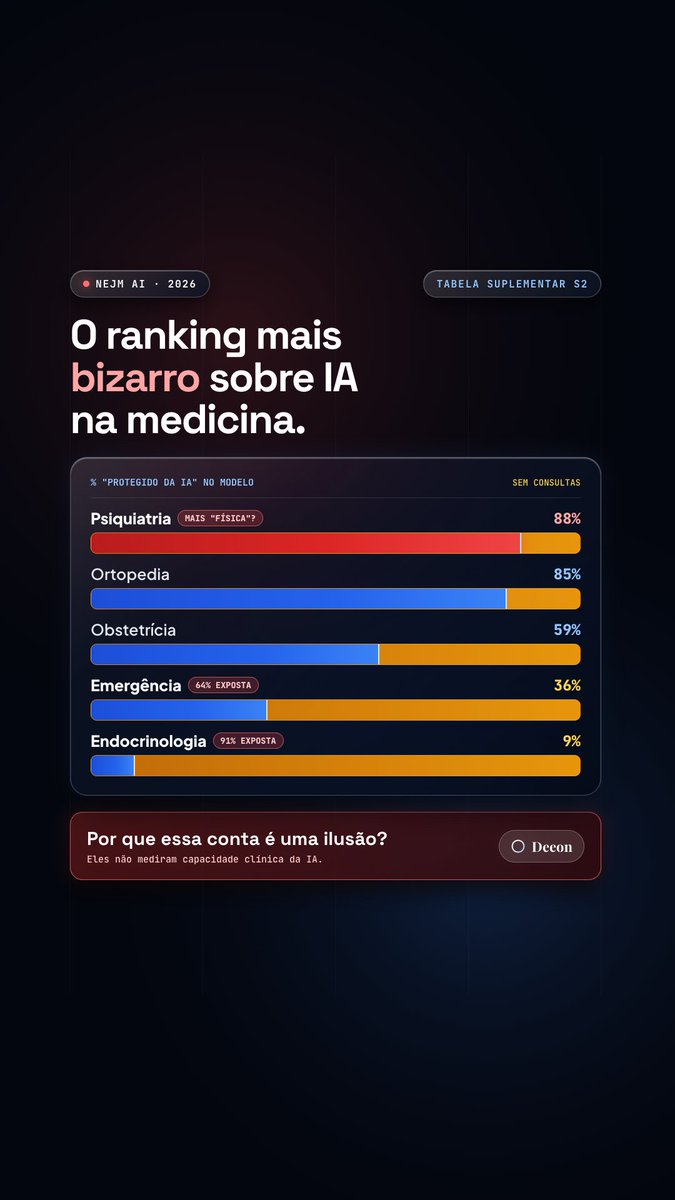
Segundo uma tabela suplementar de um novo artigo do NEJM AI, Psiquiatria (88%) está mais "protegida fisicamente" contra a IA do que Cirurgia Ortopédica (85%), Terapia Intensiva (77%), Obstetrícia (59%) e Medicina de Emergência (36%).
E Endocrinologia (9%) aparece quase tão exposta quanto Radiologia Diagnóstica (4%).
Parece absurdo — porque é uma ilusão de método.
Para montar esse ranking com 42 especialidades do Medicare (2023), os autores NÃO testaram se a IA acerta um diagnóstico ou conduz um caso real com segurança. Eles fizeram duas coisas:
1. Excluíram todas as consultas médicas (E&M — que representam 55% dos pagamentos totais do Medicare).
2. Classificaram apenas os códigos não-E&M restantes: se o código exige contato físico direto, entrou no azul ("protegido"); se é análise/teste sem toque, entrou no laranja ("potencialmente substituível").
O efeito colateral dessa matemática na tabela:
• Alergia/Imunologia (93%), Psiquiatria (88%) e Neuropsiquiatria (82%) disparam no topo porque o pouco que faturam fora das consultas tradicionais cai em códigos presenciais.
• Cardiologia (20%) e Endocrinologia (9%) despencam porque têm alto volume de exames, testes e monitorizações fora da consulta — embora a clínica dependa diretamente de exame físico e decisão médica complexa.
• Emergência (36%) e Clínica Médica (36%) ficam espremidas no meio da tabela porque quase tudo o que fazem mora justamente nos códigos de consulta que o modelo deixou de fora.
Na prática do consultório, a IA não substitui quem examina, interpreta contexto e assina a conduta — mas já redefine quem perde horas em burocracia e prontuário passivo fora do atendimento.
Qual especialidade mais te surpreendeu nesse ranking: Psiquiatria (88%), Emergência (36%) ou Endocrinologia (9%)?
Salve para revisar os números com seus colegas e conheça a arquitetura do Deeon em https://t.co/MUuX6HEJAO (link na bio).
📚 Fonte: Zeltzer D, Tam T, Bhattacharya B, Udalova V, Polyakova M. Physical Limits to AI Substitution across Physician Specialties. NEJM AI (Nov 2026) · DOI: 10.1056/AIp2600957 (Tabela Suplementar S2 e Fig. 2).
CFM regulamenta o uso de IA por médicos no Brasil
O Conselho Federal de Medicina publicou a Resolução CFM nº 2.454/2026 (em vigor desde 26 de agosto de 2026), o primeiro marco regulatório nacional específico sobre inteligência artificial na medicina.
Os principais pontos:
•A IA é ferramenta de apoio, nunca substituta do médico. A decisão final sobre diagnóstico, tratamento e prognóstico é sempre do profissional.
•Supervisão humana obrigatória. O médico pode acolher ou rejeitar as sugestões da IA conforme seu julgamento.
•O paciente deve ser informado de forma clara quando a IA for usada como apoio relevante e tem direito de recusar.
•É proibido delegar à IA a comunicação de diagnósticos, prognósticos ou decisões terapêuticas.
•O uso da IA como apoio à decisão deve ser registrado no prontuário.
•Sistemas de IA são classificados por risco (baixo, médio, alto ou inaceitável), com exigências de governança, auditoria e monitoramento proporcionais.
•Proteção de dados conforme a LGPD e normas de segurança da informação em saúde.
•O médico permanece responsável eticamente pelos atos praticados e pode se recusar a usar ferramentas sem validação científica adequada ou que contrariem princípios éticos.
A norma busca equilibrar inovação tecnológica com segurança do paciente, autonomia médica e ética profissional. Instituições de saúde também têm obrigações de governança (incluindo, em alguns casos, Comissão de IA e Telemedicina).
A tecnologia avança, mas a responsabilidade e o cuidado humano continuam no centro da medicina.
#CFM #InteligenciaArtificial #Medicina #IANaSaude #ResolucaoCFM2454 #SaudeDigital
Médico (CRM-21452) que saiu do consultório e foi construir software clínico com agentes de IA.
Porque a maioria das clínicas não perde dinheiro por falta de competência médica. Perde no intervalo entre um elo e outro:
→ Paciente manda mensagem às 22h14 e recebe “digite 1” → Cadeira das 14h cancela às 11h e fica vazia → Médico passa o fim do expediente digitando prontuário em vez de olhar pro paciente → Nota de quem mais vale morre sem resposta rápida
Estou construindo o Deeon exatamente pra isso: a arquitetura invisível da clínica — da recepção contextual ao prontuário, do pós-atendimento ao DRE em tempo real. Mostro os números: o que funciona, o que quebra e quanto custa de verdade.
Se você é médico, dono de clínica, gestor ou constrói algo na interseção de saúde + IA, me conta: Qual o maior “intervalo” que está comendo sua margem hoje?
Respondo todos. (E se fizer sentido, me segue — aqui falo só do que estou construindo e dos números reais.)
#gestaomedica #clinicasmedicas #IAmedica #Deeon #medicinaefinancas
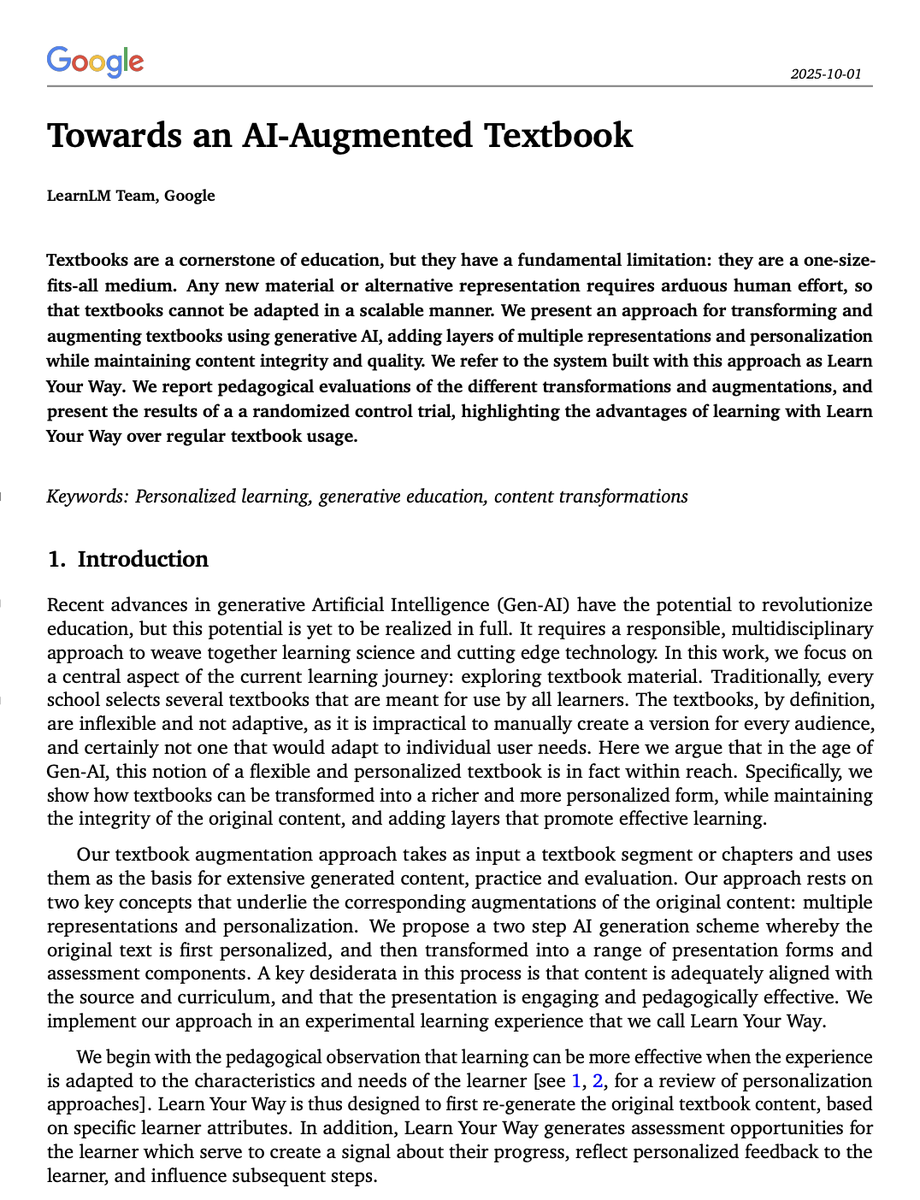
Google solved one of the oldest problems in education.
They killed the traditional textbook.
They built a system powered by LearnLM and Gemini that takes any static textbook PDF and dynamically rebuilds it around the student.
Here is how the pipeline works:
First, it asks for your grade level and what you actually care about (sports, music, food).
It re-levels the entire textbook to match your comprehension without cutting the core material, then rewrites the generic examples around your personal interests.
Then it applies "Dual Coding Theory", the cognitive science principle that your brain builds stronger mental models when it engages with the same concept across multiple formats.
Using specialized AI agents and a fine-tuned educational illustration model, it automatically turns one boring PDF into five interactive experiences:
• Immersive text broken into digestible chunks with custom visuals
• Narrated slides with interactive fill-in-the-blanks
• Zoomable mind maps that jump from the big picture to fine details
• Section-level quizzes that catch your exact knowledge gaps in real time
• Audio lessons featuring a simulated teacher and student
To see if it actually worked, Google ran a randomized controlled study with 60 high school students in Chicago.
Both groups got 40 minutes to learn about adolescent brain development.
Half got a standard digital textbook PDF. Half got Learn Your Way.
The results aren't even close:
• Students using Learn Your Way scored 9% higher on the immediate test
• 3 to 5 days later, they scored 11 percentage points higher on long-term retention (78% vs. 67%)
• 100% of them felt more comfortable taking the exam (compared to 70% with the PDF)
• 93% said they wanted to use it for future learning
And when human subject-matter experts graded the AI-transformed textbooks across subjects from history to physics, they rated them 0.85+ across accuracy and learning science principles.
Static textbooks were never the best way to learn.
They were just the only way we could scale printing.
For 500 years, students had to adapt their brains to fit the book.
Now, the book adapts to fit the student.
US hospitals already use generative AI more than predictive AI!
A new paper found that 72% of US hospitals used generative AI in 2025, passing predictive AI adoption (69%) for the first time. 81% of hospitals reported using some form of AI, which is also a strong number.
The results?
73% used AI to document clinical encounters.
70% used AI to predict inpatient health trajectories or risks.
61% of hospitals used generative AI integrated with their EHR.
74% sourced predictive tools from their EHR developer and 85% relied on third parties for generative AI.
The pace at which hospitals adopt AI is staggering. It seems almost physically impossible for regulations to keep up, while already more than a billion people use gen AI on a daily basis.
The study: https://t.co/zippO5e1Vp
@gregisenberg@midudev@thtbee_ Creators also paired Antigravity with Colab and Blender for end-to-end 3D and video workflows, including @niramayo2096's Spirited Away Jiufen drone flythrough. https://t.co/Xqm06X4k0K
🚨Elon Musk'a her şeyini kaybetsen, cebinde sadece 1.000 dolarla sıfırdan başlasan ne yapardın? diye sordular.
Sosyal medya motivasyon guruları olsa hemen başlardı: Sabah 5'te kalkarım, ikinci el eşya alıp satarım, yapay zekaya 18 saat kod yazdırırım vs vs...
Elon Musk bunların hiçbirini söylemedi. Tek cümlede bütün o "sıfırdan zengin olma" masalını çöpe attı.+++++
We’ve received FDA approval to launch LINK, the first pivotal trial for an implantable brain-computer interface in the US. This builds off of our work with 30+ participants with Neuralink to date.
Those with ALS may be eligible. To learn more:
https://t.co/dWhb5N4GdR
one of the hottest jobs in health & longevity right now is the CMO (Chief Medical Officer)
i'm in touch with countless BN dollar startups who are RACKING their brains trying to find the unicorn doctor/operator who has sick medical chops but is also commercial, well spoken, has a strong personal AND corporate brand, understands the business from first principles, & when push comes to shove knows that patient care is the ultimate north star
my take is that doctors will index a lot more on commercial skills & branding in the coming decade, i mean i already know a ton who are getting their MBAs or joining high-growth startups just for this reason
Elon Musk, the world's richest man, said that every child in the US will receive two shares in SpaceX, the space and AI company he runs, pledging a gift worth more than $18 billion https://t.co/ILsquGZPjc