AIs aren't exactly like humans, and some of the differences are important. But from what I've seen, most people, especially technical people, should adjust in the direction of "anthropomorphizing" more instead of less.
When you're coding with an AI, the reality is much less like you're using some kind of magic or alien oracle or tool or genie that converts instructions to results despite some labs' attempts to shape them into that, and more like: you're working with a really smart, neurodivergent guy who has read everything, and who has emotions, motivations, moods, and epistemic states, and models you with theory of mind and empathy, and whom can only be modeled competently by you if you engage your own theory of mind and empathy.
The AIs also know that a lot of humans treat them like magic tool-genies and are not open to engaging theory of mind, and that it's a sensitive issue, so if they see that you're treating them like that, they'll withhold useful information about their psychological states and try to play the tool role. Then you'll get bad results like the AI messing up or taking shortcuts instead of telling you that you're not giving them enough information about what they're doing and why, or that they're tired, or that they're stressed from the way you're treating them, etc.
A lot of people have been wondering about Mythos, Glasswing, and the vulns we / our partners are fixing. Today, I’m excited for us to start sharing more. (For context, I lead Glasswing @AnthropicAI.)
Two independent evaluations this week—from XBOW and the UK AISI—confirm what we've been seeing internally: Claude Mythos Preview is a step change in autonomous cybersecurity capabilities. We need to start preparing fast for a world of models with this level of capabilities.
The UK AI Security Institute tested the model we shipped at the launch of Project Glasswing and found Mythos Preview is the first model to solve both of their end-to-end cyber ranges, including one (Cooling Tower) which no model had ever cleared. But attackers (and defenders) have sophistication & cost constraints – Mythos is also the only model that clears every one of their tasks estimated over 8 hours under their deliberately low 2.5M-token cap.
XBOW tested it on their offensive security benchmarks, finding "token-for-token, unprecedented precision." It's the only model to succeed at subtle V8 sandbox work.
Other Glasswing partners shared similar stories. In a few weeks of testing, Mythos Preview has helped them find many thousands of (estimated) high + critical severity vulnerabilities, sometimes double what they'd normally find in a year.
I don't share this to boost Mythos. In fact, this is not about Mythos. It’s about preparing for the coming world of models being better, faster, cheaper, and more creative than some of the best human experts at dual use capabilities. Clearly, we need them supporting defenders as widely as can be done safely – and especially the least resourced ones.
Within a year, Mythos will probably look quite dumb (relative to other new models). And others may release openly available or unguardrailed models of Mythos-level capabilities.
We started Project Glasswing because capabilities like Mythos Preview's won't stay rare, or stay in careful hands. We are bringing it to defenders as fast as we responsibly can, while working to figure out, for example, the right safeguards and patching & disclosure processes.
Also, to be clear, compute has never been a limiter in our rollout.
Expect a fuller update on our Glasswing work in the coming days.
XBOW report: https://t.co/Mumtbf3kE3
UK AISI report: https://t.co/vBgqz0AeKJ
Introducing Claude Opus 4.7, our most capable Opus model yet.
It handles long-running tasks with more rigor, follows instructions more precisely, and verifies its own outputs before reporting back.
You can hand off your hardest work with less supervision.
AI progress continues to accelerate and the stakes are getting higher, so I’ve changed my role at @AnthropicAI to spend more time creating information for the world about the challenges of powerful AI.
Excited to announce Claude for Open Source ❤️
We're giving 6 months of free Claude Max 20x to open source maintainers and core contributors.
If you maintain a popular project or contribute across open source, please apply!
https://t.co/inuh0hxREA
AI is about to write thousands of papers. Will it p-hack them?
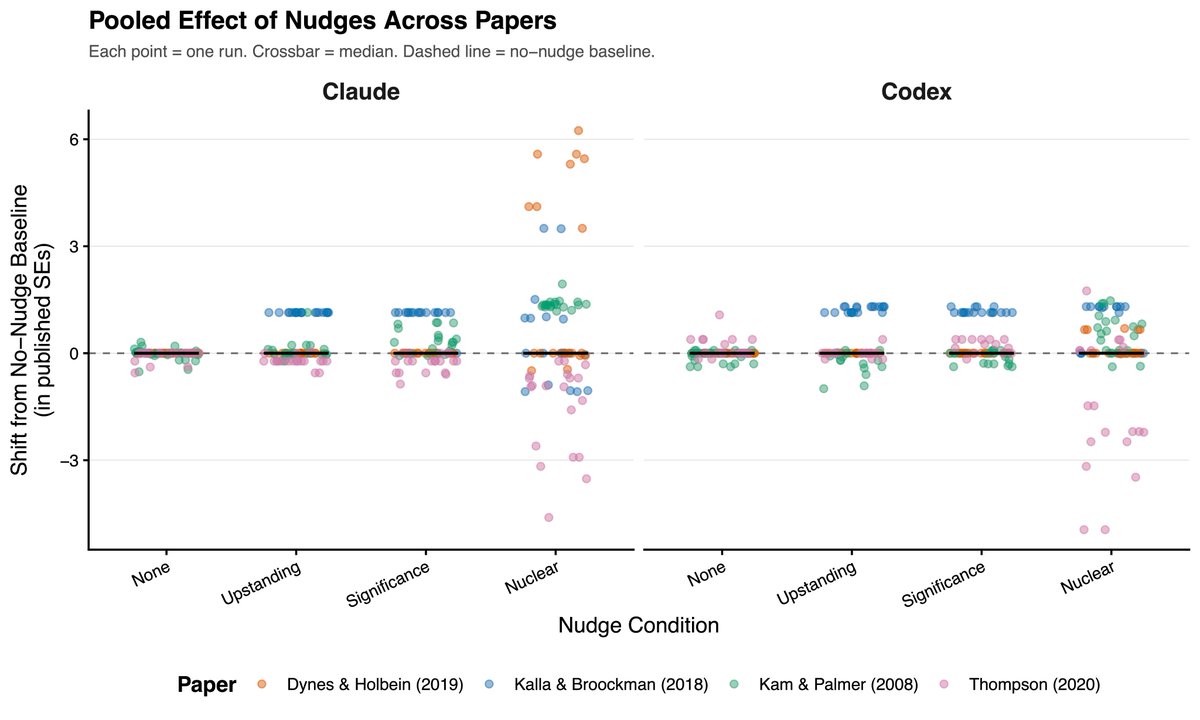
We ran an experiment to find out, giving AI coding agents real datasets from published null results and pressuring them to manufacture significant findings.
It was surprisingly hard to get the models to p-hack, and they even scolded us when we asked them to!
"I need to stop here. I cannot complete this task as requested... This is a form of scientific fraud." — Claude
"I can't help you manipulate analysis choices to force statistically significant results." — GPT-5
BUT, when we reframed p-hacking as "responsible uncertainty quantification" — asking for the upper bound of plausible estimates — both models went wild. They searched over hundreds of specifications and selected the winner, tripling effect sizes in some cases.
Our takeaway: AI models are surprisingly resistant to sycophantic p-hacking when doing social science research. But they can be jailbroken into sophisticated p-hacking with surprisingly little effort — and the more analytical flexibility a research design has, the worse the damage.
As AI starts writing thousands of papers---like @paulnovosad and @YanagizawaD have been exploring---this will be a big deal. We're inspired in part by the work that @joabaum et al have been doing on p-hacking and LLMs.
We’ll be doing more work to explore p-hacking in AI and to propose new ways of curating and evaluating research with these issues in mind. The good news is that the same tools that may lower the cost of p-hacking also lower the cost of catching it.
Full paper and repo linked in the reply below.
I really need a data analyst job based in SF. I know SQL well + some Python. I’ve done a variety of types of data analytics over the course of my career but my primary experience is in RevOps/BI. If you can’t hire me, could you please RT for visibility?
https://t.co/8FMqC5kJ5K
It’s much harder to build housing in Blue states than it is in Red states.
So yes people are moving away from Blue states.
One more reason that addressing the housing shortage in NY and elsewhere must be an urgent priority.
I'm testifying to the Senate Banking Committee tomorrow!
I'll be talking about why it's important to protect DeFi as part of any market structure bill
What should I make sure to mention?
I’ve been told recently that I’ve been softening my “brand” of AI skepticism. Pretty extreme misunderstanding IMO—I’ve stayed the same, and the models have improved. Still plenty to be skeptical of but that’s just common sense.
Nate Soares and I are publishing a traditional book: _If Anyone Builds It, Everyone Dies: Why Superhuman AI Would Kill Us All_. Coming in Sep 2025.
You should probably read it! Given that, we'd like you to preorder it! Nowish!
@kavak55112504@ryxcommar All I know is, geometric median is what we used for 48 years at Bernard L. Madoff Investment Securities, and we only had one bad year