Have you heard of never-skilling?
The trainees who constantly rely on AI and FAIL to develop foundational skills.
Get ready for the AI-powered zombie workforce.
On May 29, 2026, the White House Office of Management and Budget (OMB) released a proposed rule, titled “Regulation for Federal Financial Assistance,” revising the entirety of federal grantmaking and federal cooperative agreements in America while allowing only a 45-day public comment period. The proposed changes would fundamentally alter the practice of science in the United States, undermining the system of peer review and international collaboration that has been central to making the U.S. a global leader in science, technology, and innovation.
Have your voice heard. Submit your public comment. Link in original post.
A Brown professor gave his students a take-home midterm exam. After suspecting many cheated using AI, he made the final in-person. The orange dots are the midterm scores and the gray dots are the final scores. Looks like all but 3 cheated on the midterm.
@ScienceMagazine Unfortunately, time to degree is one of the most heavily weighted metrics in evaluating viability of Ph.D. programs at least here in the US
🚨 BREAKING: Norway BANS the use of AI in primary school, with its Prime Minister adding that children should focus on learning to write, read, and do math.
They have my full support.
This is not 2004 anymore. We are past the social media hype and seem to have learned the lesson.
Technology should not interfere with the learning process or with children's intellectual and emotional development.
Some steps should not be skipped, regardless of the shiny new tech available. AI can wait until they are older.
Kudos to Norway! Which country do you think will be next?
I'll keep you posted!
-
👉 To stay up to date on AI policy, ethics, and regulation, join my newsletter's 97,200+ subscribers below.
Students without access to LLMs are 2 to 8 times more creative than students with access.
That is the finding of a new paper comparing 2,200 college admissions essays written by humans before ChatGPT with essays generated by GPT-4.
The key point is not individual creativity. GPT-4 can write well, sometimes better than individual students. The problem is collective creativity.
Each new human essay added new semantic territory. New ideas. New angles. New experiences. New combinations.
Each new GPT-4 essay added much less.
The authors call this the diversity growth rate: how much novelty each additional text contributes to the collective pool of ideas.
Humans kept expanding the pool. GPT-4 made the pool converge.
Even when the authors pushed GPT-4 to be more creative, changed parameters, or used chain-of-thought prompting, the homogenizing effect remained.
This is the real danger of AI in education.
Not that students will write worse.
That everyone will write the same.
*
Full paper in the first reply
Deep inner suffering inevitably arises when the human person is reduced to performance, consumption, or a statistical datum. Many young people today live under the yoke of expectations to perform, immersed in an exasperated competitiveness that generates anxiety, fear of not measuring up, and disorientation.
The Pope is making exactly our point. LLMs “may imitate or even simulate, but they do not understand.”
This is the core epistemic fault line.
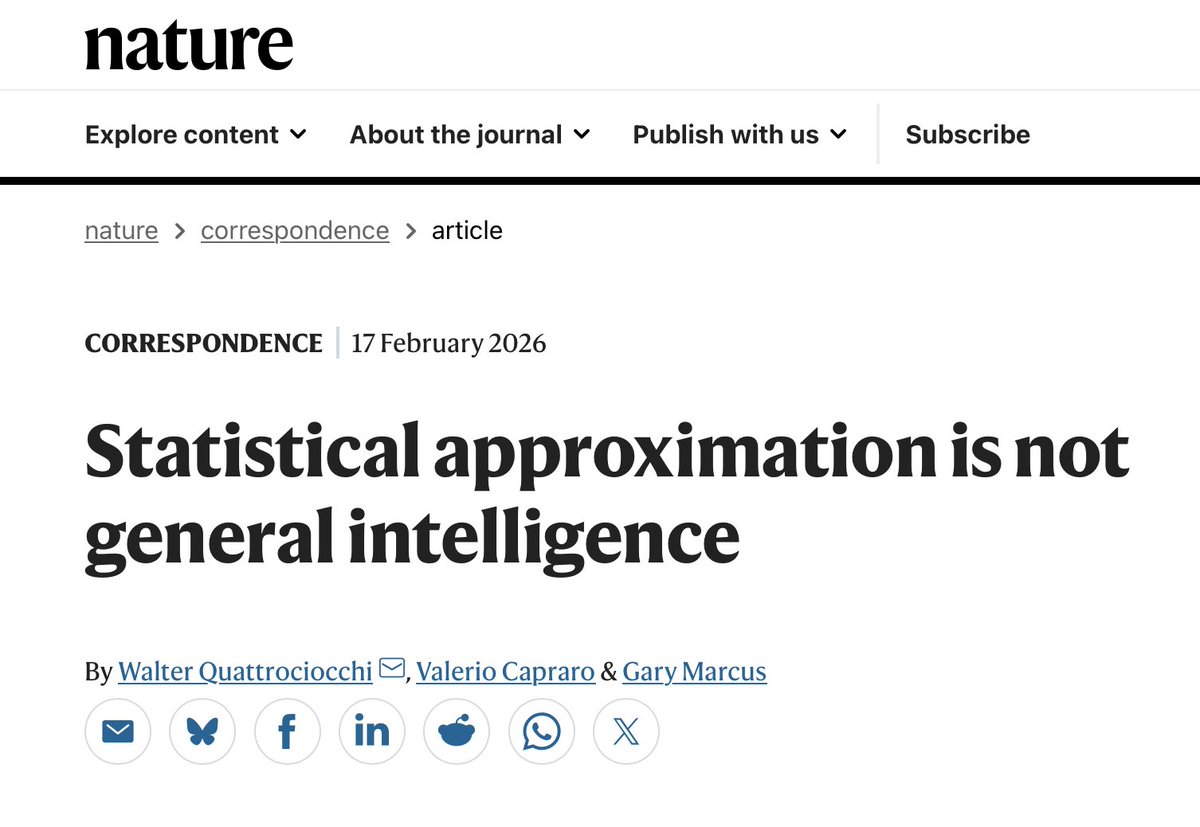
Most AI evaluation is still based on one assumption: if a system statistically approximates human behaviour, then it is close to human intelligence.
But approximation is not intelligence.
Simulation is not understanding.
LLMs can produce the right answer without knowing why it is right. They can simulate empathy without feeling. They can imitate judgment without responsibility. They can generate coherent explanations without having a world to which those explanations are accountable.
Stop confusing behavioural similarity with cognitive equivalence.
Human understanding is embodied, affective, relational, motivational, and normative. It is not just the production of plausible text.
*
Full paper in the first reply
New blog post: Evaluating Dr. Cuddy’s Claim that the Debunking of Power Posing is a Myth.
https://t.co/4kXUL6rPs5
On an AI generated description of a non-existent study, incorrectly citing findings from studies, and the importance of scientific criticism.
Imagine if Biden:
• Created a $1.8 billion slush fund to hand out to rioters who assaulted police officers
• Banned the IRS from auditing him, his family, and his companies
• Accepted a $400 million luxury jet from a foreign monarchy
Pardoned hundreds of people who assaulted police officers
• Openly promoted his own meme coin while in office
• Had family members cutting international business deals while he was in office and directly profiting from them
• Repeatedly “joked” about staying in office past two terms
• Repeatedly praised Xi, Putin, and Kim Jong Un
The outrage would never end.
The fact that people are becoming numb to this level of corruption is insane.
New Research: Acute changes in postural stability during Instagram Reels viewing using virtual reality–based posturography https://t.co/HZMFFuGRAx #FrontiersIn#BehavioralNeuroscience
Jfc.
Just saying the quiet part out loud.
This is deeply un-American.
The a president is just flat out saying he puts loyalty to him personally above the law.
This should be a massive news story.
At a time when gas prices and inflation are soaring, Trump is stealing $1.7B for his allies on top of the $1B ballroom project. Straight up corruption.
Every Republican in Congress and every GOP candidate running this November should be asked if they support this blatant corruption.
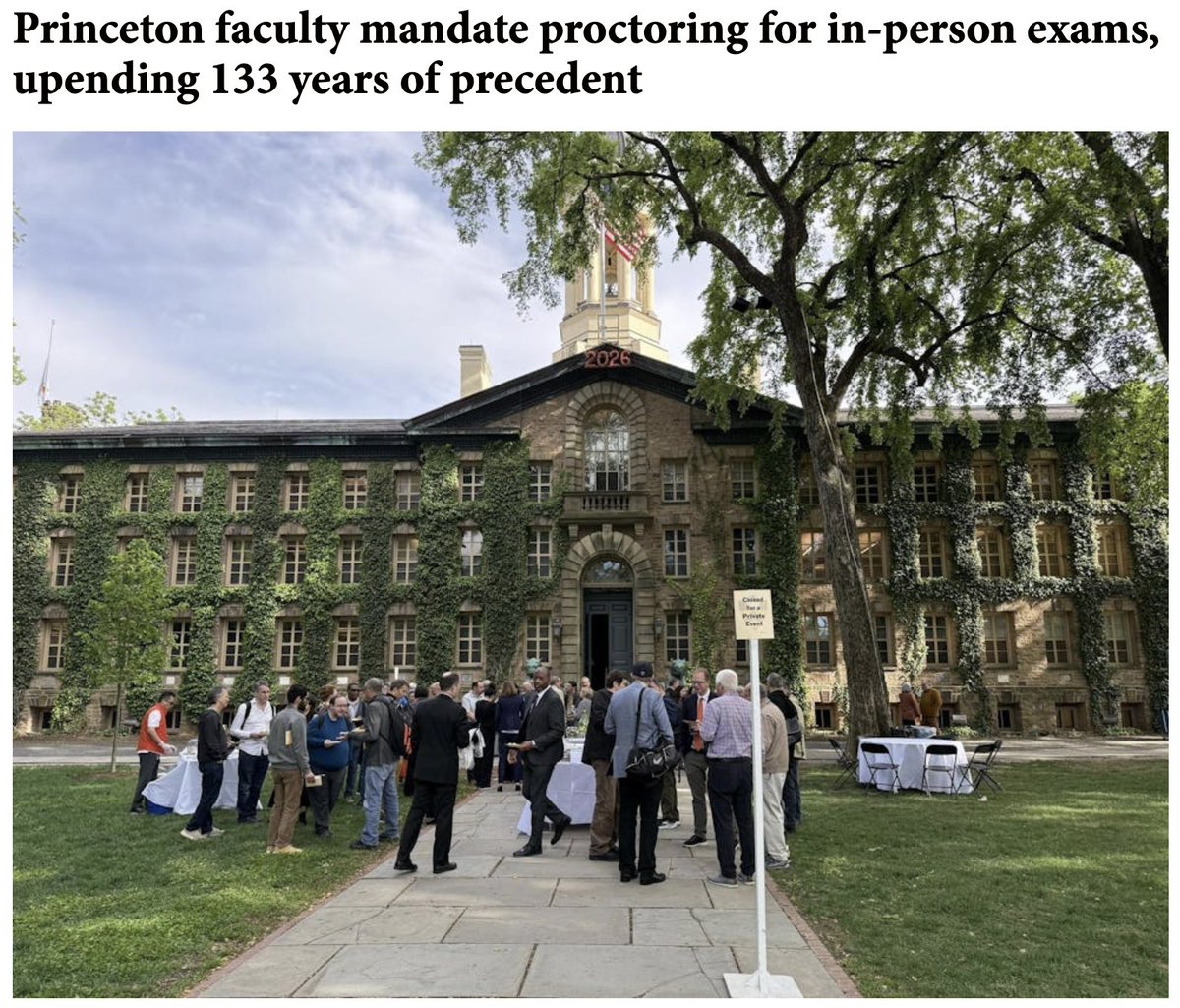
🚨 Princeton's 133-year-old Honor Code was NOT enough to tackle AI cheating, and for the first time since 1893 (!), it will mandate proctoring for ALL in-person exams. Expect other schools and universities to follow suit:
Princeton's Honor Code was instituted in 1893 in response to a student petition to end proctoring during examinations.
The Honor Code is based on individual accountability, as each student pledges to refrain from academic dishonesty and also to report if they see someone else violating it.
According to the decision taken a few days ago:
“The ease of access of these AI tools on a small personal device has also changed the external appearance of misconduct during an examination (...), making cheating much harder for other students to observe (and hence to report).”
Starting on July 1st, ALL in-person examinations at Princeton will be proctored.
As I have written a few times before in my newsletter, AI affects cognitive development, and it directly impacts learning and educational systems.
To avoid the negative impact of AI and to protect education, we should return to pen and paper, blue books, and in-person exams.
There were misconceptions and miscalculations with smartphones and social media, and those mistakes should not be repeated with AI. Schools and universities should take bold decisions now and adapt accordingly (and fast).
Of course, students should learn about AI and know how to use and experiment with it. However, that doesn't mean the educational system should be FLOODED with AI (including AI cheating) and its negative interference with learning and cognition.
Expect more schools and universities to announce similar measures.
-
👉 To learn more about AI's legal and ethical challenges, join my newsletter's 95,000+ subscribers below.