Happy Republic Day to our countrymen!
Proud to be Indian. Jai Hind!
#RepublicDay2024#RepublicDay#JaiHind
How a military parade became India’s R-Day tradition https://t.co/eizfAiuVdH
Is it only an Indian phenomenon, that people with jaundice due to acute viral hepatitis, restrict food, especially animal-based proteins to "give the liver rest?"
There is nothing called "resting the liver" when sick with jaundice.
Eat well, eat anything, eat balanced.
We need to talk about this
☠️Azithromycin and Amoxyclav for every run-of-the-mill viral sore throat
☠️Cefuroxime for every viral cold and cough
☠️Upgrading to Meropenam from Ceftrixone when a single fever spike persists in the wards
☠️Upgrading to Colistin with a single fever spike on Meropenam in the ICU
☠️Starting Ceftazidime and avibactam when patient enters the ICU
☠️Not stopping previous antibiotics but adding on more antibiotics in the ward and ICUs like a domino effect
☠️Not de-esclating or stopping antibiotics on time when body fluid cultures come back sterile
☠️Over-the-counter antibiotic sales without prescriptions
💀Alternative medicine practitioners prescribing antibiotics and antifungals without a clue, when Ayurveda or Homeopathy never had a germ theory
☠️People taking antibiotics unnecessarily and for the wrong indications AND stopping after 2 or 3 pills, that too taken erratically
☠️Irrational and illogical antibiotic use domesticated/ farmed-for-food animals and in veterinary practice
☠️Medical representatives asking doctors to prescribe a new antibiotic because it is better than the rest and more "powerful" without knowing recommendations for use - and ill-informed doctors learning medicine from medical representatives on antibiotics use.
🚨This depressing list is endless🚨
This is a complete human-made disaster that needs reflection from every treating doctor to follow what is necessary to reverse the damage done and to prevent irreversible damage in patients who will one day require life-saving antibiotics.
Patients with liver disease and cancer will be the worst hit because of this foolish and irrational antibiotic use. Brace yourselves.
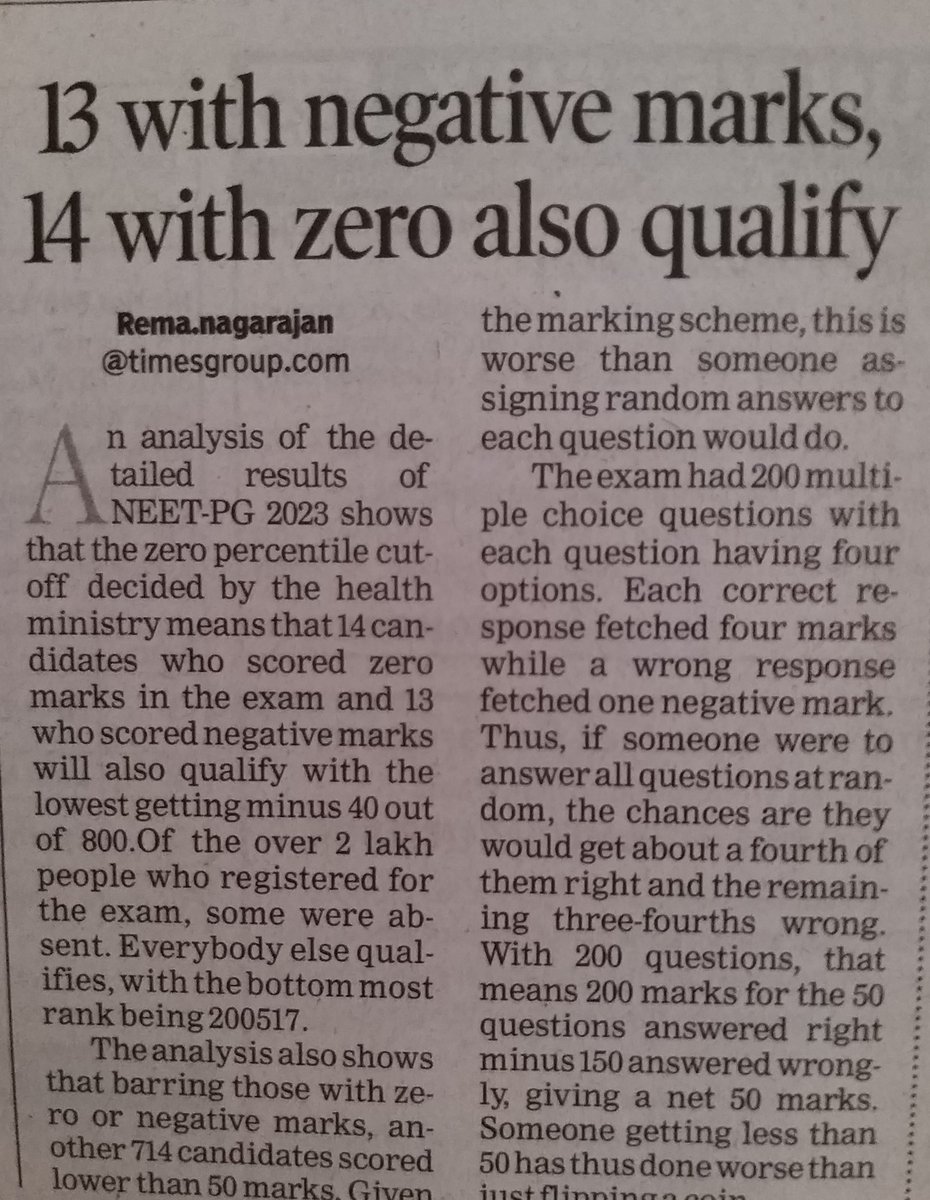
Zero percentile means 14 candidates who scored ZERO in NEET PG exam, 3 with negative marks also qualify
Last rank was 200517, score was -40👏👏👏
How did people, who supposedly passed MBBS final exam score ZERO or negative marks?
What does it say about quality of MBBS graduates?
Upcoming NMC guidelines
1. Doctors cannot take fees from patients, they can seek blessings.
2. Doctors can have only 2 meals/ day (at least one should be veg)
3. Doctors should not expect sleep or rest on Emergency days and upto 6 hours/day on other days.
4. Doctors cannot wear branded clothes, should wear generic khadi clothes.
5. Doctors cannot use branded electronic gadgets, only manual products are permitted.
6. Doctors can attend upto 3 marriage ceremonies/year (but cannot eat more than 20 g protein or 800 kcal per meal)
7. Drinking habit should be limited to water, milk,lassi and sharbat. No other drinks are allowed under any circumstances.
Non-compliance will attract cancellation of registration for 3 months.
#Satire #MedTwitter
So, NMC wants this. You go to a doctor for fever, and NMC wants the doctor to prescribe only "paracetamol", without any brand name. Fair enough.
What's the next step? The patient goes to a medical store. There, he'll be given paracetamol made by a company of the shop owner's choice.
Which company he chooses, and based on what criteria is anyone's guess. Best part, the medical store owner won't even be held responsible if the patient doesn't get better, but the doctor will be.
The NMC regulation on generic meds doesn't solve anything but creates more problems.
#medtwitter #NMC
76 years ago: This was India in 1947
- Life expectancy 32 years (most South East Asian countries were almost 20 yrs ahead)
- Literacy 18%
- GDP growth sub 0.5% per annum for over 50 years (Yup. The 'Hindu' rate of growth was an 8-fold increase over the growth in the first half of the 20th century)
- Negligible capital as the Raj was about building capital in Britian, not India
- Dire poverty
We have come a very long way since and must always remember all those who fought for our freedom, giving up years of their life or even their life itself.
And those who put a Framework in place: who had the vision, strategy and execution to take a road no other post colonial nation took.
I do not think we appreciate enough that the path with took was not the only one possible.
It was not inevitable, or even easy!
In 1947, almost no one would have bet on our surviving as an united nation for 75 years, with a functioning democracy.
Why a Constitution that has lasted 75 + years is itself and outlier in the 900 odd constitutions the world has seen.
It took a lot of thinking, passion and execution.
Even a simple thing like universal franchise was not the norm.
Let alone developing countries of Africa and South America; Switzerland gave voting rights to women only in 1971.
Canada, Australia and United States gave voting rights to their ethnic minorities only in the 1960s.
There is no other parallel even till date in a post colonial nation at anywhere close to those poverty levels making a smooth transition to a liberal democracy.
Most fell into various forms of civil strife, military takeovers and where there were charismatic leaders, they became dictators (eg Indonesia and later Philippines)
AND none of those Nations had the added challenges of India in terms of diversity of languages, cultures, religions etc
I repeat none of this was accidental. To give only one example:
Both India and Pakistan had armies which had the same origin so why's it that Pakistan had military coups and military dictators, and we did not? It was part of a step by step process to ensure that the military remains under civil rule
Those who founded the country did their bit, now it is on us.
Let us not take what we have for granted.
Two areas to my mind for focus: Job creation and Technology/Science/ Innovation.
The latter is an area where we went above and beyond in our early decades. No other country at that stage of development even dreamt of areas like atomic energy & space research!
The rest of Asia had barely any Management institute even till the 1990s - 30 years after the IITs and IIMs.
Even in the '80s it appeared strange to many, incl. myself, that how could a prime minister talk of computers & telecommunication being a priority in a poor nation - but that's what vision is about.
That is what drove the economy & job creation for decades on end.
But we've taken our eyes off the ball in the last few decades and are getting left behind in the innovation game. China is extremely focused on every new area of technology from neuroscience & biotechnology to renewables & semi conductors.
Our demographic dividend will also dissipate if we can't find jobs for young people and specially for women.
We need to do our bit to be worthy successors to those who gave us a free nation.
Jai Hind!
Happy Independence Day🙏🇮🇳
@Luthra_Sidharth@sanjayuvacha@BDUTT@virsanghvi@gulrayys@hvgoenka@anandmahindra
@DrDhruvchauhan@anujtiwari11 Dr Dhruv, u can surely post "personal views" on X, or any other social media/public platform, as long as u r not using ur professional identity to gain influence. 'coz if u are, then that influence comes
with sm responsibilities tht u cant shrug off by callin it "personal views"
NEET PG COUNSELLING SNIPPETS:
1) 30 out of top 50 ranks opted seats in New Delhi (60%); next was Mumbai (20%)
2) 27 out of top 50 ranks opted for MD Medicine (54%)
3) 15 out of top 50 ranks opted for MD Radiology (30%)
4) Only 2 out of top 100 ranks opted for Surgical Speciality!
5) Most sought after medical College: Dr RML Hospital Delhi (24%); MAMC Delhi (22%); Safdarjung Hospital Delhi (14%)
Next generation is always smarter. Best brains of the smarter generation are:
1) Avoiding surgical branches (lesser professional risk; less money; more peace of mind)
2) Radiology will always rule at the top (least risk of being exposed to violence at place of work)
3) Delhi rules as there is NO BONDED LABOR after 3 years
#NEETPG2023 #nmc @MoHFW_INDIA@ndtv@CNNnews18@ZeeNewsEnglish #NEETPG #NEET @Rssdi_official@PTI_News@j_metb
In the year 1917, a Tamil Indian girl was born in a middle class family at Rangoon, Burma, where her father had gone for a living. He named her Sivaramakrishna Iyer Padmavathi. At a time when women were traditionally confined to the kitchen/illiterate, the middle class girl did MBBS from Rangoon Medical College.
When the Japanese invaded Burma, they briefly returned to their traditional home in Coimbatore. In 1949, she went to London to do an FRCP, then unimaginable for a Female Indian doctor. She was selected to study further at Johns Hopkins University, US, where she trained under the legendary cardiologist Helen Taussig. Thereafter, she moved to Harvard University, where she trained under the Father of Cardiology- Paul Dudley White.
When a glorious cardiology career awaited her in the US, she was firm in returning to India & serving Indians. She joined Lady Hardinge Medical College in 1953, to become India's First Lady Cardiologist.
S.I.Padmavathi started India's first Cathlab & exclusive Cardiac Clinic. Started India's first DM Cardiology course. She founded the All India Heart Foundation (AIHF) in 1962, to serve the poor & needy. She joined Maulana Azad Medical College in 1967, by which time her fame had spread. The Indian Govt under Indira Gandhi honoured her with the Padma Bhushan, that year.
She was the cardiologist & administrator of 3 great colleges at the same time- MAMC, G.B.Pant Hospital & Lok Nayak Hospital. She retired as Director,MAMC in 1978.
She set up the National Heart Institute (NIH) in 1981, at Delhi. At age 90, Padmavathi became a fellow of The European Society of Cardiology in 2007.
Till age 95, (year 2015), Padmavathi worked 12 hours a day, five days a week, to serve poor and needy Indians, with state-of-the-art Cardiac Care. She retired from active practice, that year. The Government of India bestowed India's second highest Civilian Award, the Padma Vibushan on S.I.Padmavathi in 1992.
Both Padmavathi and her sister Janaki(neurologist) remained single and started the Janaki-Padmavathi trust, pouring in their entire earnings to start a trust to provide poor people with money for life-saving Heart Surgeries.
After dedicating her entire life to serving the poor in the field of Cardiology, S.I.Padmavathi passed away in 2020, at age 103 from Corona.
Imagine the steely resolve, vision, brilliance and sheer determination of this iron- lady to shatter the glass ceiling in achieving all these, serving poor Indians with quality cardiac care, and finally giving away all her wealth to her fellow citizens.
Most of the DMs I get are about: How do I get through USMLE or PLAB? What salaries can I get? Quality of Life? Citizenship?
Here is an inspiring story of the first female cardiologist of India, who achieved so much by returning to her country. Tamilnadu & India should be mighty proud of their daughter- Sivaramakrishna Iyer Padmavathi!
Cancer is the emperor of all maladies. The only thing worse than fighting this formidable foe, is fighting it alone and poor. Imagine you have a stable career as a Professor of Surgical Oncology in one of Asia’s most renowned hospitals in Chennai. Your wife works for the US consulate and you have a daughter studying class 5. Will you risk your idyllic life to give poor cancer patients in a remote part of India, a shot at least, at dignified death?
That’s exactly what Dr Ravi Kannan did. One fateful day in 2006, Dr Kannan, then a surgical oncologist in Adyar cancer institute, got a call. Dr Chinmoy Choudhury, from Cachar cancer center in Silchar, Assam had called to discuss about a case - but he also asked whether Dr Kannan would like to work in Barak Valley, Silchar. Dr Kannan wasn’t sure - he however agreed to visit the hospital once.
What he saw there, made him realise the dire situation - to reach the nearest cancer center people had to travel nearly 15 hours through serpentine roads. Cancer treatment required multiple visits to the hospital. It was expensive. The outcomes weren’t always great. People had imbibed the fatalistic idea that there is little one can do about cancer - it is too powerful. So when a family member got the dreaded disease, the family had to choose between which life to save - the patient’s or their own.
Initially, Dr Kannan tried the usual silver bullet - free treatment to poor patients. He asked his IT friend to help him track patients - to his shock, he found that more than 50 % of patients never came back for the second visit. Unlike Chennai, these people hadn’t gone doctor shopping - for there were no doctors to shop! It turned out that even to access free health care, the patient and the attender had to lose out on daily wages. If the family had only one earning member this meant trouble.
They came up with an innovative idea - ad hoc jobs for the attenders in the hospital itself ! Not only that, but the attenders who were employed in cleaning, cooking etc - got free accommodation and nutritious meals. No one had to go hungry, just to get treatment. Having solved the first problem, Dr Kannan set out to solve the cost of treatment.
Some suggested making the rich pay more to subsidise treatment for the poor. Dr Kannan refused - fearing that the paying “customers” will eventually elbow out the “free” ones. He instead devised a flat lifetime fee of Rs 500 - which included unlimited visits to hospital, dental care and treatment ! Even with a flat fee, free food and stay, some people were still falling through the cracks. He then realised that treatment for the poor had to be faster - because there was no one to take care of elders or kids at school. To reduce time to diagnosis and treatment, Dr Kannan replaced the time consuming standard biopsy with frozen sections.
Patients started coming in large numbers. This made Dr Kannan wonder - why do these people get cancer in the first place and what can we do about it? Lifestyle is a major contributor, but hard to change. So he settled for the next best thing - to pick up cancer early, by screening people in their homes itself. Since there weren’t enough doctors , he trained volunteers to do the job - fighting a lot of skepticism. The idea paid off - examining patients in their own homes meant everyone could be screened for cancer.
One day a trainee doctor told Dr Kannan, “Sir, many patients are actually well off. They don’t want to pay. They are gaming the system”. He was quiet for a couple of seconds, then went with the trainee doctor to homes of random patients. The abject poverty of their homes hit the trainee doctor like a ton of bricks - perhaps there were people who gamed the system, but the vast majority did not.
The effort bore fruit and Silchar mounted a counter attack against cancer. Indian govt gave him Padmashri
Dr Ravi Kannan’s life shows what one man can do, if he cares enough.
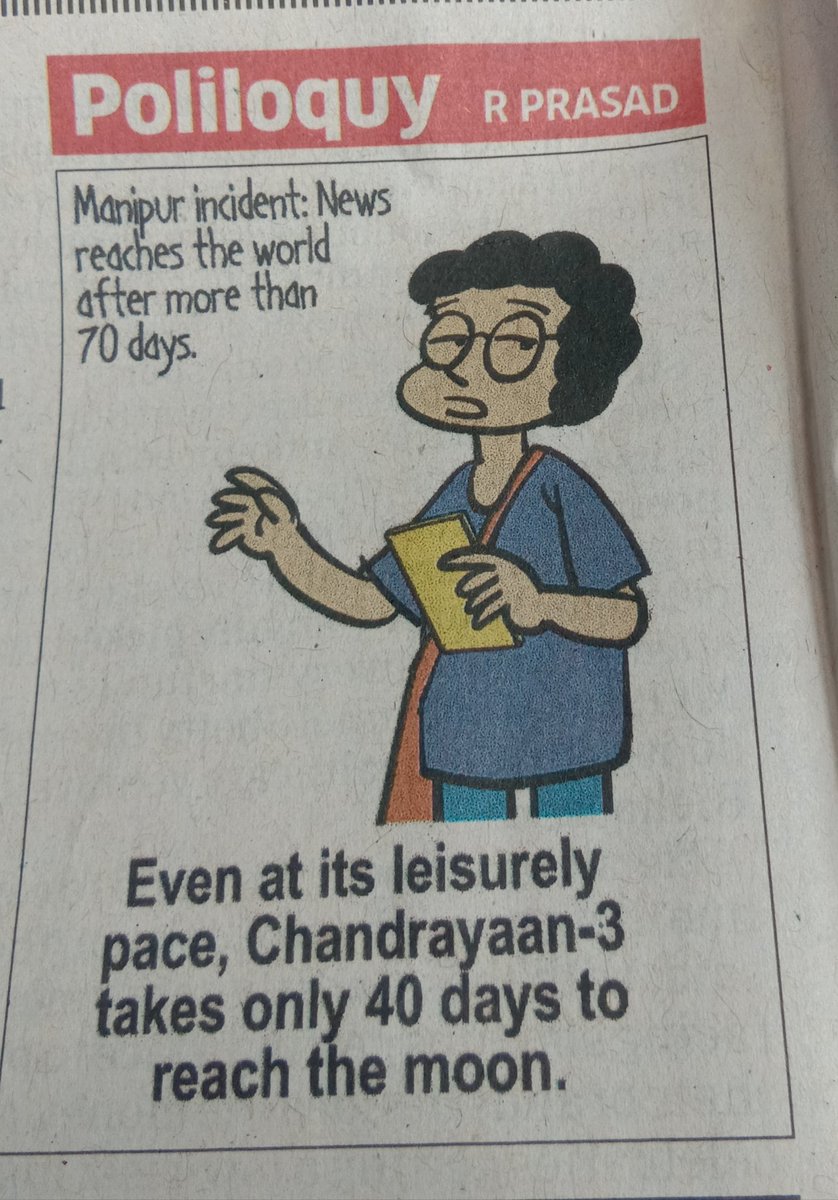
Patriotic citizens of India were sharing pics and congratulatory messages on all social media when Chanrayaan 3 was launched.
Where's the patriotism now in the face of such national shame due to the #Manipur Incidence?
#ManipurViolence