Three decades of biodiversity data, published a decade after we started! Our new paper in @NatureComms shows how airborne eDNA from archived aerosol filters can track ecosystem changes across the tree of life—2700+ genera, weekly resolution, 34 years.
https://t.co/j5GFYkBDnc
New year, new assemblies!
I'm excited to announce Autocycler, my new tool for consensus assembly of long-read bacterial genomes!
It's the successor to Trycycler, designed to be faster and less reliant on user intervention.
Check it out: https://t.co/NksiyESF7u
(1/5)
Working on designing a new hybridisation capture panel for a virus family. Previously used CATCH to select optimal set of probes but now looking for alt tools setting tiling coverage to 2 or 3 intead of complete coverage. Any recommendation of tools or code that can do it?
Come and join our meeting in Sweden next autumn! Some parts of it will cover sequencing, AI and bioinformatics in the CBRNe field. Happy to discuss ideas for potential talks.
Sign up for next year's CBRNe Protection Symposium! A perfect opportunity to learn more about the latest in CBRNe protection research, showcase your own research. We also welcome abstract submissions for oral or poster presentation. More information here: https://t.co/sD5uFEMcsH
Three weeks left to apply for this exciting PhD position focusing on eukaryotic genome evolution! Come work with us at @MIB_WUR! Please RT #PhDposition#evolution@WUR 🦠🧬🧐
Martin Hunt has made Incremental release 2024-08 on AllTheBacteria - adds 507k assemblies taking us up to 2.44 million in total: https://t.co/KP07xAN5ns is there, please use and publish with it!
https://t.co/nJ1aNZJP4T
1/n
One of the reasons I've been quiet on Twitter for a few months is because I've been working on something big - something I'm really happy to share now!
https://t.co/m7KHsR3H8c
A new, open-source database for pathogen sequence sharing. 👐🧬🌎
1/12
I finally got around to testing HERRO (https://t.co/irsWGnjpT2), the new @nanopore read correction algorithm which takes simplex ONT reads to PacBio-HiFi-level accuracy.
I was impressed! Findings are on my blog in a two-part post:
https://t.co/unWf7fIMFS
https://t.co/yEllyimky8
If you’ve just put together a bioinformatics software package and want to put it on Bioconda and get easy docker/singularity containers at the same time, here’s a nice tutorial by @jfy133 - this would’ve saved me a lot of time (before I met @viji112 at least!)
🧹🤩 #tidyomics made it to @naturemethods!
"The tidyomics ecosystem: Enhancing omic data analyses", 👏🏽, @hutchisonwj0, @timothykeyes, and Team!
32 researchers | 26 institutes | 10 countries | 4 continents
A #crowd/#community-research success
https://t.co/koiFWBVygM @cziscience
New blog post:
https://t.co/pwUWKP53tr
ONT-only bacterial assemblies are much better than they were only a couple of years ago. Often <10 errors in the whole genome. Does that mean that less short-read sequencing is required for polishing? See my post for the answer!
(1/4)
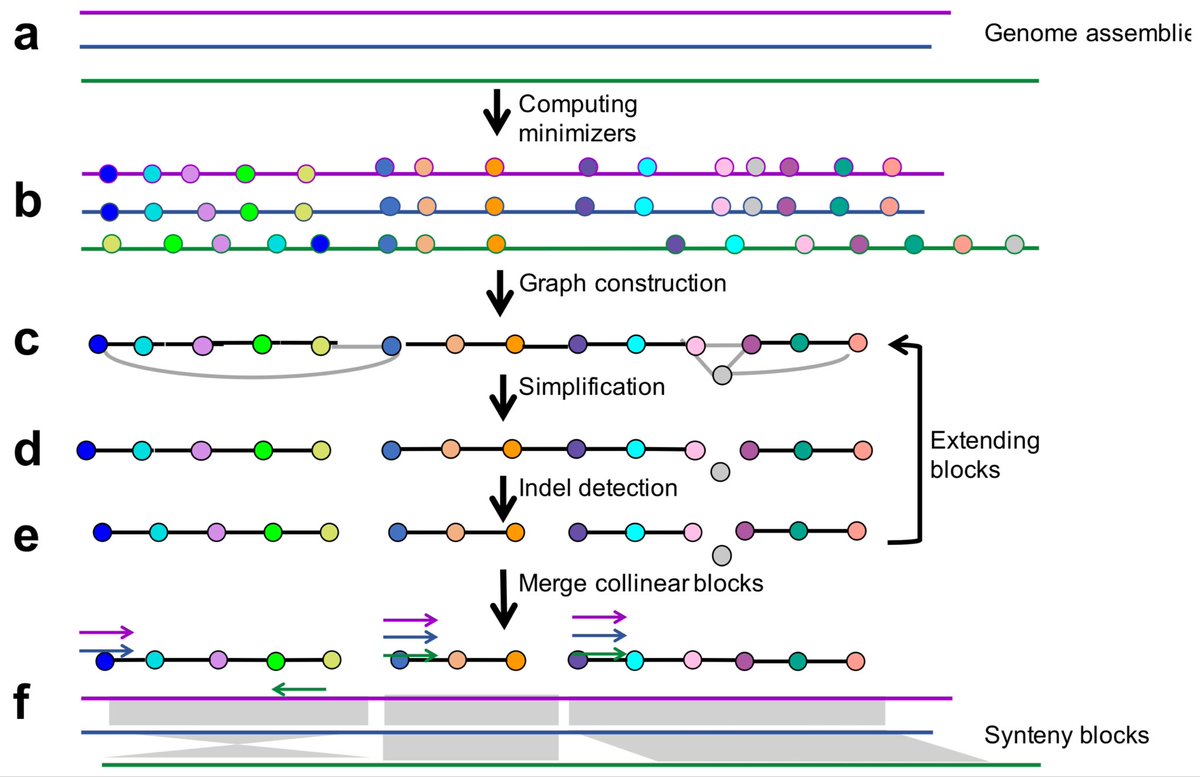
Preprint on Exploring gene content with pangenome gene graphs: https://t.co/quqnW7M50a. It describes pangene for building gene graphs and for calling gene-level variations which can be found at https://t.co/fjehEcrnyl.
Pleasant collaboration with @maxgmarin and @MahaFarhat.
Delighted to see our work on simplifying real-time analysis of nanopore reads, even without bioinformatics skills, being published! #Nanopore#Bioinformatics#plotly
https://t.co/3mDw639Tih
I wrote a new blog post with @GB13Faithless:
https://t.co/HZOcsCyqRu
In it, we describe a couple interesting mistakes we found in long-read bacterial genome assemblies. I think they demonstrate a few valuable lessons:
(1/2)
Feels like yesterday we published our first nanopore scaffolding paper back in 2015. They quality was not good enough for assembly so we had to use that amazing machine that could generate long reads.
https://t.co/e9uh78K3Mr
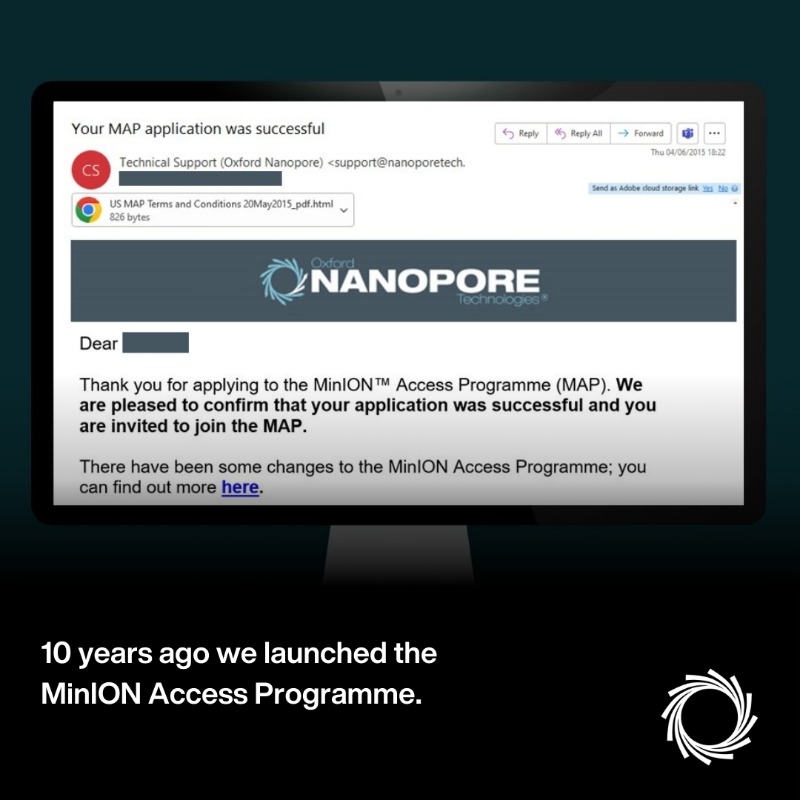
Today marks #10yearsON from the MinION Access Programme launch.
After a decade of innovation (yours and ours), we'd love to hear your ambitions for the next 10 years of distributed sequencing.
Learn more about MinION: https://t.co/xQxHi9fmSToday marks #10yearsON from the MinION Access Programme launch.
After a decade of innovation (yours and ours), we'd love to hear your ambitions for the next 10 years of distributed sequencing.
Learn more about MinION: https://t.co/xQxHi9fmSToday marks #10yearsON from the MinION Access Programme launch.
After a decade of innovation (yours and ours), we'd love to hear your ambitions for the next 10 years of distributed sequencing.
Learn more about MinION: https://t.co/xQxHi9fmSToday marks #10yearsON from the MinION Access Programme launch.
After a decade of innovation (yours and ours), we'd love to hear your ambitions for the next 10 years of distributed sequencing.
Learn more about MinION: https://t.co/xQxHi9fmSG
How stable are bacterial genomes as they adapt to an environment? My collaboration with @anuraglimdi, @EvolSys, @RELenski, and @ten_olivier exploring this over 50,000 generations of evolution is out today!
1/
https://t.co/q7WwMo1LvY
With improvement in @nanopore basecalling we now get reads of Q20+ (soon Q30?). Are anyone actively working on establishing a standardized workflow for 16S rRNA gene #amplicon processing to generate OTUs/ASVs in the style of QIIME/Mothur/USEARCH? #bioinformatics