$QCOM: Great work by @StreetSignal__ on bogeys:
JPM Tech Spec: "most investors think this is a management that sets aggressive targets, so many expect an aggressively bullish tone – and quite a number say they expect to be shorting after the smoke clears from the event. Most folks I’ve spoken with expect either an update of the guide through F29, or discussion through C30 (though some did correctly underscore that they already informally guided F31 revenue during their investor day two years ago) and bulls sound like something at the higher end of $10~15b would be viewed positively. Bears seem very skeptical about the complexion and size of new order wins, with questions about who ASIC customers will be (particularly given a seeming lack of AI networking expertise, and SerDes that are viewed as lower-tier); more constructive investors are just looking at the TAM and assuming that as it disaggregates, and QCOM naturally wins some orders. Interestingly, a number of folks said they found some comfort in just how skeptical folks sound in conversations, suggesting expectations are not high."
$QCOM Investor Day tomorrow. Expecting a strong slate of datacenter wins to back our long term thesis that it has a massive multi-billion revenue expansion op by winning a small fraction of a massive DC TAM. 👀
You’re going to want to tune into the $QCOM investor day tomorrow. It’ll be an interesting one, for sure. I will be there on the ground in NYC, attending.
This acquisition would be interesting in two ways. Qualcomm will likely build a RV DC CPU for any willing customer. And is more than likely looking to migrate Auto off Arm. Adding more RV talent doesn't hurt.
I think what Qualcomm is mostly interested in is the post-HBM world. And Tenstorrent is actively participating in that.
Remember Qualcomm is shipping the AI200 with LPDDR and the AI250 with some sort of LPDDR-PIM (but has some tricks up their sleeves apparently).
The way Qualcomm is approaching computing on the data seems to meld very similarly with how Tenstorrent is thinking about it.
Getting access to both engineering talent, their software-managed NoC, pairing the Ethernet routing with the AWE acquisition's IP. And lastly their compiler combined with everything else can solve scale out. This all helps build towards evangelizing non-HBM accelerators.
tl;dr I'm unsure but leading to yes. (this is a long one)
I was thinking about that same thing today. Modular is more programming languages and compiler focused - their CEO is Chris Lattner who is the god of compilers. My understanding is that Modular has a strong group of MILR LLVM folks - an area Qualcomm is quickly trying to ramp into as I assume their main area for this potential acquisition. (https://t.co/n1KsKCA5LJ)
For the AI250 managing an NPU that combines HMX (Hexagon Matrix Extensions), HVX (Hexagon Vector Extensions), and LPDDR-PIM (Processing-in-Memory) is a huge pain in the ass to do correctly. You have three completely different computing paradigms on a single chip, each optimized for different data-locality constraints and arithmetic intensities. Without MLIR, writing a unified compiler for this silicon would be a nightmare. It appears MLIR is critical to Qualcomm as it helps solves the unique problems of heterogeneous partitioning, custom memory layouts, and kernel fusion.
All of above is what Modular is good at, so it is a good fit for Qualcomm to bolster the software side of their accelerators.
As for Tenstorrent they're both a software and hardware firm. I highlighted some thoughts here (https://t.co/5kruNOLBP0). Tenstorrent has an incredibly strong compiler team as well. Their compiler’s primary job is to place and route data across a spatial grid of Tensix cores, handling local L1 SRAM, GDDR, and RISC-V execution. Tenstorrent's new compiler stack, TT-Forge, is built entirely on top of MLIR.
It's unclear to me whether they will acquire both, and whether they wanted more compiler experience, and one company (Tenstorrent) also came with RISC-V/CPU. Or if they were looking at these from distinct perspectives.
On RISC-V I don't think they fully need Tenstorrent talent or IP. They acquired Ventana. They have a DC CPU coming out with Meta as the customer. I don't think it would take more than 8 months to also put a RV front-end on that CPU. There is some replumbing that needs to happen down to the NoCs and LLCs for RV. And some software work on TrustZone replacement with PMP and OpenSBI, then for Arm CCA RV's CoVE already exists. -- so this is a long winded way of saying that I don't fully know what the RV part of Tenstorrent gets Qualcomm that it doesn't already have.
#AI is no longer confined to one domain. That’s why we power the entire compute continuum, so that intelligence works as one connected system across every experience, from personal devices to data centers.
$QCOM is in advanced talks to acquire AI chip startup Modular at a ~$4B valuation.
The deal would add Modular’s hardware-agnostic software and compiler layer as Qualcomm builds a fuller AI compute platform across connectivity, custom silicon, accelerators and developer tooling.
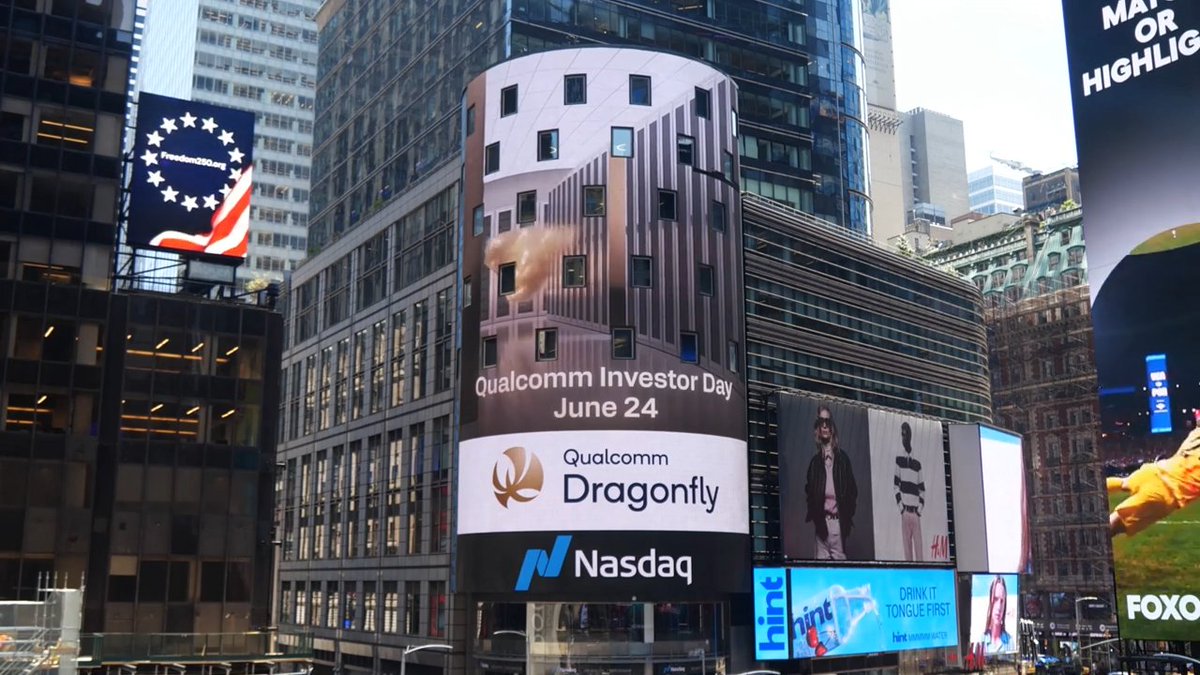
We helped wirelessly connect the world. Now, billions of devices later, Qualcomm makes your world go around by powering the entire compute continuum. Learn more at #QCOMInvestorDay on June 24.
Great interview @cristianoamon with @CNBC@ArjunKharpal // Congrats on the slick new studio //
💭I believe this was inevitable and part of the roadmap. It was more about aligning with full DC portfolio strategy, the timing and demand.
I believe all boxes should be checked for @Qualcomm building upon the acquisitions from @nuvia_inc to @alphawavesemi
1⃣The first metric to look at would be when Qualcomm ships the CPU and securing enough wafers from TSMC.
2⃣The second one is the software stack and how it can scale its "edge and automotive" AI Stack expertise to DC.
There is no brand, capability or channel problem here for Qualcomm to expand into DC space like it has been facing in some of the areas for AI PCs.
Look forward to the #QualcommInvestorDay next week!
$QCOM $TSM $MU $INTC $AMD #QID2026
https://t.co/DxXMoXk2lo
$QCOM Huge launchpad setting up off 214 area that was previously buy level the last week
Today is decision maker if we close strong in the 220s and can push a huge opportunity ahead for 250+ end of month
Memory relief arrives 2H 2027, not 2028. Amon is 6-12 months ahead of consensus.
Cristiano Amon @cristianoamon told Arjun Kharpal @ArjunKharpal that AI data centers have absorbed the vast majority of available memory. Consumer devices - phones, PCs, AI glasses - are supply-constrained as a result. New fab capacity takes years.
The street calls 2028 for resolution. Amon calls 2H 2027 - new fab capacity coming online combined with AI model efficiency improvements making each device need less memory.
A 6-12 month acceleration changes when the AI device upgrade cycle begins. For $QCOM that means earlier adoption of agent-capable phones and smart glasses.
How to verify: watch capex announcements from SK Hynix, Samsung, and Micron. If they guide 2027, Amon has real visibility.
Full analysis: https://t.co/reAkluPXfD
Source: CNBC Tech Download - https://t.co/eGGWRLdHbd
"The players that are interested in the mobile industry are changing. Now all AI companies are looking at mobile devices as endpoints and they're building devices…I think this industry is going to see change. I cannot predict the winners and the losers, but I can predict change and I think it's likely going to change the relationship between smartphone OEM, OS's and agents, that's going to change." @cristianoamon CEO of @Qualcomm
https://t.co/jqi4UaPEnP
$QCOM is reportedly in talks to acquire AI chip startup Tenstorrent for between $8-10B, a move that would significantly expand Qualcomm’s AI and data center chip ambitions beyond smartphones.
Tenstorrent, led by renowned chip architect Jim Keller, develops AI accelerators for training and inference workloads, making it a strategic asset against $NVDA and $AMD.
QCOM is in talks to acquire Tenstorrent at $8-10B per The Information.
Tenstorrent builds RISC-V AI accelerators for data center and edge inference. RISC-V is an open-source chip instruction set: no ARM royalties, fully customizable silicon. Key differentiator is that these chips promise to avoid the costly HBM memory that NVIDIA depends on.
Led by Jim Keller (AMD Zen, Tesla FSD chip), Tenstorrent's last confirmed round: $693M Series D, Dec 2024, $2.6B valuation. Was in talks for $800M more at $3.2B pre-money as of Nov 2025.
Why does this matter? NVIDIA just paid $20B to acquihire Groq, another low-memory alternative architecture. Then absorbed the IP and the HBM supercycle kept rolling.
Pattern worth watching: big players keep buying the memory alternatives, but DRAM requirements aren't coming down yet.
QCOM buying Tenstorrent would be their data center AI entry and an ARM dependency hedge simultaneously. Or it becomes the next acquihire that quietly disappears.