I need to stop talking. Everything I write comes true.
Did you notice how when the market thought $META just reduced capex.
Every semi-name tanked.
And Mag-7?
Lol.
Been adding into a basket of Upstream Memory plays.
The thesis: the memory bottleneck (DRAM/HBM) forces the big 3 makers to expand capacity. The equipment layer captures that capex regardless of where memory margins settle.
$AMAT - broadest tool portfolio (deposition, etch, inspection). DRAM/HBM now its fastest-growing segment.
$LRCX - the most memory-levered of the big names. Etch and deposition intensity rises as HBM stacks get taller. My top pick for pure memory torque.
$KLAC - process control and inspection. The toll booth on every advanced fab.
$ICHR - fluid/gas delivery subsystems that go inside the big tools. Higher-beta proxy on the whole capex wave.
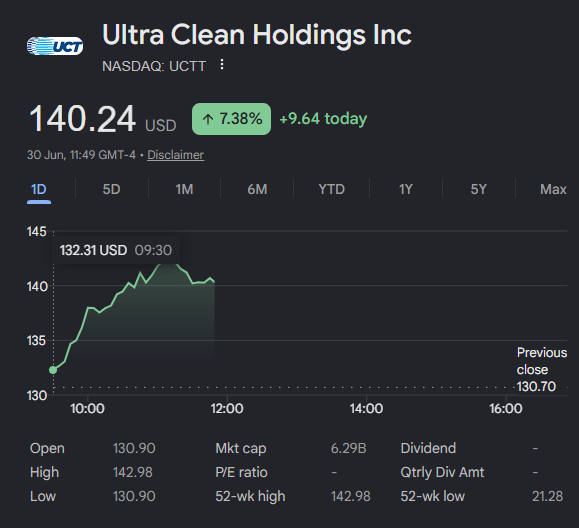
$UCTT - subsystems and cleanroom components feeding the tool makers. Same leveraged-proxy logic.
$ONTO - metrology and inspection, with real advanced-packaging and HBM exposure.
The group ripped since $MU earnings. That is the market starting to price the forced expansion thesis.
The extra leg most people are not pricing: robotics and on device AI add a second memory demand wave on top of data centers, which means the expansion runs bigger and longer than consensus.
They are basically in the middle of both hype theme at the moment, Robotics and Memory, so liquidity is flying in this sector.
Scaled in a time as a long-cycle hold, the thesis is multiyear (the capex cycle), not a one day trade.
@labubu_trader Beat me to it. Follow the goat.
Just a random thought, leading US humanoid players strangely me of the current LLM dynamics:
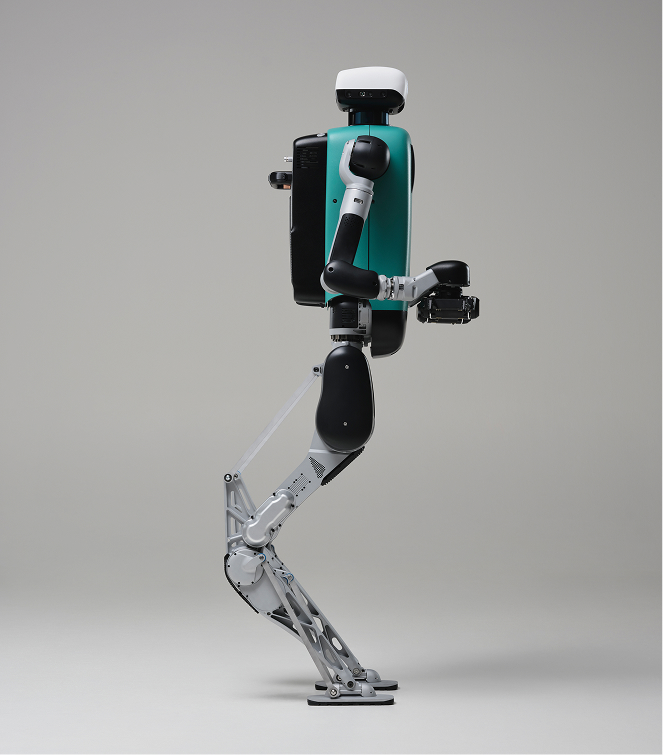
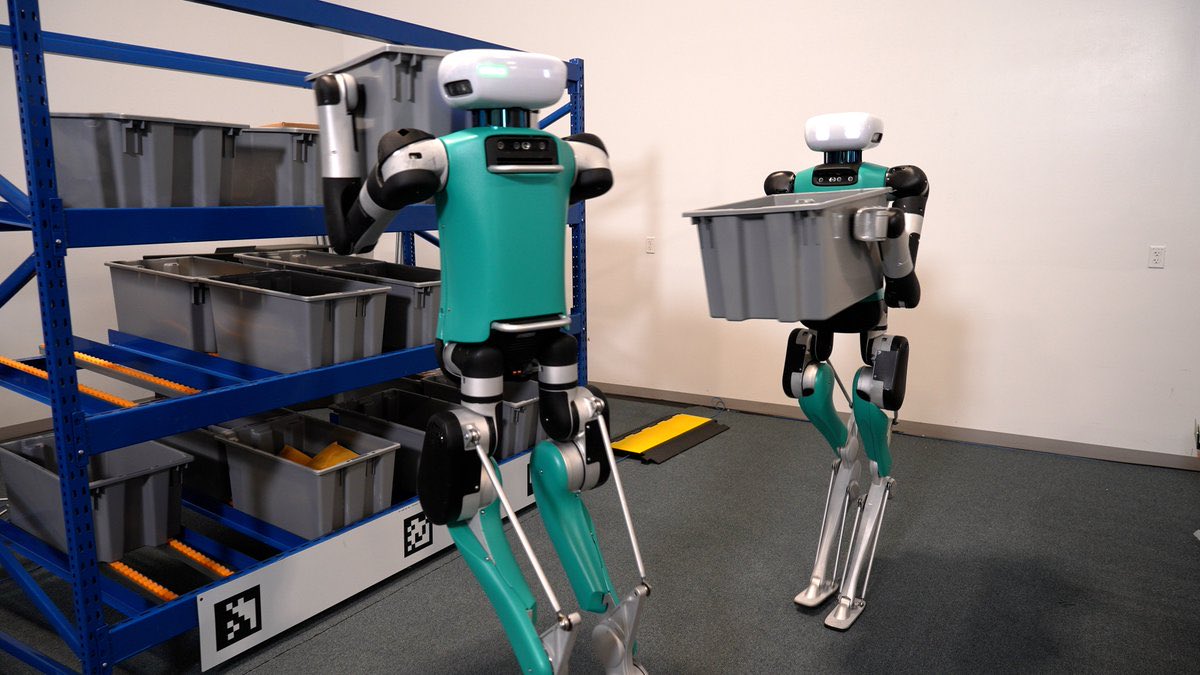
Agility ( $CCXI ) kinda feels like Anthropic for robotics.
With $AMZN and $NVDA heavily backing it, ingrained with $GOOGL Deepmind (like TPUs). And it starts off with enterprise commercialization.
Optimus is kinda off doing its own thing like xAI.
Supported by Tesla/Elon and his visionary roadmap as usual.
Figure is like ChatGPT
With Microsoft/OpenAI investing (kinda like Microsoft), then ended up kinda competing them by building their own VlA and setting them behind.
But ends up top 2 leaders anyway.
Boston Dynamics is Gemini
Kinda started the entire humanoids thing like transformers with backflip videos.
With R&D supported by $GOOGL but somehow let everyone else leapfrog them in commercialization.
And then there’s $NVDA just chilling, silently powering the entire humanoids ecosystem.
Super interesting seeing everyone jumping in on the humanoid trade with $CCXI recently!
Just important to remember that it's still extremely early:
- Est. 2026 AI capex = ~$1 trillion
- Est. 2026 humanoid VC funding = ~$70 billion
Personally, I'm investing early as a core believer in robotics / humanoids.
But I do kinda feel like you'd want to wait and see which OEM like Agility or Figure breaks out to become the de facto leader and go-to OEM as prodcution volume ramps up.
For B2B customers like $AMZN, $MELI, and Toyota etc.
Similar to $NVDA and GPUs.
At that point, the upstream supply chain starts to open up where you'll see names like Harmonic Drive, Leaderdrive etc also have steeper volume/financial inflections especially if supply constrained (highly dependent on China).
Personally, I've been waiting years for humanoids to enter the commercialization phase and wanna participate in that early.
Just still very early to build conviction with the likes of Siemens / $TSLA still running proof of concept tests in a small number of factories.
With a tail of other OEMs like "Humanoid" in the UK a couple gens behind the likes of Agility.
And you've still got issues where it's taking some time to actually develop humanoid hands for more tricky tasks on top of moving boxes in warehouses etc.
So then you've got a further commercial TAM expansion into fields like medical/research on top of logistics currently.
Paradis Stock Report: Harmonic Drive Systems (6324)
For upstream humanoid exposure. (Disclosure: I hold a position).
I have mentioned HDS a few times in my humanoids article and in various comments.
-> Here's my technical research article that I wrote a few months ago for a few buy-side institutions.
(With updated financials and amended/shortened for my anonymity and integrity to paying firms. Some customer mapping etc. may need updating also):
Report:
Every humanoid demo you have seen - Figure pouring a coffee, Optimus folding a shirt, a Unitree robot doing a backflip - leans on a very specific component almost nobody outside the motion control world can name.
Before the model decides to move the hand and before the motor delivers torque, something has to convert a low-torque rotor into the precise, high-torque rotation a wrist or finger actually needs.
That something is a precision reducer.
And in the highest precision joints, the reducer of record for 40 years has been the strain-wave gear.
Invented, branded, and still dominated at the premium end by one company: Harmonic Drive Systems (6324).
First, a piece of housekeeping:
- The entity that matters is the Japanese parent, listed on the Tokyo Prime Market.
- It owns 100% of Harmonic Drive SE in Germany (the former Harmonic Drive AG) and a majority of Harmonic Drive LLC in Beverly, Massachusetts.
- It is not a Nidec company. Nidec-Shimpo is a separate competitor, and Harmonic Drive actually sold its policy stake in fellow reducer-maker Nabtesco during the year to March 2025.
Their flagship product is a simple three-part assembly:
1. a wave generator
2. a thin walled steel cup called a flexspline
3. a rigid circular spline
[I've removed some technical stuff cos it can get boring quickly]
Harmonic Drive sells this as component sets (the CSF, CSG, SHF and SHG families), as integrated AC servo actuators bundling a frameless motor, the gear and an encoder (the SHA and FHA lines), and as lower-ratio planetary units for less demanding joints.
In a six-axis industrial arm or a cobot, this is the gear in the wrist, forearm and elbow.
The heavy base and shoulder axes belong to RV cycloidal reducers, where Nabtesco holds something like 60% of the world market; harmonic and cycloidal are complements far more than competitors.
The same strain-wave gear shows up in semiconductor wafer-handling and lithography stages, in surgical robots. In aerospace, Harmonic Drive units have flown on NASA's Curiosity and Perseverance rovers.
The customer map broadly reads like a census of the automation industry: FANUC, Yaskawa, ABB, KUKA, Kawasaki, Universal Robots, plus a long tail of semiconductor equipment and medical device OEMs.
[I've removed some speculative numbers and customers]
For analysts considering the bull-case optionality:
The moat is in the process, and specifically in one component: the flexspline. That thin steel cup is elastically deformed millions of times over its life, and it is the part that fails.
Patent and engineering literature is blunt about this...the flexspline fatigues, and the cheap routes to making one wreck its cycle life. Bulk-metallic-glass flexsplines crack at far lower cycle counts because their fracture toughness is a fraction of forged steel's. 3D printed metal flexsplines carry porosity and surface roughness defects that, in the words of one patent filing, dramatically reduce their lifetimes.
[Patent/IP stuff is boring, so I have removed]
Harmonic Drive's proprietary tooth profiles (the "IH" generation and its successors) spread load across many teeth meshing at once, which is how you buy fatigue margin without buying weight.
It is an empirical feedback loop: decades of field-return data from satellites, wafer handlers and arms running under extreme duty, fed back into design margins.
Layered on top is qualification lock-in:
In aerospace, semiconductor and medical applications, the reducer is designed into a system that then takes 12 to 24 months to re-certify if you swap it. Once a Harmonic Drive part is flight or fab qualified, the switching cost is the re-qualification programme.
That locks revenue for years, and in aerospace it is close to permanent.
Now moving onto the core demand vector: Humanoids
The narrative premium is humanoids and maths can be seductive.
A humanoid uses somewhere between 20 and 40 reducers across its joints, a mix of harmonic and planetary.
At a Harmonic-grade ASP frequently cited near $800 a unit, 100,000 humanoids is on the order of $1.6B of harmonic-reducer demand which is a 5-10x TAM expansion against today's industrial base.
From supply chain mapping, unit numbers are finally inflecting off zero:
Harmonic Drive has started to book real, if small, humanoid orders. Roughly ¥1.3B in a single quarter, around ¥2.5B guided for the year to March 2026, with management telling analysts the following year could double or triple that, and the count of potential humanoid customers climbing past 15, concentrated in Japan and North America.
In my view, this is the closest thing the listed world has to a pure play on the actuator content of a humanoid joint.
For clients, there are naturally some coverage concerns however:
Coverage is thin and almost entirely Japan-desk - Goldman, Morgan Stanley MUFG, Jefferies, Macquarie, Citi, Nomura, Mizuho.
For a generalist global fund the name is genuinely hard to own:
1. A Tokyo Prime listing
2. Japanese-GAAP disclosure
3. No quarterly order detail
And a business whose irreplaceability lives in segments (semiconductor, aerospace, premium humanoid) that headline market share data (which shows Harmonic Drive losing share) actively obscures.
However, in my view, the cyclical recovery is underway:
This is not a story stock with no business. For the year to March 2026, Net sales rose 7.0% to ¥59.6B.
It is important to factor in the quarterly cadence too:
Revenue climbed ¥13.5B, ¥14.3B, ¥14.3B, ¥17.4B through the year, and EPS went from minus ¥0.40 in the first quarter to ¥8.86 in the fourth as factory utilisation recovered and the CoS ratio fell.
This is textbook fixed-cost absorption, with incremental margins reportedly above 50%.
Guidance for the year to March 2027 is for sales of ¥68.0B, up 14.2%, operating profit up 141% to ¥6.2B, and net income up 180% to ¥4.5B.
Orders are corroborating:
- full-year intake of ¥61.6B was up 16.2%, with North American reduction-gear orders up 31.3% and Japan up 26.9%.
The balance sheet removes any solvency question from the discussion:
- Roughly 72% equity ratio, net cash, operating cash flow of ¥6.4B, and enough firepower to fund a 33% expansion of the US Beverly plant by December 2026 without touching shareholders.
In May the company set a fresh five-year plan:
- ¥100B-plus in sales and a >15% operating margin by the year to March 2031.
On review, this is a fortress balance sheet attached to a genuine moat in a market that is inflecting.
Risks:
China.
Harmonic Drive's global unit share has fallen from north of 70% historically to an estimated 20% today. In China (the largest robot market) domestic suppliers now lead outright:
Leaderdrive and Zhejiang Laifual held roughly 27.5% and 21.4% of the country's robotic harmonic-reducer market by 2025 shipments.
Leaderdrive grew revenue 47% to 570.7M yuan in 2025 and more than doubled net profit, and has already fulfilled humanoid R&D orders for Tesla and Figure.
The pricing gap should be emphasised at this stage:
Chinese Tier-1 units land at circa 40-60% of Harmonic Drive's price, and that gap is widening.
Laifual's average reducer ASP fell about 30% in two years, which its own IPO prospectus framed as a deliberate share grab. Independent stress-testing puts the best Chinese parts at 70-85% of the Japanese benchmark on torque density and lifespan, but at backlash parity.
Based on discussions with [famous robotics company], for most of the joints in most of the robots, "good enough at half the price" is the whole ballgame.
Management's own long-term framing has overall strain-wave share declining toward 6% in the long run.
[Some analysis on valuations and financial modelling, removed cos it's boring]
Further, the largest humanoid programmes may design around Harmonic Drive:
Tesla designs its actuators in-house and multi-sources the reducers, including from Chinese suppliers, with teardown chatter pointing to a meaningful and rising Chinese share of Optimus content at 30-40% lower cost.
Harmonic Drive is, at best, one of several reducer sources for the biggest program and not the sole-source chokepoint the current valuation and our forecasting implies.
[More boring bits on depreciation, yen strength, cyclicality, sales geographies]
To conclude:
1. Harmonic Drive owns a qualification locked chokepoint in premium precision reducers.
2. Sits on a strong balance sheet.
3. Is one year into a credible cyclical recovery.
4. Holds the cleanest listed exposure to humanoid actuator content that exists.
If a large Western humanoid program (Figure, Apptronik, even Tesla) confirms primary source Harmonic Drive content shipping at premium prices and scale, the structural story has potential to re-rate.
Yeah, I've got positions in $CCXI for exposure to Agility.
I do believe that they're one of the best humanoid producers globally ex-China.
Especially their current Digit v4 commercial humanoid which has one of the best spec sheets worldwide.
Some important points on Agility's BOM:
-> Actuators are ~50% of the BOM for a humanoid
-> Schaeffler are crucial here for Agility.
Schaeffler:
- invested in Agility
- buy Agility's robots
- but are also Agility's strain wave/planetary actuator merchant supplier
And Schaeffler are probably the best actuator platform worldwide (maybe more than Harmonic) since theirs are smaller and lighter than rivals.
And, going back to the BOM, Agility get the actuators at cheaper rates than rival OEMs like Humanoid (a UK humanoid maker...obviously lol). Preferential supply treatment etc.
So w/ economies of scale:
As more customers like Amazon etc buy from Agility -> the cheaper the actuators become -> the cheaper the humanoids become
= Agility in theory become the de facto humanoid leader.
If Schaeffler ofc maintain supply agreements and preferential treatment (which they can as an Agility investor).
And looking at Agility's order book w/ 30+ customers in the pipeline, it does seem like their BOM has been rapidly declining recently.
Unlike memory w/ $SNDK and $MU, you do want humanoid costs to come down for scalability and commercial reasons.
And has been deployed in:
- GXO Logistics
- Schaeffler
- Toyota
- $MELI
- $AMZN
With basically every deployment citing "multi site" language for the future beyond current single site deployments.
Which Agility have plenty of capacity for at ~10k units per yr if you wanna believe the CEO vs. hundreds of units currently being produced.
Amazon for example explicitly need costs to come down e.g. that's why they're trialling robotics in Poland rn.
For payback analysis mainly. Which if that goes well, you can expect to see wider deployments in the US in the coming years.
Same with $MELI in Latam too.
That being said, I do think SPACs are inherently risky - I think we all know the risks.
But given I'm a humanoid enjoyer, I do wanna participate in some way since that's where the next AI paradigm shift will be beyond "software".
$ASTS 🚨 Deal Win Confirmed!
Rakuten & $ASTS joint venture wins Japan's J-LEO satellite contract.
Total funding: ¥150B (~$926M) over 3 years 📡🚀
That is ONE government contract.
Many many more to come.
It's super obvious every government globally will want at least 1 SpaceX alternative.
A government can not rely on 1 man and 1 company.
Also: everyone with 2 brain cells gets that the local telcom lobby folks are powerful and will fight everything to the death where they don't get a cut.
I think the smartest thing $ASTS got from the start is that partnering makes their opportunity much much bigger. 1 + 1 = 3
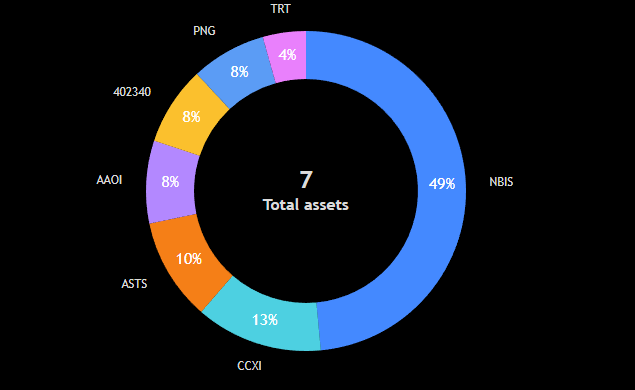
Portfolio update:
$NBIS 48.52%
$CCXI 12.84%
$ASTS 10.36%
$AAOI 8.37%
$402340 7.96%
$PNG 7.58%
$TRT 4.36%
Added a visual for a nicer way to look at it, numbers are rounded here.
$CCXI and $OUST opening strong.
Two of $NVDA’s picks in the humanoids and physical AI market.
A reminder that Agility Robotics is a direct customer of Ouster.
Agility Robotics’ flagship bipedal humanoid robot, Digit (which is actively being deployed in industrial warehouses like GXO Logistics and $AMZN ), relies directly on Ouster’s digital LiDAR technology for its advanced spatial perception, long-range obstacle detection, and navigation stack.
For robotics companies, I have a favorable view on Unitree and Agility Robotics, two humanoid players.
And I have largest concentration in Agility Robotics, since I personally prefer US humanoid players.
For upstream component exposure, I currently own:
- Harmonic Drive (6324) given high content BOM on things like harmonic reduction gear.
- Vishay Precision for sensors and a possible candidate for Telsa Optimus.
LeaderDrive (688017) and Schaeffler I have favorable views on but don't own personally.
Many of the other AI DC players, I have indirect exposure to robotics like memory.
Don't recommend anyone to copy, just sharing personal positions/thoughts.
Humanoid sector is large, and as seen with Goldman Sachs report that "Korean companies will command a 30% direct and indirect share of global humanoid robot production".
Lot of players out there globally. This was an older report but just linking it again since you see all of them pop up in GS institutional reports + what they cover.
Agility Robotics is my personal favorite as of now.
Pretty tough to find compelling opportunities across the Korea humanoid supply chain rn.
Many bleeding edge companies are either:
1. Private
2. Buried deep within large conglomerates
For example, Wonik Robotics (030530):
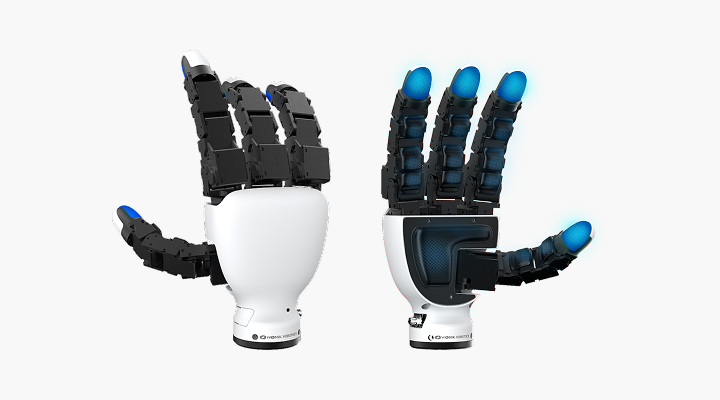
- They make the world's most widely adopted / research-grade dextrous hand.
- And Elon's said numerous times that the hand is the hardest part to make on a humanoid:
"The hands are the majority of the engineering difficulty of the entire robot" w/ $TSLA manufacturing the parts in-house.
- So if Wonik were to develop + protect a superior hand than the rest of the market, they most certainly become a multi year winner as humanoid output scales.
But the issue is that Wonik Robotics is just a tiny subsidiary of Wonik Holdings who do semis gases / piping.
So the exposure is massively diluted.
Kinda sad cos their Allegro Hand V5 Plus model looks very good compared to other public companies.
E.g. 16-DoF which allows for "more precise control and stable grasping of objects with diverse shapes."
And to my understanding, is the standard platform on which $GOOGL Deepmind/Stanford/MIT/CMU manipulation research runs on.
Then on top of Wonik Robotics, you have other names like:
- Robotis (108490) - backed by LG and make building blocks + gripper/manipulator products rather than an actual 5-finger hand.
- Tesollo - private, but do a a five-finger, 20-DoF hand with dedicated actuator tech, validated at Kia.
- WIRobotics - private, but make a 15-DoF hand.








![ParadisLabs's tweet photo. Paradis Stock Report: Harmonic Drive Systems (6324)
For upstream humanoid exposure. (Disclosure: I hold a position).
I have mentioned HDS a few times in my humanoids article and in various comments.
-> Here's my technical research article that I wrote a few months ago for a few buy-side institutions.
(With updated financials and amended/shortened for my anonymity and integrity to paying firms. Some customer mapping etc. may need updating also):
Report:
Every humanoid demo you have seen - Figure pouring a coffee, Optimus folding a shirt, a Unitree robot doing a backflip - leans on a very specific component almost nobody outside the motion control world can name.
Before the model decides to move the hand and before the motor delivers torque, something has to convert a low-torque rotor into the precise, high-torque rotation a wrist or finger actually needs.
That something is a precision reducer.
And in the highest precision joints, the reducer of record for 40 years has been the strain-wave gear.
Invented, branded, and still dominated at the premium end by one company: Harmonic Drive Systems (6324).
First, a piece of housekeeping:
- The entity that matters is the Japanese parent, listed on the Tokyo Prime Market.
- It owns 100% of Harmonic Drive SE in Germany (the former Harmonic Drive AG) and a majority of Harmonic Drive LLC in Beverly, Massachusetts.
- It is not a Nidec company. Nidec-Shimpo is a separate competitor, and Harmonic Drive actually sold its policy stake in fellow reducer-maker Nabtesco during the year to March 2025.
Their flagship product is a simple three-part assembly:
1. a wave generator
2. a thin walled steel cup called a flexspline
3. a rigid circular spline
[I've removed some technical stuff cos it can get boring quickly]
Harmonic Drive sells this as component sets (the CSF, CSG, SHF and SHG families), as integrated AC servo actuators bundling a frameless motor, the gear and an encoder (the SHA and FHA lines), and as lower-ratio planetary units for less demanding joints.
In a six-axis industrial arm or a cobot, this is the gear in the wrist, forearm and elbow.
The heavy base and shoulder axes belong to RV cycloidal reducers, where Nabtesco holds something like 60% of the world market; harmonic and cycloidal are complements far more than competitors.
The same strain-wave gear shows up in semiconductor wafer-handling and lithography stages, in surgical robots. In aerospace, Harmonic Drive units have flown on NASA's Curiosity and Perseverance rovers.
The customer map broadly reads like a census of the automation industry: FANUC, Yaskawa, ABB, KUKA, Kawasaki, Universal Robots, plus a long tail of semiconductor equipment and medical device OEMs.
[I've removed some speculative numbers and customers]
For analysts considering the bull-case optionality:
The moat is in the process, and specifically in one component: the flexspline. That thin steel cup is elastically deformed millions of times over its life, and it is the part that fails.
Patent and engineering literature is blunt about this...the flexspline fatigues, and the cheap routes to making one wreck its cycle life. Bulk-metallic-glass flexsplines crack at far lower cycle counts because their fracture toughness is a fraction of forged steel's. 3D printed metal flexsplines carry porosity and surface roughness defects that, in the words of one patent filing, dramatically reduce their lifetimes.
[Patent/IP stuff is boring, so I have removed]
Harmonic Drive's proprietary tooth profiles (the "IH" generation and its successors) spread load across many teeth meshing at once, which is how you buy fatigue margin without buying weight.
It is an empirical feedback loop: decades of field-return data from satellites, wafer handlers and arms running under extreme duty, fed back into design margins.
Layered on top is qualification lock-in:
In aerospace, semiconductor and medical applications, the reducer is designed into a system that then takes 12 to 24 months to re-certify if you swap it. Once a Harmonic Drive part is flight or fab qualified, the switching cost is the re-qualification programme.
That locks revenue for years, and in aerospace it is close to permanent.
Now moving onto the core demand vector: Humanoids
The narrative premium is humanoids and maths can be seductive.
A humanoid uses somewhere between 20 and 40 reducers across its joints, a mix of harmonic and planetary.
At a Harmonic-grade ASP frequently cited near $800 a unit, 100,000 humanoids is on the order of $1.6B of harmonic-reducer demand which is a 5-10x TAM expansion against today's industrial base.
From supply chain mapping, unit numbers are finally inflecting off zero:
Harmonic Drive has started to book real, if small, humanoid orders. Roughly ¥1.3B in a single quarter, around ¥2.5B guided for the year to March 2026, with management telling analysts the following year could double or triple that, and the count of potential humanoid customers climbing past 15, concentrated in Japan and North America.
In my view, this is the closest thing the listed world has to a pure play on the actuator content of a humanoid joint.
For clients, there are naturally some coverage concerns however:
Coverage is thin and almost entirely Japan-desk - Goldman, Morgan Stanley MUFG, Jefferies, Macquarie, Citi, Nomura, Mizuho.
For a generalist global fund the name is genuinely hard to own:
1. A Tokyo Prime listing
2. Japanese-GAAP disclosure
3. No quarterly order detail
And a business whose irreplaceability lives in segments (semiconductor, aerospace, premium humanoid) that headline market share data (which shows Harmonic Drive losing share) actively obscures.
However, in my view, the cyclical recovery is underway:
This is not a story stock with no business. For the year to March 2026, Net sales rose 7.0% to ¥59.6B.
It is important to factor in the quarterly cadence too:
Revenue climbed ¥13.5B, ¥14.3B, ¥14.3B, ¥17.4B through the year, and EPS went from minus ¥0.40 in the first quarter to ¥8.86 in the fourth as factory utilisation recovered and the CoS ratio fell.
This is textbook fixed-cost absorption, with incremental margins reportedly above 50%.
Guidance for the year to March 2027 is for sales of ¥68.0B, up 14.2%, operating profit up 141% to ¥6.2B, and net income up 180% to ¥4.5B.
Orders are corroborating:
- full-year intake of ¥61.6B was up 16.2%, with North American reduction-gear orders up 31.3% and Japan up 26.9%.
The balance sheet removes any solvency question from the discussion:
- Roughly 72% equity ratio, net cash, operating cash flow of ¥6.4B, and enough firepower to fund a 33% expansion of the US Beverly plant by December 2026 without touching shareholders.
In May the company set a fresh five-year plan:
- ¥100B-plus in sales and a >15% operating margin by the year to March 2031.
On review, this is a fortress balance sheet attached to a genuine moat in a market that is inflecting.
Risks:
China.
Harmonic Drive's global unit share has fallen from north of 70% historically to an estimated 20% today. In China (the largest robot market) domestic suppliers now lead outright:
Leaderdrive and Zhejiang Laifual held roughly 27.5% and 21.4% of the country's robotic harmonic-reducer market by 2025 shipments.
Leaderdrive grew revenue 47% to 570.7M yuan in 2025 and more than doubled net profit, and has already fulfilled humanoid R&D orders for Tesla and Figure.
The pricing gap should be emphasised at this stage:
Chinese Tier-1 units land at circa 40-60% of Harmonic Drive's price, and that gap is widening.
Laifual's average reducer ASP fell about 30% in two years, which its own IPO prospectus framed as a deliberate share grab. Independent stress-testing puts the best Chinese parts at 70-85% of the Japanese benchmark on torque density and lifespan, but at backlash parity.
Based on discussions with [famous robotics company], for most of the joints in most of the robots, "good enough at half the price" is the whole ballgame.
Management's own long-term framing has overall strain-wave share declining toward 6% in the long run.
[Some analysis on valuations and financial modelling, removed cos it's boring]
Further, the largest humanoid programmes may design around Harmonic Drive:
Tesla designs its actuators in-house and multi-sources the reducers, including from Chinese suppliers, with teardown chatter pointing to a meaningful and rising Chinese share of Optimus content at 30-40% lower cost.
Harmonic Drive is, at best, one of several reducer sources for the biggest program and not the sole-source chokepoint the current valuation and our forecasting implies.
[More boring bits on depreciation, yen strength, cyclicality, sales geographies]
To conclude:
1. Harmonic Drive owns a qualification locked chokepoint in premium precision reducers.
2. Sits on a strong balance sheet.
3. Is one year into a credible cyclical recovery.
4. Holds the cleanest listed exposure to humanoid actuator content that exists.
If a large Western humanoid program (Figure, Apptronik, even Tesla) confirms primary source Harmonic Drive content shipping at premium prices and scale, the structural story has potential to re-rate.](https://pbs.twimg.com/media/HMFiE2jWEAA3ppF.jpg)