The number of people asking if this is AI generated when his hand phases through the robot’s shoulder before the dancing? We’re cooked. Media literacy at an all time low when we need it most.
@xpasky “There isn't enough space on the market for OpenAI, Anthropic, and Google to co-exist”
The market for AI adoption at true scale is still so early, why wouldn’t there be enough space for all 3?
A lesson this week: a proof of concept and an MVP are not the same thing!
Recent ideas die in the wasteland between those two concepts. Are there tricks for pushing through? Or is this a sign my ideas are missing the “deeply interesting” criteria PG lays out for great work
I always thought the hard part about starting something would be the product.
Now that I’m trying to make things instead of dreaming? The hard part is getting anyone to care.
Anyone have resources on how to launch, market, and distribute saas?
Zed has raised a $32M Series B, led by @Sequoia.
We’re full speed ahead making a great editor, but there’s a bigger picture: we're building DeltaDB, a new kind of database for collaborative coding.
Early days, but the vision is clear: https://t.co/flEYYMxwWh
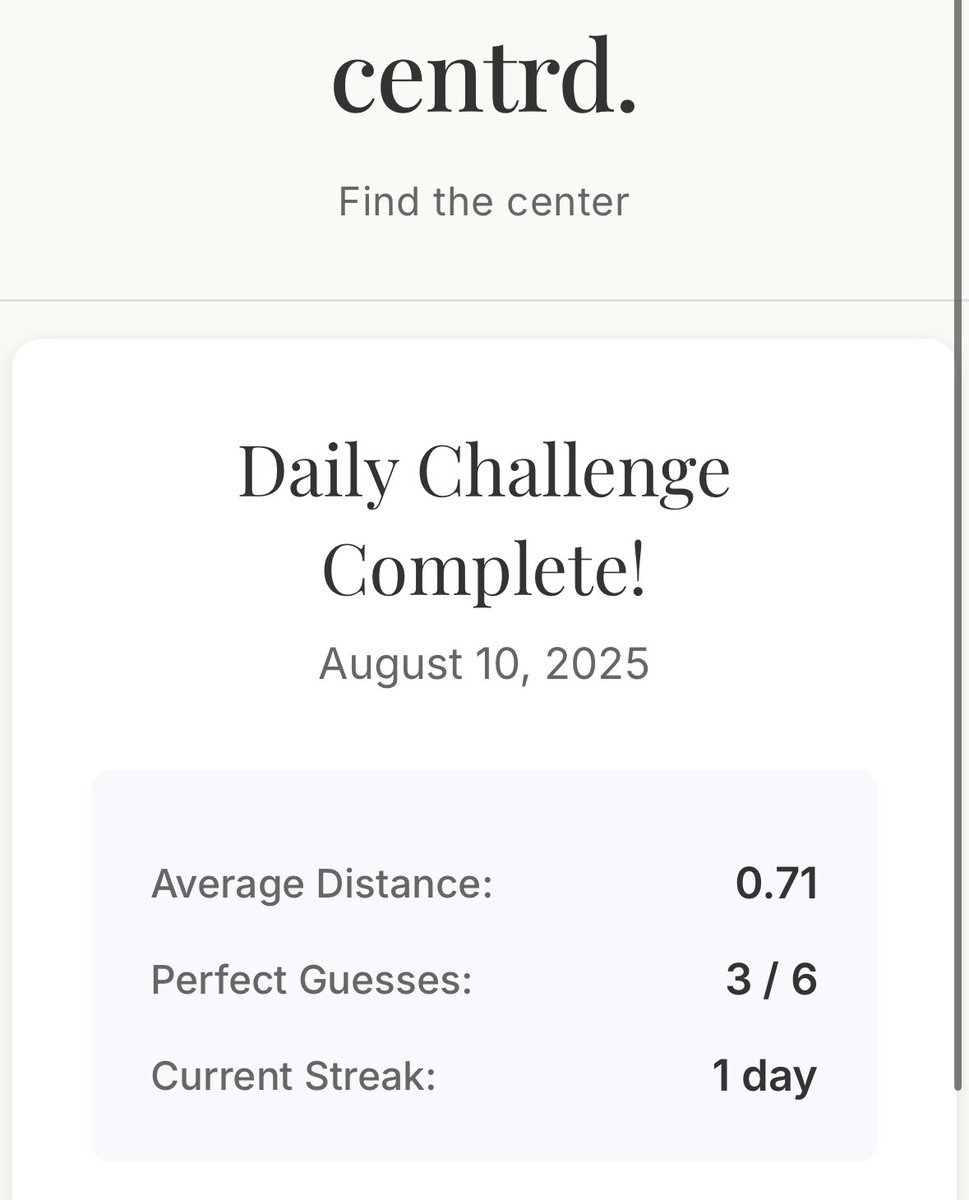
Recently I built Centrd, a daily puzzle game to test your spacial reasoning. The goal is to find the center square of all the dots on a grid. Do you know where the center lies? Or does the center lie to you? Link to play in the replies or in my bio.
Last chopper out of nam getting a big tech job from a low tier school and grinding LC before they switch to only recruiting from top 30 universities and asking you who your dad is like finance does
@ludwigABAP It’s a question of vision/roadmap. Microsoft is rapidly catching up to feature parity but what happens when they catch up?
We saw Microsoft be first to copilot and lack vision on how to make it palatable. As long as cursor stays 10% more creative they can keep my money
1/ We are releasing Playground v2.5, our latest foundation model to create images.
We tested our model across 20K+ users in a rigorous benchmark that went beyond anything we've seen to date.
This model is open weights. More information in the tweets below. 👇
This video was generated by Sora.
That's the new model by OpenAI. The most advanced text-to-video tool created so far.
I'll share the videos here. Absolutely insane.
Prompt: This close-up shot of a Victoria crowned pigeon showcases its striking blue plumage and red chest. Its crest is made of delicate, lacy feathers, while its eye is a striking red color. The bird’s head is tilted slightly to the side, giving the impression of it looking regal and majestic. The background is blurred, drawing attention to the bird’s striking appearance.
Have you ever done a dense grid search over neural network hyperparameters? Like a *really dense* grid search? It looks like this (!!). Blueish colors correspond to hyperparameters for which training converges, redish colors to hyperparameters for which training diverges.
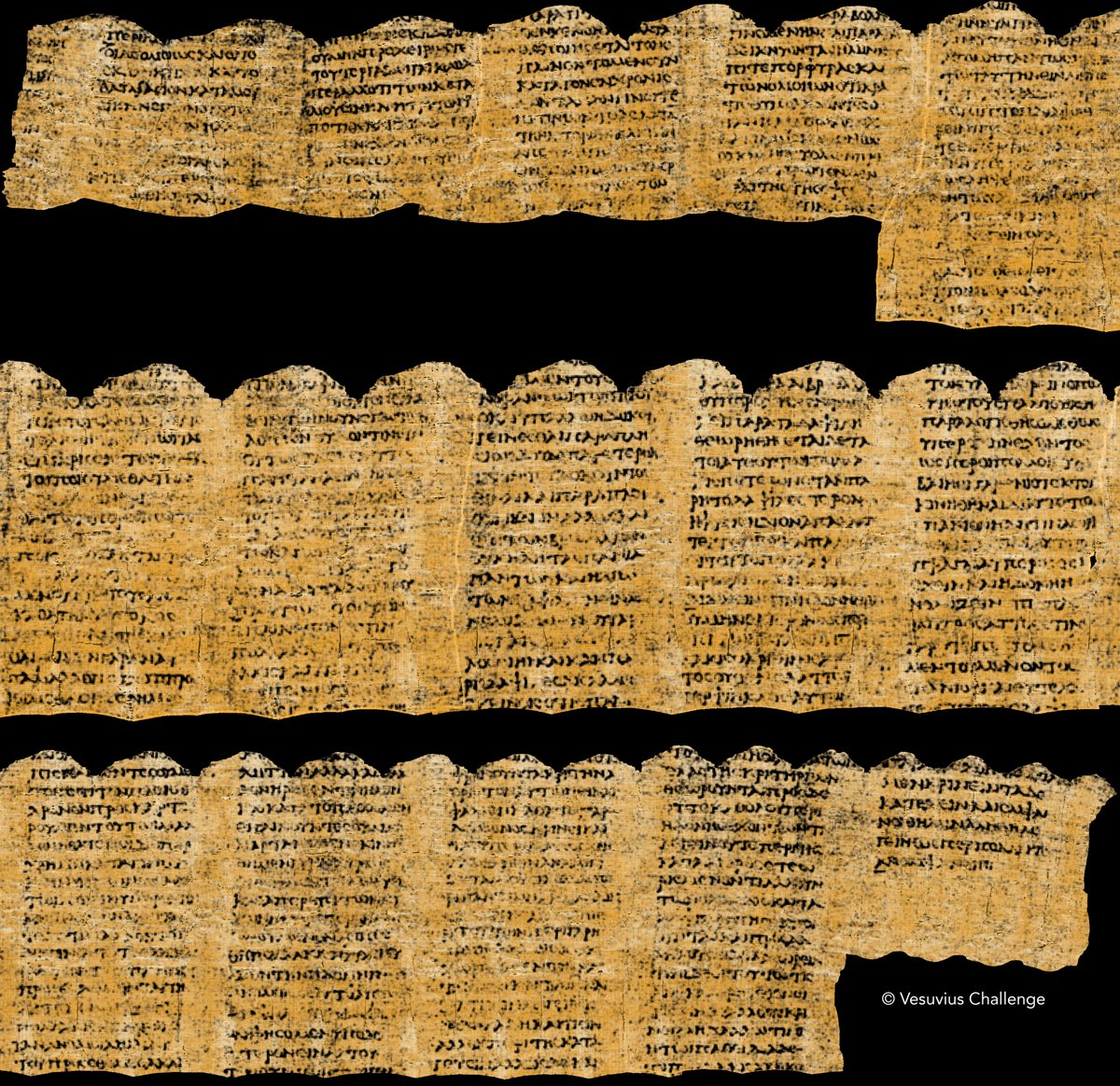
Ten months ago, we launched the Vesuvius Challenge to solve the ancient problem of the Herculaneum Papyri, a library of scrolls that were flash-fried by the eruption of Mount Vesuvius in 79 AD.
Today we are overjoyed to announce that our crazy project has succeeded. After 2000 years, we can finally read the scrolls:
This image was produced by @Youssef_M_Nader, @LukeFarritor, and @JuliSchillij, who have now won the Vesuvius Challenge Grand Prize of $700,000. Congratulations!!
These fifteen columns come from the very end of the first scroll we have been able to read and contain new text from the ancient world that has never been seen before. The author – probably Epicurean philosopher Philodemus – writes here about music, food, and how to enjoy life's pleasures. In the closing section, he throws shade at unnamed ideological adversaries – perhaps the stoics? – who "have nothing to say about pleasure, either in general or in particular."
This year, the Vesuvius Challenge continues. The text that we revealed so far represents just 5% of one scroll.
In 2024, our goal is to from reading a few passages of text to entire scrolls, and we're announcing a new $100,000 grand prize for the first team that is able to read at least 90% of all four scrolls that we have scanned.
The scrolls stored in Naples that remain to be read represent more than 16 megabytes of ancient text. But the villa where the scrolls were found was only partially excavated, and scholars tell us that there may be thousands more scrolls underground. Our hope is that the success of the Vesuvius Challenge catalyzes the excavation of the villa, that the main library is discovered, and that whatever we find there rewrites history and inspires all of us.
It's been a great joy to work on this strange and amazing project. Thanks to Brent Seales for laying the foundation for this work over so many years, thanks to the friends and Twitter users whose donations powered our effort, and thanks to the many contestants whose contributions have made the Vesuvius Challenge successful!
Read more in our announcement: https://t.co/rUlrdGXBMs
We were able to embed all of Wikipedia in < 15 minutes on Modal Labs for ~ 17$.
Here's what this actually means for an organization:
1. Unrestricted Rates: Eliminates the bottleneck of rate limits for large-scale operations.
2. Rapid Experimentation: Allows quick iterations of data chunking experiments, reducing wait times from hours to minutes.
3. Fine-tuning: Use of the same hf infrastructure for model fine-tuning, speeding up experiment cycles, and deployment.
Reducing experiment timelines from hours to approximately to minutes is something that has compounding effects!
take a look! https://t.co/zGdGtXFgsM