Best investment ideas are hidden in your error logs.
Engineers think they’re debugging production issues.
Actually, they’re reading Wall Street research in monospace.
⸻
torch.cuda.OutOfMemoryError: CUDA out of memory → HBM / DRAM → $MU
NCCL WARN NET/IB → AI networking → $NVDA $ANET $AVGO $MRVL
RuntimeError: Socket Timeout → optical / interconnect → $COHR $LITE $CIEN $MRVL
No space left on device → SSD / NAND / storage → $SNDK $WDC $STX $PSTG
nvme nvme0: I/O timeout, aborting → enterprise storage reliability → $SNDK $WDC $STX $PSTG
SW Power Cap : Active → data-center power / cooling → $VRT $ETN $PWR
FailedScheduling ... No preemption victims found → GPU capacity scarcity → $NVDA $AMD $SMCI $CRWV
Your logs knew the AI trade before your portfolio did.
Chatbox is not sticky. Coding agent is sticky.
Memory, logs, repo context, and interaction style compound over time.
That accumulated context is the product.
True fatherly love is giving all your Claude Code quota to your kid to build games, while you go back to last year’s workflow: hand-write coding using VS Code.
Companies using Claude Code:
“Productivity boost, layoffs planned”
Companies not allowed to use Claude Code:
OpenAI: “Hire more people”
xAI: “Rebuild it, it wasn’t built right”
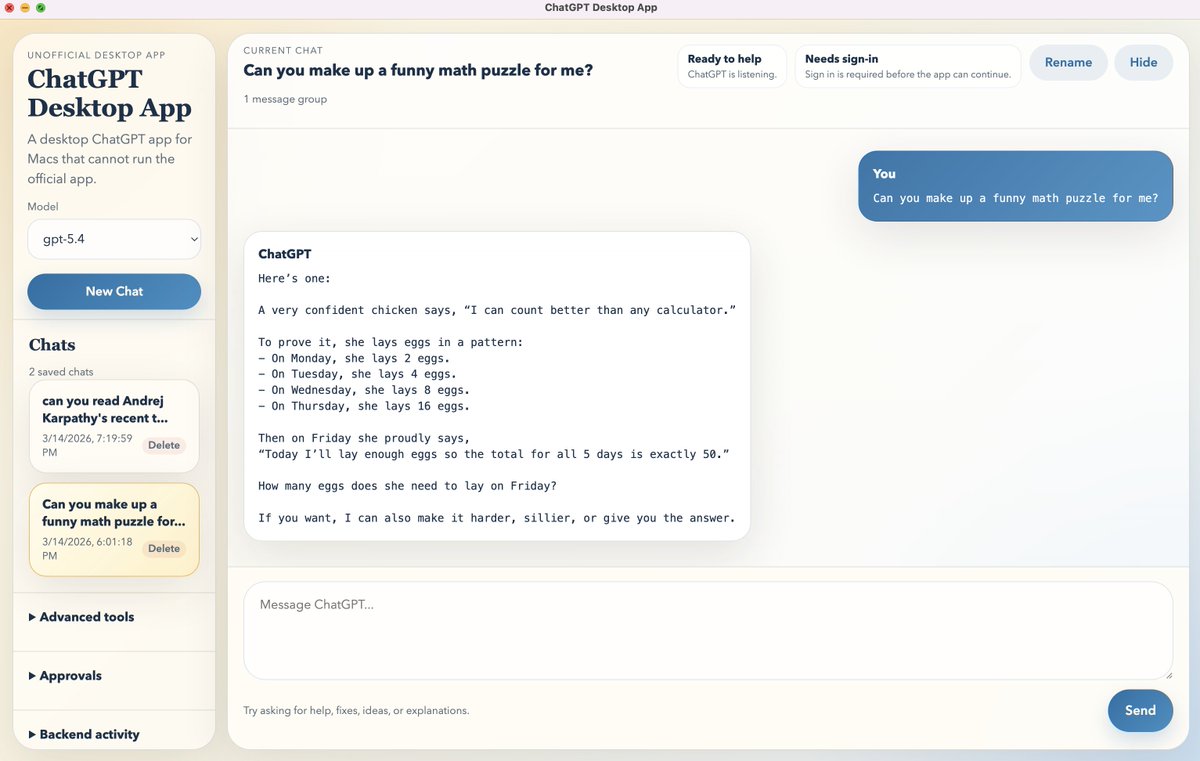
Actually I just built a chatgpt app(using codex and connecting to codex app server) for me and especially for my kid, the only desktop we have at home is 2015 iMac using intel chips, most AI apps does not support it. The best part? I can keep adding new features using codex.
Codex App Server is a very under-mentioned feature:
it runs locally as a server exposing the full Codex agent runtime.
That means you can build any interface on top of it.
The Codex app and CLI are just clients.
I’m building a two-panel Electron app(using codex, and connecting to code app server) for my kid:
Left: chat (or voice) with the computer
Right: realtime HTML game rendering
My kid can literally tell the computer what game he wants, or what feature he wants
and it just works 🎮
AI is the new gradient operator.
The loop isn't new — iterate, test, update. That's been engineering forever.
What's new: AI can finally compute the gradient when you plug it into pretty much *any* system.
Read the failure, understand why, write the fix. That step used to be reserved for human intelligence.
It works when the oracle is clear (compile Linux in @AnthropicAI 's ccc , or optimize a metric in @karpathy 's autoresearch).
The only place it breaks is when the loss is fuzzy.
The human's job now shifts from computing the gradient to defining the loss landscape.
In Q2 2026, Claude Code and Codex both shipped a native “tmux-like” feature.
At first it looked like just another power-user feature.
But by the end of the year, people realized something bigger was happening:
Traditional GUIs were quietly disappearing.
Every window on your computer — browser, IDE, docs, terminal, even video players — stopped being standalone apps.
They became just panes inside a single AI session.
Your operating system faded into a minimal container:
Boot → you enter one long-running AI session Shutdown → you exit that session
No desktop. No app launcher. No file explorer.
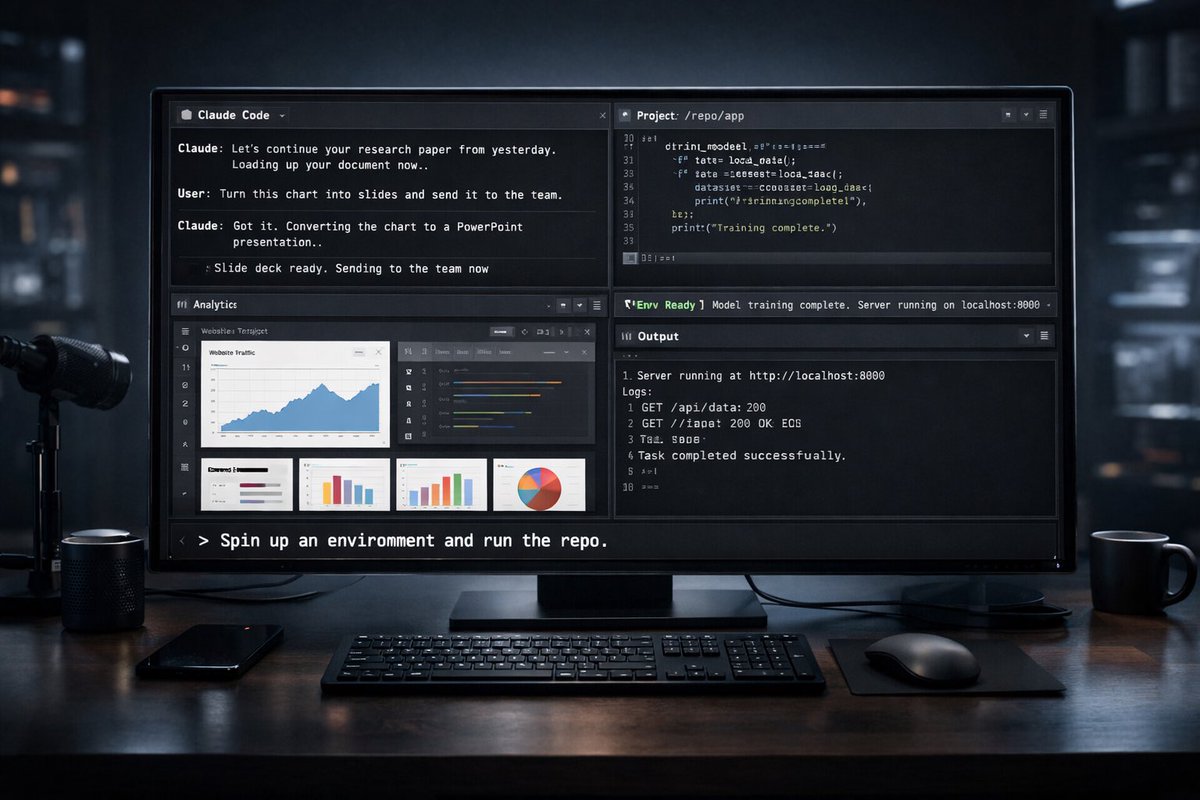
Claude Code is the computer.
It feels like history looping back.
Personal computing seems to be returning to the DOS era — a single “black screen.”
But this time, you don’t need to learn commands.
Because the new command line only speaks one language:
Natural language. Voice. Context.
You don’t “open apps” anymore. You just say:
“Continue the paper I was writing yesterday.” “Turn this chart into slides and send it to the team.” “Spin up an environment and run this repo.”
Everything becomes an operation on a persistent stream of context.