Food for thought.
Iran Is Not Winning. It Is Unraveling.
The prevailing narrative on Iran has it almost perfectly reversed. We are told that Tehran is winning a war of wills in the Gulf and that Donald Trump is gambling recklessly with the world’s most sensitive chokepoint. In reality, Iran is not consolidating strength; it is managing decline. And Trump’s play on the Strait of Hormuz has quietly forced energy markets to reprice security—tilting the balance decisively toward the Americas, and away from Europe, Asia and China.
The Islamic Republic no longer resembles a confident revolutionary project.
With the old clerical core leadership shattered, power has splintered between a camp that recognises a deal with the outside world as the only path to survival and the Islamic Revolutionary Guard Corps, a class of military dictators with guns, patronage networks and a rational fear that any genuine settlement will ultimately throw them overboard. This is not a unified strategy at work; it’s infighting, paranoia, a fragmented system in late-stage decay, crumbling under pressure.
Into this fragmentation, the White House has introduced a form of calibrated coercion too often caricatured as impulsive.
Around the Strait of Hormuz, Washington has threatened disruption without fully triggering it, forcing shipowners, insurers and policymakers to absorb a hard truth: dependence on vulnerable, seaborne Middle Eastern barrels is not a passing inconvenience but a structural risk. Iran can harass tankers and jolt day-to-day sentiment; it cannot rebuild a broken economy on sporadic shocks to global shipping. And the world must deal with the end of Pax Americana!
The underlying playbook is anything but novel. Sun Tzu’s insistence that “all warfare is based on deception”, Machiavelli’s counsel that a ruler must manipulate appearances and exploit factionalism, and Alfred Thayer Mahan’s argument that sea power and control of chokepoints shape the fate of nations are not museum pieces. They are, in this case, the operating code. Trump’s opaque signalling, deliberate use of disinformation and visible but limited naval posture in and around Hormuz amount to a modern, Mahanian use of sea power as economic statecraft.
Energy markets are already adjusting. Tankers are head to the Gulf of America. In a world where a single strait can a risk to economies is Europe and Asia, without ever being fully closed, assets tied to secure basins and diversified export routes deserve a premium.
The Americas sit in an enviable position: vast, politically stable hydrocarbon resources, multiple pipelines and ports, and no dependence on a distant maritime chokepoint controlled by adversaries. By contrast, Europe, much of Asia and China find themselves downstream of vulnerabilities they do not control and regimes they cannot stabilise, exposed to shipping routes that can be threatened faster than alternative supply can be mobilised.
All of this plays out against a domestic backdrop in Iran that looks less like revolutionary vigour and more like fear. A state that cannot safely keep its internet on, that must rely on public brutality to deter dissent, is not projecting confidence. It is signalling weakness, to its own citizens as much as to its rivals.
Winston Churchill once remarked that “in war, resolution; in defeat, defiance; in victory, magnanimity; in peace, goodwill.” Iran’s leadership offers only defiance, without realistic prospects of victory or peace.
The uncomfortable conclusion for those still insisting that Tehran is “winning” is that what they are observing is not the rise of a regional hegemon, but the protracted, strategically exploited unwinding of a brittle regime at the centre of an overexposed energy system.
The most remarkable pattern is showing up in our high frequency freight data for the first time since we launched in 2018.
The center of the country: the rust belt and and the industrial heartland is no longer just recipients of freight (imports) but actual producers of freight thanks to the surge in American manufacturing.
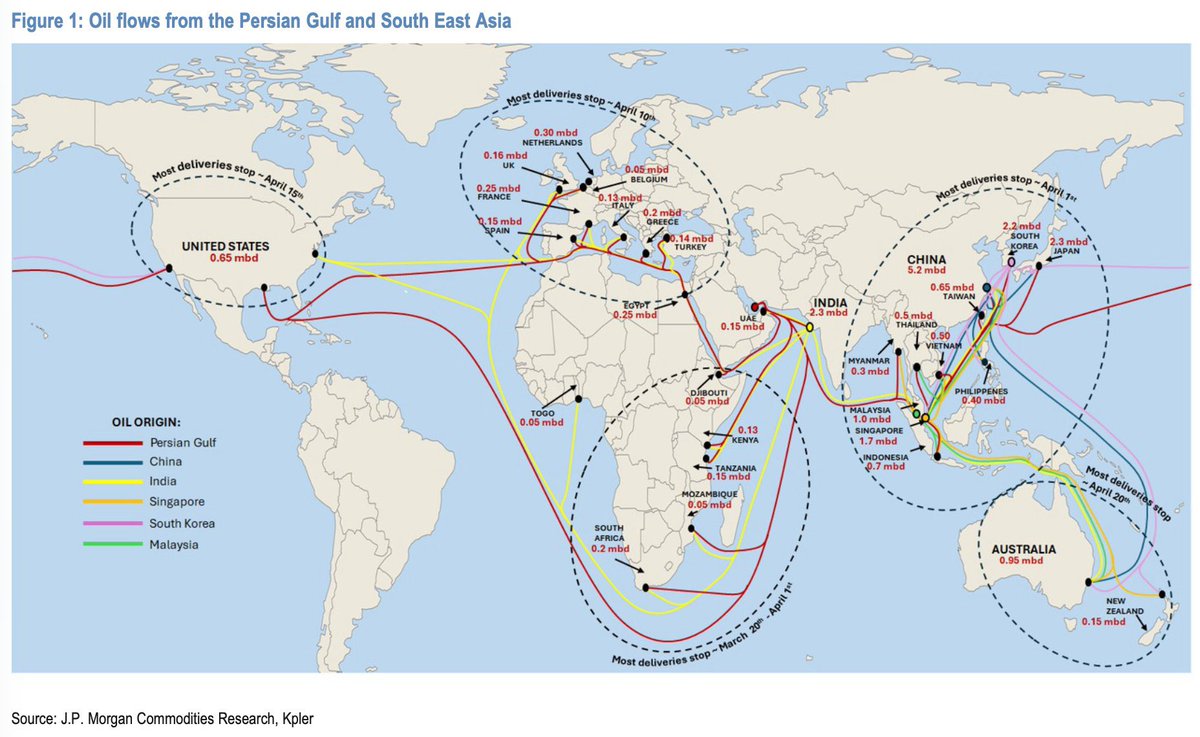
I’ve been describing the supply loss from the closure of the Strait of Hormuz as an “air pocket” moving through the normal flow of oil out of the Gulf
Helpful map from JPM highlighting when that air pocket will “land” in different major consuming regions:
- East Africa last week
- East Asia this week
- Europe next week
- North America two more weeks
Things men slowly learn as they grow older:
- No woman loves you for who you are, she only loves for what you can do for her
-Nobody is coming to save you
-Discipline beats motivation
-Money solves many problems
-Silence is better than arguing
- Nobody cares until you are rich or dead.
-Respect is earned, not begged for
- No woman is ever yours
- You can do everything right and still lose.
- Your colleagues are not your friends
- Your father is the only man who wants you to be better than him
@joseph_st_onge Everything is relative
I'll also just add the headline "Software" exposure presented in public filings is likely not a full representation of the exposure.. some can be hiding in different end market industry classifications
The public BDCs are loaded with software and AI data center exposure.. In contrast to the below, I think investors will likely continue to short public BDC stocks if liquidity dries up and redemption requests go unanswered.
I'm still scratching my head a bit at how the fintwit narrative is Private Credit is all going to zero but somehow Private Equity problems aren't getting mentioned at all.