The most important SpaceX detail nobody is talking about: the lockup is staggered.
There is no single 180-day cliff. Insiders get to sell in tiers, starting MUCH earlier than a standard IPO.
Here’s exactly when insiders can start selling:
After Q2 2026 earnings (around August 11): Up to 20% unlocks. Another 10% on top if SPCX trades 30%+ above the $135 IPO price (so $175.50+) for 5 of the prior 10 sessions.
Five time-based tranches at 70, 90, 105, 120, and 135 days post-IPO. Each releases 7% of eligible shares.
After Q3 2026 earnings (late October to early November): Another 28% unlocks.
180 days post-IPO (around December 9): Everything else unlocks.
Elon and certain major investors get a longer 366-day lockup. They stay locked until around June 2027.
Some context on the size:
The IPO sold around 555.6M shares, representing roughly 4.2% of total shares outstanding. The other 95.8% was locked pre-IPO. The staggered pool (employees and early backers) is where the early releases happen.
The structure is smart. It spreads selling pressure instead of concentrating it on one day.
Still, watch August earnings closely. That is the first real wave of potential selling, up to 30% of eligible shares. After that it drips steadily through fall.
Float is tiny right now, so volatility cuts both ways.
Not financial advice. This is the lockup mechanics from the S-1 and reporting.
People dramatically underestimate how often large drawdowns occur in high-volatility assets.
I ran a Monte Carlo on an asset with 40% CAGR, and 70% vol.
The chance of a 50% drawdown every two years is 71%.
Over 4 years, 93%.
A human brain uses 12-20 watts for core thinking while an AI system doing the same processing could use 2.7 billion watts.
This makes organic brains roughly 100–225 million times more energy-efficient than current silicon-based systems for full biological neural computation.
@GaryCardone@JamesWynnReal Hey Gary, I suggest you study the s-curve theory. This is something that you would expect to see over the last 4 years if that is playing out.
Since the $126k bitcoin top, this is now the third time the STH supply ratio has hit the 95% loss threshold.
Just nasty stuff - similar to the 2022 pain cycles on this metric.
Hope, then back to more pain.
The $BTC bottoming process continues.
We are in the final phase of the bear market.
I believe $BTC is bottoming.
75% of my net worth is positioned in BTC spot.
If we get one last flush, the remaining 25% gets deployed.
I am extremely bullish on the HTF.
Jordi Visser says we will have a crash. He also says trying to call the exact top is ego, not strategy.
He frames AI not as a bubble but a $90 trillion global infrastructure buildout over the next decade.
The S&P 500 sits at all-time highs, but 97% of long returns come from AI-related sectors: semiconductors, hardware, power. Everything else is stagnant. This is not a broad market rally. It is a narrow infrastructure buildout rally masquerading as one.
His approach is, ride the momentum until 20-day and 50-day moving averages signal to reduce exposure, then rotate into scarcity assets that benefit from the buildout regardless.
The real alpha is not in the obvious AI winners. It is in the supply chain bottlenecks that are not yet priced for half of what is coming. Data centers, copper, silver, companies like Fujikura and Modine Manufacturing. The physical world cannot keep pace with AI demand.
The energy constraint is getting worse. Exxon and Chevron both said oil could hit $160. Goldman Sachs published capacity schedules showing summer peak load already past 135 gigawatts.
As of this morning, Iran has ended negotiations and vowed complete Hormuz closure, making that $160 scenario considerably more likely.
This connects to what @JohnTinsman laid out for us, compute leasing is a 3-4x ROI business. XAI built Colossus for $3-4 billion and leases it for $15 billion a year. Tinsman said demand is "insatiable" and we are not meeting half of it.
@jvisserlabs and Tinsman are arriving at the same conclusion from different directions. The AI buildout is real, the physical constraints are the binding variable, and Bitcoin benefits as the scarcity asset in an inflationary buildout.
On Bitcoin specifically, despite the AI boom, BTC has been range-bound. Visser remains long-term bullish, viewing Bitcoin as one of three moats that survived the test of time: gold, religion, Bitcoin.
His "Bitcoin IPO" thesis is that the massive distribution from early holders to ETF buyers is done. The next breakout will not stop because the seller base is exhausted.
Rough week for the "AI is taking our jobs" narrative.
> Amazon just axed its AI leaderboard as costs soared with no clear payoff
> Starbucks' AI can't even count coffee cups right
> Uber burning a $3.4B AI budget in just 4 months with nothing to show for it
WE ARE SO BACK.
Trump could have presided over a very strong economy. All he had to do was...nothing: Inflation was trending downward, the AI boom was raising growth.
Instead, he engineered a global trade war and energy shock, while shrinking America's labor force. https://t.co/JvvlsQ83R8
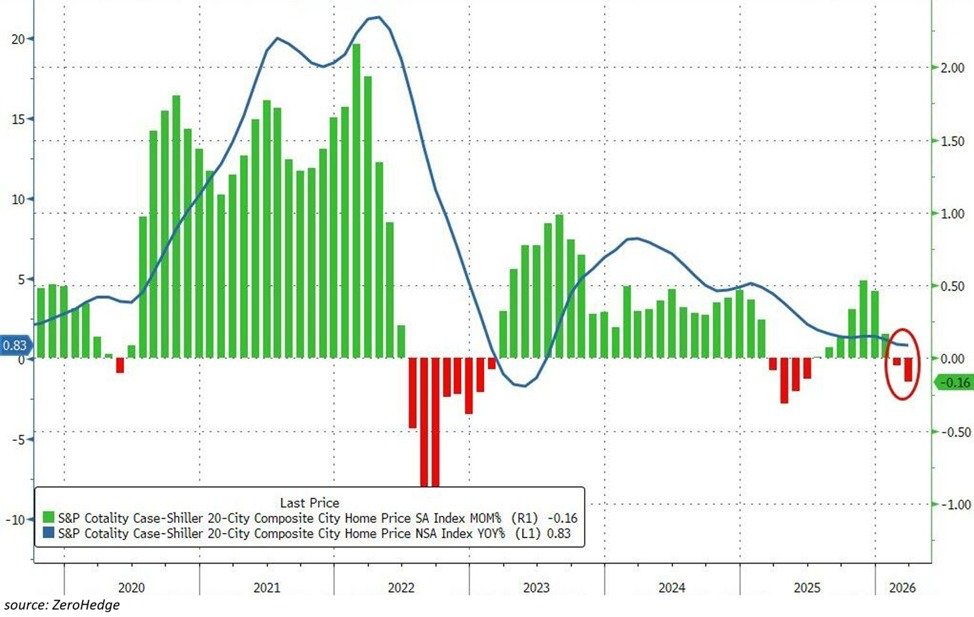
BREAKING: Home prices across America's 20 largest cities fell -0.16% MoM in March, the 2nd-consecutive monthly decline after 6-straight monthly increases.
YoY, prices rose +0.83%, the weakest annual gain since July 2023.
This comes as over half of the 20 major US housing markets posted YoY price decreases.
Seattle posted the steepest decline at -2.5%, followed by Denver at -2.0%, Tampa at -1.9%, Dallas at -1.7%, and Los Angeles and Phoenix at -1.6%.
Meanwhile, the spread between the strongest and weakest markets stands at 8.6 percentage points, highlighting how uneven the housing slowdown has become.
In real terms, home prices fell for their 10th consecutive month, as inflation continued to outpace nominal price gains.
The US housing market is cooling.
Once you hit about a 20-point IQ gap, communication starts to completely break down.
It's not that the lower IQ person is "stupid" (although that can often be the case) or the higher one is arrogant, it's that you're literally operating on different systems.
A 20 point difference (roughly 1.3 standard deviations) means:
Vocabulary and abstraction levels diverge sharply. What feels like crystal clear logic to one side sounds like vague, pretentious word salad to the other. Jokes land flat. Metaphors get taken literally. Complex cause and effect chains get simplified into "this good, that bad."
Different time horizons and pattern recognition. One person thinks in months or years and sees systems, the other is locked into days or immediate rewards. Trying to explain second order effects feels like speaking another language.
Also, processing speed and working memory gaps. The higher IQ person is already three steps ahead, getting impatient. The lower IQ person feels talked down to or overwhelmed.
Both walk away frustrated.
Both have wasted each others time.