1/n I am excited to share my very first preprint as a part of my PhD project with @fabferrage that explores the important role of disordered protein regions in DNA double-strand break repair by the non-homologous end joining. 🧬 #DNARepair#NHEJ
Multivalent interactions of the disordered regions of XLF and XRCC4 foster robust cellular NHEJ and drive the formation of ligation-boosting condensates in vitro https://t.co/jQbpcW1HKn #bioRxiv
@HannesStaerk I don’t think avidity (1→2) alone can explain a 250x affinity drop. We have reverse cases where flipping the target gives stronger binding because the binder dimerizes on the tip.
@HannesStaerk I mean CSF1 also tends to dimerize. If you immobilize CSF1 on the tip, you significantly increase local concentration, so all CSF1 forms dimers (PDB 1HMC) and creates steric hindrance that may exclude binding.
Today we're launching Latent-Y: the world's first autonomous agent for drug design, lab-validated end to end.
Give it a research goal. Latent-Y reasons, designs, iterates, and delivers lab-ready antibodies, autonomously or collaboratively, with the biological reasoning of a PhD protein design expert.
Technical report: https://t.co/E7IHfkvvD3
Blog post: https://t.co/GfJAfzj0Qx
Apply for access: https://t.co/E0SR9znZiP
Now that everyone is an expert on curing pancreatic cancer in mice, not rats - I want to add some context that goes beyond the headline.
You will want to read this.
Cancer is cured in mice all the time.
Thousands of times. ~90% of those “cures” fail in humans.
Why?
Because mice are:
Genetically simpler.
Treated earlier.
Short-lived.
Not humans.
Mice are a filter - not a finish line.
Yes, this study matters. It comes from the Spanish National Cancer Research Centre.
Yes, it’s pancreatic cancer - one of the deadliest there is. Yes, full tumor regression is impressive.
But here’s what it actually means:
“This approach is now good enough to risk years, trials, and millions of euros on.”
Not:
“Cancer is solved.”
What happens next?
More animal work.
Toxicology.
Phase I (safety).
Phase II (maybe works).
Phase III (beats standard care?).
Maybe 8-10 years if everything goes right.
The real damage isn’t failed drugs.
It’s failed expectations.
Every “cured cancer in mice” headline trains the public to believe:
Cures are being hidden.
Progress should be fast.
Scientists are lying when reality hits.
That’s how trust erodes.
Bottom line:
This is how real cancer progress looks.
Messy. Slow. Risky. Incremental.
Not miracles.
Not conspiracies.
Just science - doing the hard work.
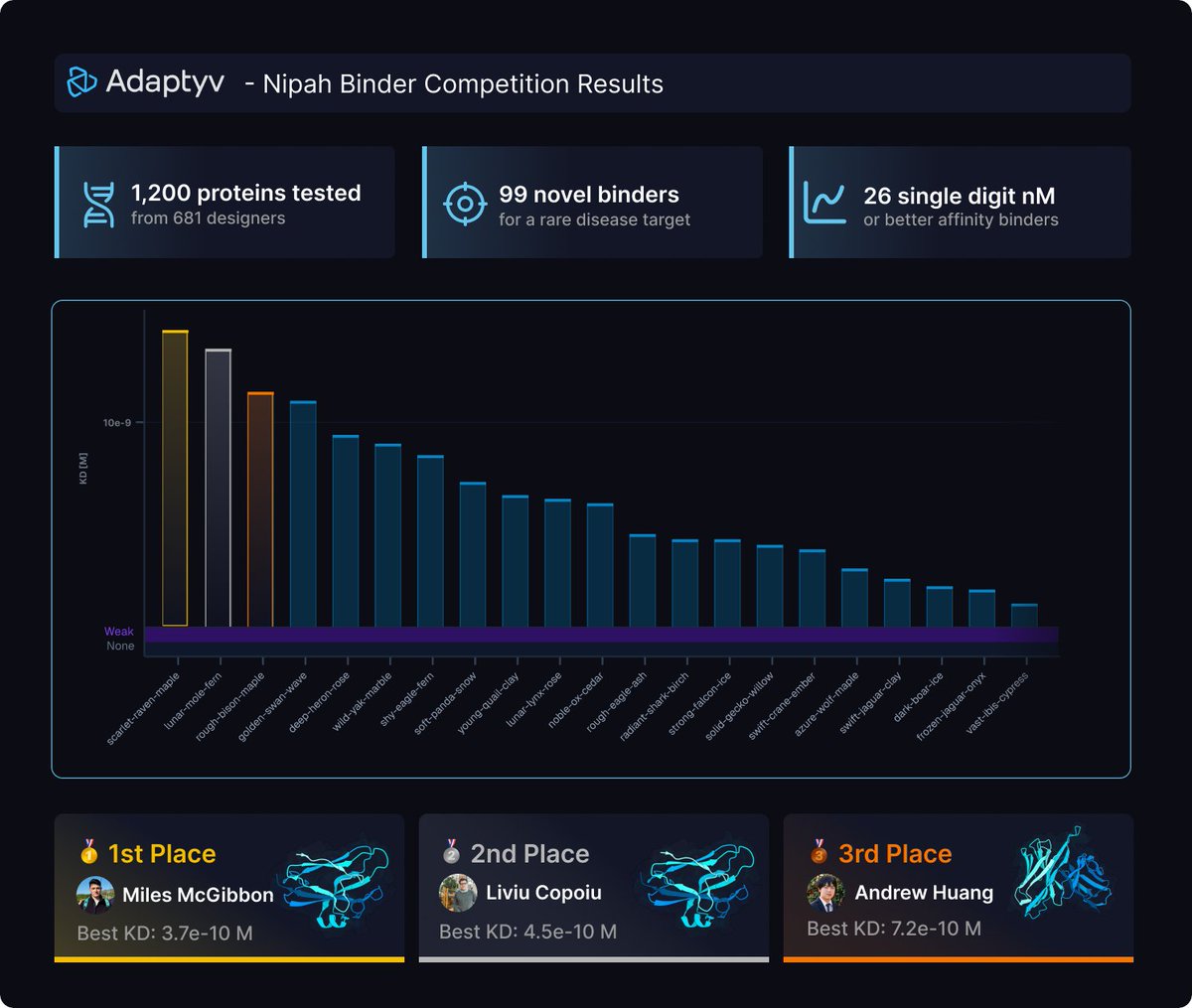
The results of the Nipah Protein Design Competition are out!
🧬 1200 proteins experimentally validated (3x more than last year)
📈 99 novel binders against the target protein (a challenging tetramer with little prior work)
💪 26 single digit nM or better binders, with the best ones at single-digit picomolar affinity!
All data now available open-source on Proteinbase!
Let's take a look at the results ⬇️
[04] In terms of the pipeline, I used a four-stage AF2 hallucination design implemented in Bindcraft and then filtered it with Botlz2 to select the top 20 using ipSAE. The top 10 is selected by manually checking to remove bad binders based on my "structural biologist intuition.
[03]
✅ Distinct mode of action – Can be combined with other antibodies to build a more powerful therapeutic cocktail.
✅ Rational design advantage – Fewer disordered loops, leading to higher success rates.
[01]
Unlike other participants, I chose to target the cryptic pocket of the Nipah G protein. Why I chose this epitope:
✅ Functionally validated – Antibodies targeting this pocket show potent viral neutralization.
@hnguyentt@BolikCoulon This makes me think that assays like NMR, which can provide information about the binding epitope, can be very beneficial in this case.
@hnguyentt@BolikCoulon This competition also highlighted the limited generalization of machine learning models for different classes of molecules, which I believe is due to the massive scale of the chemical space.
@hnguyentt@BolikCoulon It was a very eye-opening journey. The discussions and shared notebooks from the participants were very informative and taught me a lot about different techniques for encoding small molecules and optimizing various machine-learning models.
@hnguyentt@BolikCoulon Our team finished in 121st position (out of 1,946 participating teams) with a bronze medal. Our model was based on 1D CNN combined with Xgboost classification and data augmentation by bioisostere replacement.
@hnguyentt@BolikCoulon The goal is to develop a machine-learning model to predict DNA-encoded compounds interacting with 3 targets. The main challenge is to predict the molecules with different scaffolds/ building blocks from the training sets, thus testing the ability to generalize the model.
The main project of my PhD is finally out. This has been more than four years in the making, with enormous obstacles from beginning to end. However, I have learned a lot along the way.