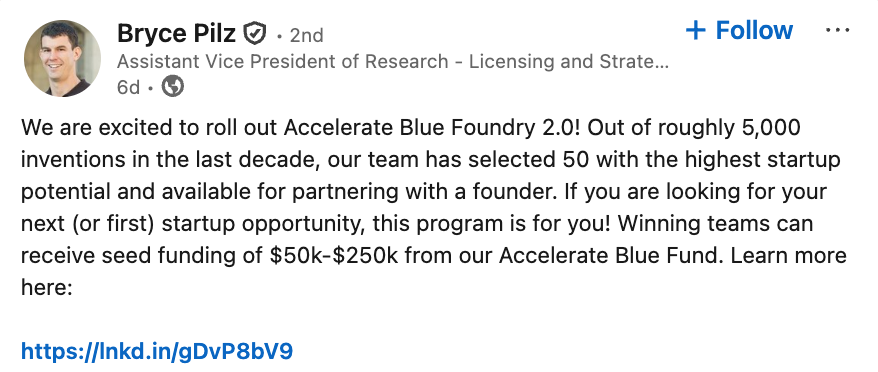
The University of Michigan chose 50 inventions from its catalog for its new startup accelerator. That leaves 4,950 misfits on the sidelines, with no owner, no way forward, and no one asking what else could be done with them.
That’s what my four-part series is about
University innovation systems can produce companies, but struggle to develop a product without building a startup around it.
Part 2 of my Orphaned Innovations series about how the startup became the only option, why it persists, + what it costs.
https://t.co/48TtL5WmWV
A whole category of innovations coming out of universities have no path forward. First of four posts on why these get orphaned, and what a different model might look like.
https://t.co/m53CqgJDXg
@aakashgupta also interesting that I'm having multiple, simultaneous health-related conversations with AIs (eg, diet choices, medical issues, health goals, exercise/workouts) and it is able to cross-reference + fully integrate those more readily than individual purpose-specific apps
I wonder whether anyone's tried to make a terrestrial radio station powered entirely by AI? (ie, using a combo of tools to write dialogue, research local events / news, speak text, create music, and stitch it altogether and control broadcast)?
Including Kivo Health, Zeph Technologies, Kaia Health, FlexTogether, BreatheSuite and Morlen Health (Kaiser Permanente spinout), all profiled in this overview
https://t.co/AAYzEq8Qy7
For as long as I can remember pulmonary rehab has been a marvel of supply constraint. A safe + effective intervention for COPD that we make available only to a handful. Even if you don’t hear much about it, thankfully there’s been a strong, recent surge in virtual PR programs
@auren I’m meeting a lot of academic founders (ie scientists and clinicians turned entrepreneurs) now trying to get new companies off the ground. Many are compelling! Would love to connect them to you and Flex
Too late now, but dang this was a massive study of Propeller Health in COPD. 164 primary care centers, 835 patients, enrolled for a year, yielding 23 percent reduction in treatment failure