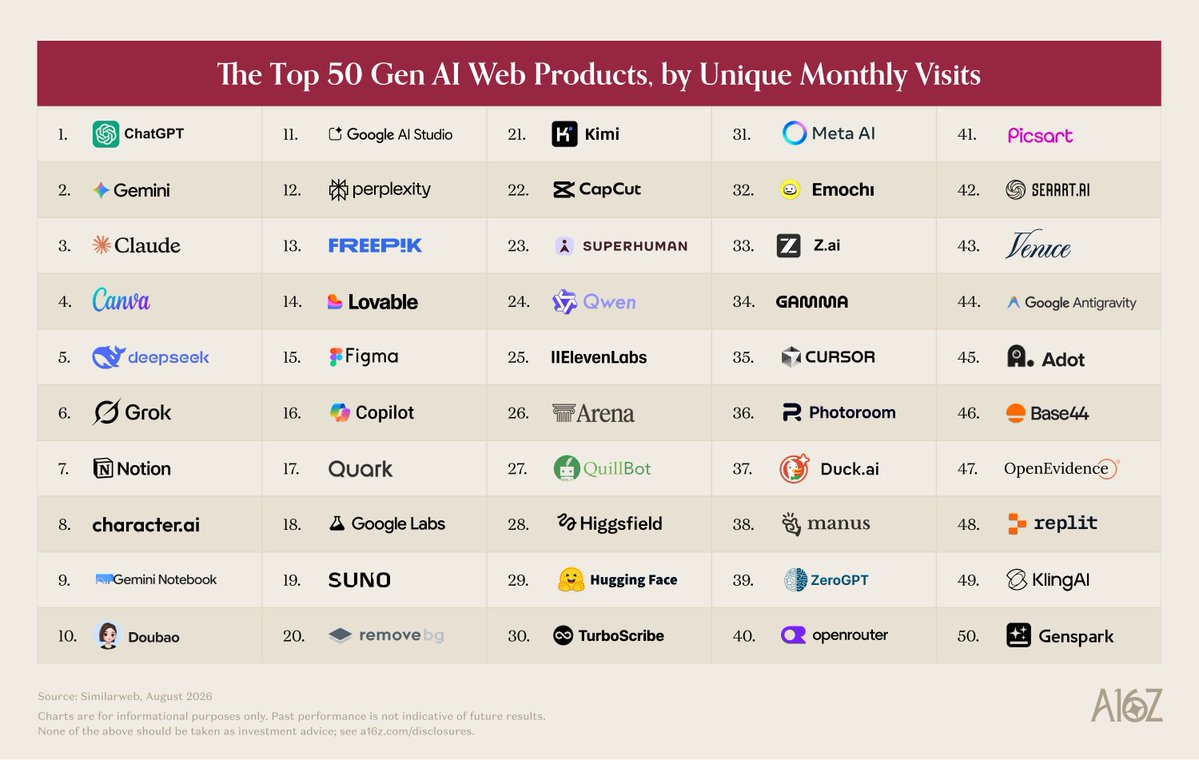
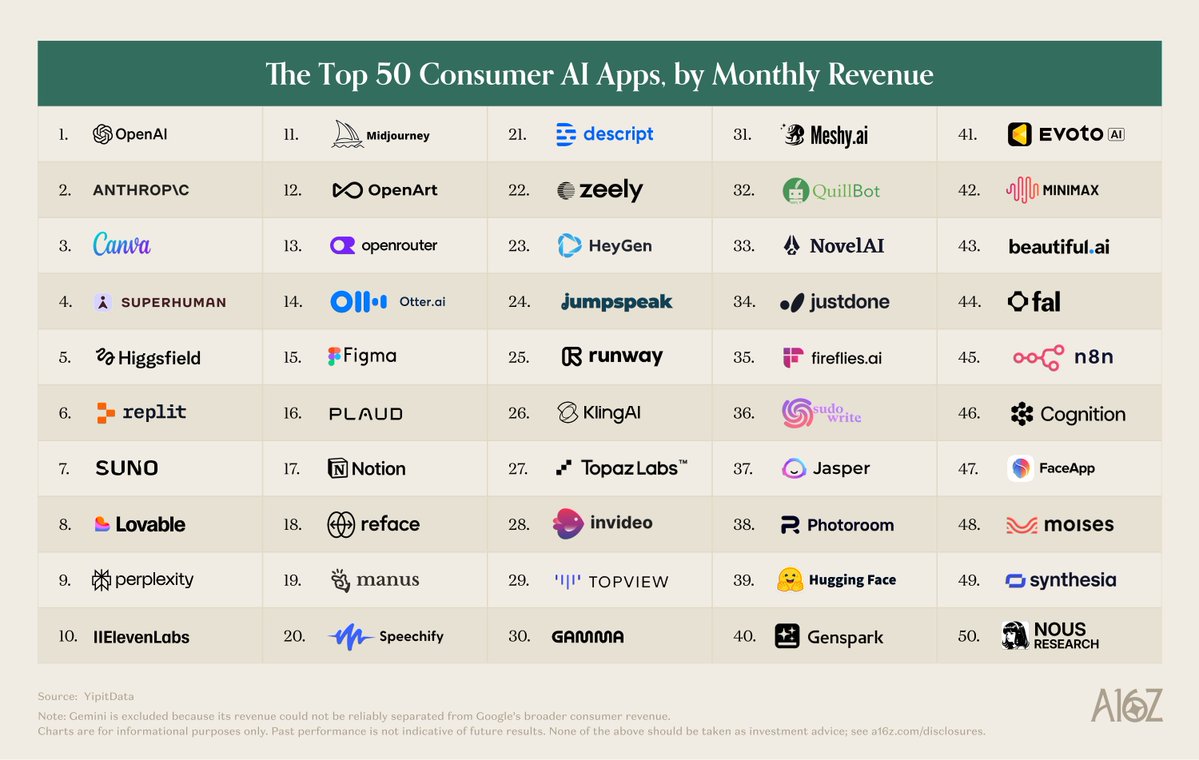
🚨 The @a16z Consumer AI Top 100 is back - but this time, it's 150!
We added revenue data from @yipitdata to track how consumers are spending not just time, but money, on AI.
The result? A story of heavy concentration among AI's power users. Our takeaways 👇
@ZexyAmbassador@clownworld No, but it's common sense that burning fuel indoors is negative for health. Just like second hand smoke.
The oil industry, with trillions of dollars at stake, has not produced any evidence to discredit this.
I don't support banning nat gas btw. Market-distorting
overreach👎
@ZexyAmbassador@clownworld I dug into the studies behind the childhood asthma figures I shared.
It comes from 41 individual peer-reviewed studies, with 400 - 14,000 children per study, across multiple continents, and controls for factors like parental smoking, maternal health, socioeconomics and more.
@ZexyAmbassador@clownworld I agree the effects can be greatly reduced with a vented range hood, open windows, and advanced air purifiers.
But I care about outcomes, not theory.
And people aren't doing the above. Otherwise kids with gas stoves wouldn't be 24% more likely to develop lifelong asthma.
@ZexyAmbassador@clownworld Fair, I haven't dug into the underlying studies.
But the mechanism is simple - inhaling burned shit isn't good for our lungs. So I'd need to see evidence to the contrary to change my view.
But you do you. Health is personal.
@ZexyAmbassador@clownworld Children with gas stoves at home are 42% more likely to report asthma symptoms and 24% more likely to develop lifetime asthma.
They also release the following known carcinogens:
- Formaldehyde
- Benzene (especially when off)
- PAHs
- PM2.5
Study: https://t.co/d2rjYPqDFe
@energysmartwv Could run local Google ads for HVAC issues and send the traffic to a killer landing page with a lead magnet. Then sell those leads to a forward-thinking contractor or two.
Only one way to find out if a well-designed landing page can overcome the disadvantages!
@J9NUARY@hankgreen After 1 year the EV comes out ahead of an equivalent ICE car.
The exact # depends on usage and grid mix but even a pure coal grid (which exists nowhere) only takes 5 years, much less than the vehicle’s lifespan. Pure renewables grid = 6 months.
@RandBuilds@kylejahner@moseskagan@HistoryBoomer True. But global warming is not yet under control and the US could do more. Implementing a “carbon fee and dividend” is the free-market way to do more.
@RandBuilds@kylejahner@moseskagan@HistoryBoomer Annual carbon emissions are still rising globally! They are declining in wealthy regions with the highest per capita emissions like the USA and Europe, but the global peak has not been found. We have a long way to go.
@alexisxrivas@kylejahner@moseskagan@HistoryBoomer The negative externality is highly subsidized in many cases!
I.e., Massive tax subsidies for oil extraction, bonus depreciation of private jets, and the especially favorable tax treatment of pickup trucks used for business purposes… the list goes on.
@kylejahner@moseskagan@HistoryBoomer Tax carbon to internalize the negative externality of contributing to global warming.
Then redistribute it equally to every US citizen to make it revenue-neutral.
@kleinflask@rjonesy@awilkinson Bingo. And solving the 0.1% edge cases is what allows cars to become fully driverless, which creates massive value.
Digital LIDAR is changing the game.
@SMB_Invest@rjonesy@awilkinson But isn’t car safety and removing the need for a human driver worth a lot?
Digital LIDAR’s price and size is falling every year thanks to profitable use cases in agriculture, factory and warehouse automation, drones etc. See $OUST
@Stuart_Adams@antonia_mdprjct No. Government needs to make it easier to develop dense housing. Fewer zoning and building regs from overlapping agencies that only add rules, never subtract.