L’ultima grande regina a trazione posteriore capace di imporsi nel Mondiale Rally contro l’avanzata delle integrali. Motore centrale, compressore volumetrico, telaio leggero e una guida spettacolare, fisica, quasi brutale.
Sulla neve diventava pura arte meccanica: bianca, Martini, cattiva. Una delle Lancia più leggendarie di sempre.
Hay que tener una pelotas de acero para conducir un un Alfa Romeo Cabriolet a 160 km/h-180 km/h en la sopraelevata de Monza sin usar una sola protección
Es por esto que tanto schumi como Senna consideraron a Fangio como el mejor piloto F1 de la historia
The Planck length ✍️
It is the smallest distance that has any real meaning in our universe. It is incredibly small, about 1.6 × 10⁻³⁵ meters. If you compared it to the size of a proton, the proton would be massively larger by a factor of 10²⁰, which is 100 billion billion times bigger. Scientists found it by combining three basic constants of nature: the strength of gravity, the speed of light, and the scale of quantum effects. At distances smaller than this, our usual concepts of smooth space and time break down. Space itself may become "foamy" or grainy. We need a new theory of quantum gravity to understand what happens at this level. In simple terms, the Planck length is like nature's smallest pixel or building block for distance. Everything we see and experience in daily life is trillions upon trillions of times larger than this fundamental limit.
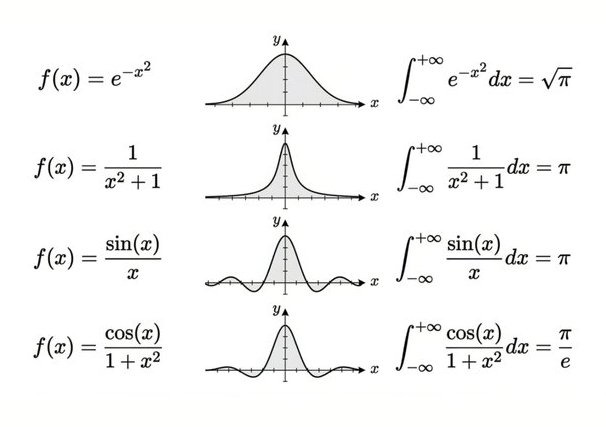
Some of the most beautiful improper integrals in mathematics
From the Gaussian bell curve to the Lorentzian, sinc function, and damped cosine; each integrates over ℝ to a clean, elegant constant:
∫ e^{-x²} dx = √π
∫ 1/(x²+1) dx = π
∫ sin(x)/x dx = π
∫ cos(x)/(1+x²) dx = π/e
Which one is your favorite?
After the Challenger exploded just 73 seconds after launch on January 28, 1986 (killing all seven astronauts), President Reagan appointed a commission to investigate. Feynman, then 67 and battling cancer, was reluctantly added as a member.
During a televised hearing, Feynman cut through the bureaucracy with a simple, brilliant experiment. He took a piece of the O-ring material, clamped it to simulate the joint, and dropped it into a glass of ice water (about 32°F / 0°C, matching launch conditions). After a moment, he pulled it out, released the clamp — and the rubber stayed compressed. It didn't bounce back.
He held it up to the cameras and said calmly:
"I discovered that when you put some pressure on it for a while and then undo it, it doesn't stretch back. It stays the same dimension. In other words, there is no resilience in this particular material when it is at a temperature of 32 degrees."
This live demo instantly made the problem crystal clear to the world: cold weather had likely caused the O-ring failure, allowing hot gas to leak and destroy the shuttle. It bypassed layers of denial and public relations spin. Feynman later wrote in his appendix to the report: "For a successful technology, reality must take precedence over public relations, for nature cannot be fooled."
A tribute to Muñoz and a yellow computer 🚴
Tadej Pogačar wore a black armband at Liège-Bastogne-Liège in memory of Cristian Camilo Muñoz and also used a yellow bike computer like the one he used at last year's Tour de France.
📸 Getty Images
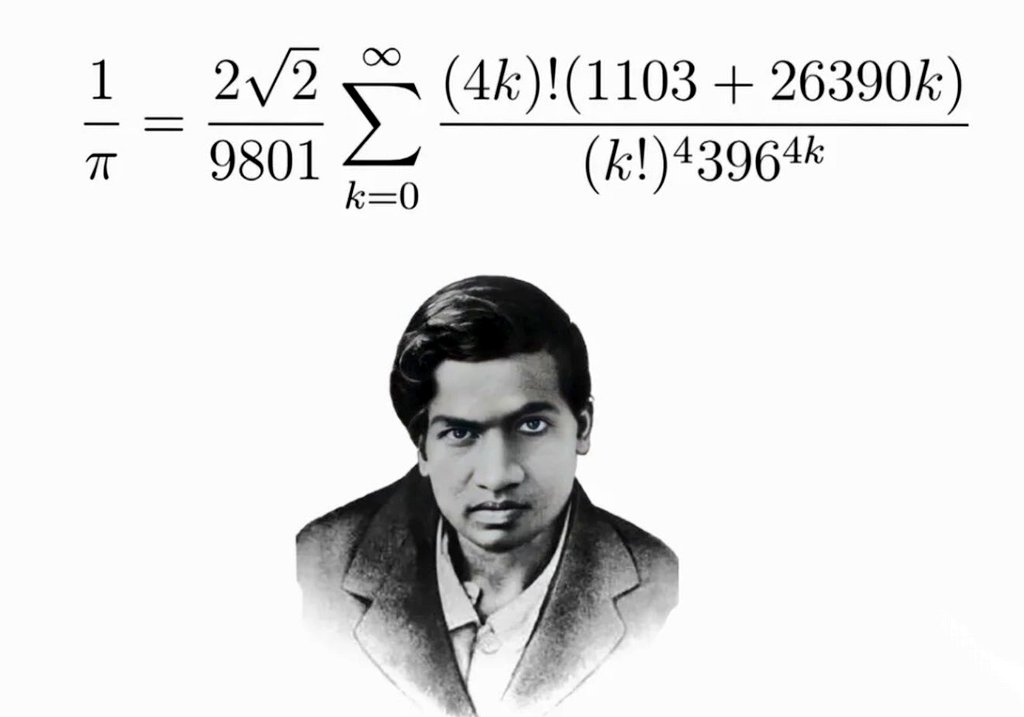
Today is the 106th death anniversary of the genius Srinivasa Ramanujan.
Ramanujan discovered nearly 4,000 theorems and equations—remarkable, original, and far ahead of their time.
Many of his results were so advanced that mathematicians could not prove them until decades after his passing.
He also showed deep insight into ideas that later became important in modern mathematics and physics, including concepts related to fractals, modular forms, string theory, and black hole cosmology.
max(∣x∣,∣y∣,∣z∣,∣w∣)=1
You’re witnessing a 2D projection of a 3D shadow cast by a 4D tesseract.
As it rotates through the W-axis, the "inner" and "outer" cubes swap roles: a spatial inversion that feels like a glitch only because our biology is trapped in 3-space.
It’s a hauntingly beautiful reminder that our "reality" is often just a lower-dimensional cross-section of a much more complex structure. Perspective is everything.
This is used in high-dimensional data visualization, hypercube topologies in parallel computing networks, and exploring the geometry of extra dimensions in theoretical physics.
Dirac, a founder of quantum mechanics and Nobel laureate, believed the laws of nature are not arbitrary. They are rooted in elegant, precise mathematics.
He saw math as the language of the cosmos, suggesting a deep cosmic order.
In his 1963 essay The Evolution of the Physicist’s Picture of Nature, he noted that abstract, “interesting” mathematics often becomes the exact framework nature follows.
He also valued beauty in equations:
“It is more important to have beauty in one’s equations than to have them fit experiment.”
Can you tell which equation is considered the most beautiful in all of mathematics?
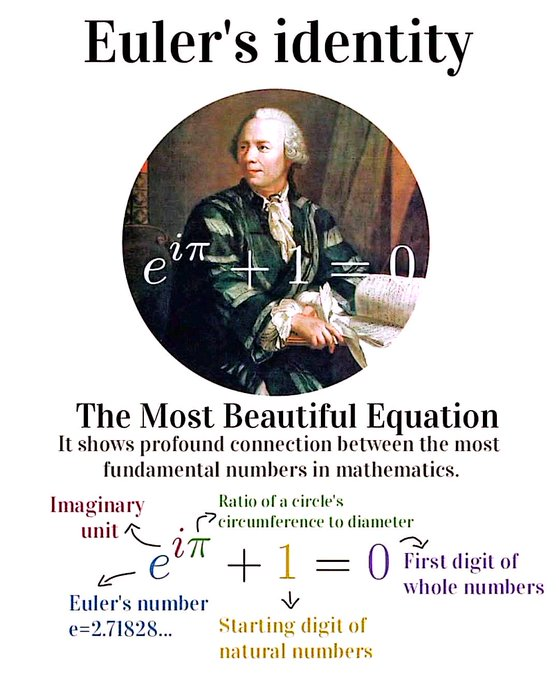
It includes e, a positive number whose value is approximately 2.7. It is raised to the power of π (pi), which is also a positive number, and multiplied by the imaginary number i, whose value is √−1. Each of these numbers is unique and fundamental in mathematics. When they come together in this elegant combination, the result is −1.
This equation is called Euler’s Identity.
And just to clarify the pronunciation—it's “Euler,” not “Yooler.” It’s named after the mathematician Leonhard Euler, so we pronounce it the way his name was originally spoken.
Now, what’s really happening here is that whenever we take e raised to the power of i times x, it can be expressed in another form:
e^(ix) = cos(x) + i·sin(x)
This is known as Euler’s formula, and it beautifully connects exponential functions with trigonometry.
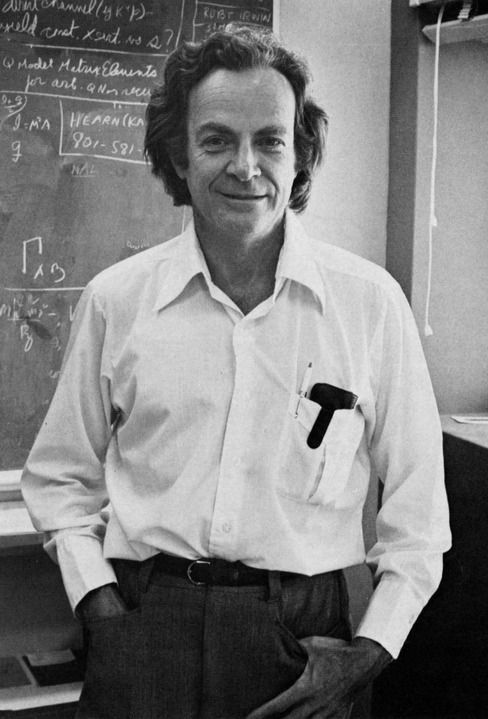
Did you know that one of the greatest physicists in history, Richard Feynman, once said he couldn’t clearly explain his own Nobel Prize–winning work to his grandmother?
Feynman realized something surprising: many experts, including himself, often hide behind complicated words.
These words can make ideas sound impressive, but they sometimes cover up a lack of deep understanding.
So, he created a simple but powerful test.
If you cannot explain an idea in plain, simple language—like you are talking to a 10-year-old—then you don’t truly understand it.
His method was brutally simple:
First, study a concept.
Then, try to explain it in the simplest words possible.
When you get stuck or confused, that’s the exact point where your understanding is weak. Go back, learn that part again, and simplify it further.
Feynman used this approach even for difficult topics like quantum mechanics. He would explain complex ideas using everyday examples, like spinning plates or rubber bands, to make them easier to imagine.
Despite winning the Nobel Prize, he continued teaching basic physics. He believed that going back to the fundamentals kept his thinking clear and sharp.
Feynman understood an important truth: curiosity matters more than titles or degrees. Complexity often hides confusion, while true wisdom shows up as clarity.
The smartest people keep a beginner’s mindset. They are not afraid to say, “I don’t know,” and start again.
Real mastery is not about sounding intelligent.
It is about understanding something so deeply that you can explain it simply.
The moment you think you are too advanced to explain the basics is the moment you stop truly learning.