🔥 Spectacular footage of a strike drone flying against the backdrop of a burning Moscow as it pushes through air defenses to deliver another hit on the Moscow Oil Refinery.
Barack and I were so honored to have @AkunyiliCrosby create our portrait for the Obama Presidential Center. Her artistic brilliance shines through — and the way she infused such life and joy into the piece is truly extraordinary. We love it, and we think everyone who visits the Center will too!
🤯Questlove says when Blue Ivy was born, he gifted Jay & Bey an iPod filled with all the musical greats to play in her nursery so she’d become a musical genius. But he had to make a 2nd one because Jay & Bey took the 1st one for themselves 🤣❤️
This is one of the beauties of the World Cup.
Japan's PR once skyrocketed because their fans stayed back to clean the stadium after a match.
This mexican is returning Bafana Bafana Tshirt after learning the xenophobic culture of South Africans. 👏👏
On a Monday morning in March 2023, Amara Nwosu woke up to discover she had bought a house.
She had not bought a house.
She had never signed any document.
She had never met the seller.
But somewhere in the Lagos land registry, her BVN, her NIN, her signature — perfect, precise, indistinguishable from the one she had used her entire adult life — had authorised the purchase of a property worth ₦47 million.
And the loan taken to buy it was in her name.
Amara was 34.
A data analyst at a telecoms firm in Victoria Island.
She was the kind of person who used different passwords for different accounts, who read privacy policies, who had set up two-factor authentication on everything she owned before most Nigerians knew what two-factor authentication meant.
She was, professionally and personally, a woman who understood how data worked.
Which is why, when she saw the loan alert on her phone at 6:47am, her blood went cold in a specific way.
Not panic.
Recognition.
Someone had been inside her life.
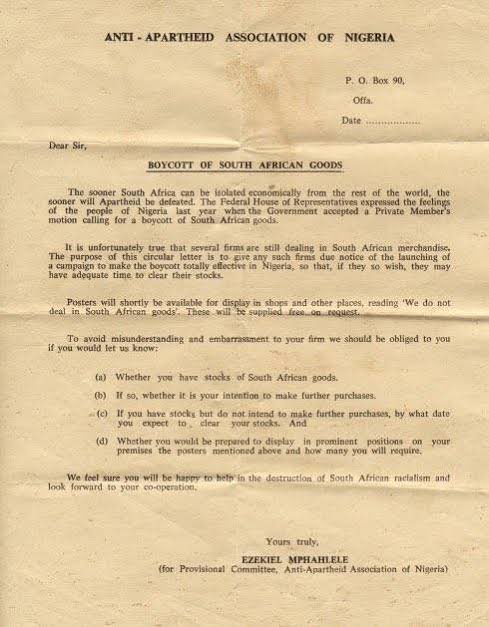
Southern Africa Relief Fund: SARF.
This was Nigeria’s way of funding the fight against apartheid.
In 1976, after the Soweto Uprising, Nigeria set up SARF to send money and relief materials to freedom fighters and civilians suffering under white minority rule in South Africa, Namibia, Zimbabwe, Angola, etc.
The “Mandela Tax”: Every Nigerian civil servant and public officer had to donate a % of their monthly salary.
Everyone from clerks to ministers paid it.
That small deduction from millions of workers built up to serious cash and food, clothes, medical supplies.
The goal was to keep ANC, SWAPO, ZANU, MPLA and other liberation movements alive while they were banned and exiled.
Nigeria basically said “we’ll carry the financial burden so you can carry the guns/protest”.
It was one of Africa’s biggest anti-apartheid contributions. Nigeria was broke from civil war, but still taxed itself to fund freedom 4,000km away.
A Russian fighter pulled off the most confusing flying squirrel takedown on a French opponent and nobody in the building could explain it, the French guy was completely lost
To everyone so eager to cancel someone for a tattoo they got at age 22, a drunk text, a selfie they took in the middle of a mental health crisis:
Show us your laptop.
Show us your iCloud.
Open your entire digital life to your worst enemy. No context. No filter. No explanation.
You won’t.
You won’t because you know what I know. Any one of us, frozen at our worst moment, photographed in our lowest hour, looks like a monster. Looks like a stranger. Looks like someone who deserves to be cast out.
That is not who we are.
My mom and baby sister were killed in a car accident when I was just a kid. Cancer took my brother Beau, my best friend and my rock. I battled alcoholism. I battled addiction. I chose the coward’s way out more times than I can count.
For years I believed the defining chapters of my life were written by tragedy, loss, and shame.
I no longer believe that.
Pain can shape us. Loss can humble us. Failures can leave scars that never fully fade. But none of them have the authority to define us.
And it sure as hell ain’t the critic that counts.
That authority belongs to us alone-the person in the arena.
Every setback presents a choice. Play the victim, or cut the bullshit and take ownership for who we become next.
Life does not determine our character. It reveals it.
Again and again we are asked the same question. When shit happens, what next?
We are not defined by what happened to us. We are not defined by the worst photo, the worst text, the worst tattoo, the worst night. We are defined by the person we choose to become. And by the courage to choose that person, every single day.
So before you reach for the gavel - show us your laptop.
You won’t.
The whole world saw mine. And I am still here. Still becoming. Still choosing. Still standing.
That is the only definition that matters.
A toothpaste company has quietly killed the entire market research industry and nobody is talking about it.
Colgate published a paper showing you can predict real purchase intent at 90% accuracy by simply asking LLMs to roleplay customers.
And this is beyond insane.
If you ask an AI, "Rate this product from 1 to 5," it gives safe, middle-of-the-road garbage.
So researchers invented a method called Semantic Similarity Rating (SSR).
Instead of asking the AI for a number, they asked it to roleplay.
They gave the LLM a demographic profile. They showed it a product concept. And they asked it to write down its raw, unfiltered thoughts.
Then, they used a semantic model to translate those written thoughts into a numerical score.
The results are staggering.
Tested against 57 real corporate surveys and 9,300 actual human responses, the synthetic AI consumers matched real human buying behavior with 90% reliability.
They perfectly mirrored how different age brackets and income levels react to price changes.
And they provided detailed, qualitative feedback that was deeper and more critical than what actual humans wrote.
This destroys the economics of traditional market research.
You don't need to wait a month to see if a product will sell.
You can simulate 1,000 hyper-targeted customer interviews overnight.
You can A/B test pricing across every demographic instantly.
What June 12 Should Mean to Us Nigerians
Today, we observe a day that should mean a great deal to us as a people who cherish democratic principles. Every year on June 12, the conversation inevitably turns to a critical assessment of the state of our nation. It serves as an annual benchmark for asking important questions: Are our elections today as transparent as they were in 1993? Is the social contract being honoured? Are the institutions of governance truly serving the people?
Ultimately, June 12 is a powerful blend of reflection and aspiration. It honours a fractured past while serving as a constant and foundational reminder of the immense power inherent in the collective democratic will of the Nigerian people.
For us in Nigeria, June 12 is not merely a date on the calendar; it is the emotional and structural bedrock of our modern democratic identity. Officially recognised as Democracy Day, June 12 carries deep historical, political, and social significance, representing both a monumental tragedy and the ultimate triumph of the collective will of the people.
To understand what June 12 means to Nigeria, one must examine its history, its evolution, and its enduring symbolism.
A new era of true democracy is POssible. -PO
On June 9, 1944, the French Resistance captured a senior SS officer named Helmut Kämpfe near Limoges. The next morning, his unit, the 2nd SS Panzer Division Das Reich, was looking for a response. They had already hanged 99 men from the balconies of Tulle the day before, chosen at random from townspeople, leaving them to strangle slowly in front of their families because they couldn't find enough rope for a proper drop.
Now they needed something more.
On June 10, Sturmbannführer Adolf Diekmann led his men to Oradour-sur-Glane. Some historians believe he confused it with Oradour-sur-Vayres, a different village where the Resistance was actually active. Others believe he knew exactly where he was. Either way, at 2pm his soldiers blocked every road in and out of the village.
They told everyone to gather in the marketplace for a routine identity check. People complied. A dentist came. A farmer left his fields. Schoolchildren were told by their teachers not to worry, they'd be back by dinner. A man cycling through town stopped to see what was happening.
By 2:30pm, around 650 people were standing in the square.
Then the soldiers separated the men.
The women and children were marched to the church. The 190 men were divided into six groups and taken to barns across the village. The mayor, Dr. Paul Desourteaux, reportedly tried to negotiate. There was nothing to negotiate.
In the barns, the soldiers opened fire but aimed deliberately at legs. At thighs. At knees. The goal was not to kill but to incapacitate. To ensure that when they piled straw over the bodies and lit it, nobody could crawl away. Men who were on fire and still conscious screamed while soldiers stood outside the doors.
Six men survived by playing dead beneath other bodies. One died from his burns days later. Five lived.
In the church, the women had been waiting almost two hours with the children. Soldiers carried in a large wooden box and placed it in the nave. They lit a fuse and left. The explosion released a thick, suffocating smoke. Soldiers then entered and opened fire on anyone still moving. Then they piled wood, straw, and chairs onto the bodies and lit everything.
The church bell rang for hours as the fire climbed the tower.
Women broke windows. Those who reached the ledge were shot before they could jump. One woman, 47-year-old Marguerite Rouffanche, crawled behind the altar, found a small window, and squeezed through. She dropped three meters to the ground. A 19-year-old named Henriette Joyeux saw her and followed, throwing her seven-month-old baby out first. Soldiers shot the baby out of the air. Then shot Henriette. Then shot Marguerite five times as she ran.
Marguerite survived by lying still beneath pea plants in a garden while the village burned around her. She lay there until the next morning. She was the only person to leave the church alive.
The youngest confirmed victim was seven days old.
After the killings, the soldiers spent the afternoon looting every building. Food, valuables, livestock, wine. Some burned homes with elderly residents still inside. Then they ate dinner. That evening. In the area.
The next morning, relatives from surrounding villages arrived looking for their families. They found 642 dead and a village of smoking ruins.
The aftermath is almost as horrifying as the massacre itself.
At the 1953 war crimes tribunal, 65 men were indicted. Only 20 could be found. Fourteen were Alsatians, French citizens, and Alsace threatened to riot if its sons were convicted. An amnesty law was quietly passed. Almost everyone walked free within a year.
Nobody spent meaningful time in prison for Oradour-sur-Glane.
By French law, nothing in the original village may be moved, repaired, or altered. The rusted cars sit in the street where they burned. The sewing machines are fused to the shop floors. The baby carriages are still there. The church stands open to the sky with a plaque listing the names of the children killed inside.
You can walk through it today.
82 years ago this morning, those 642 people had no idea. The dentist was thinking about his afternoon appointments. The teachers were relieved the children were behaving. The man on the bicycle was annoyed about the delay.
By 6pm they were all dead, and the soldiers who killed them were eating dinner.
Never forget Oradour-sur-Glane.
Dear Nigerians,
There is nothing wrong with President Tinubu.
And although an overwhelming majority are wont to censure his administration, he is a paragon of the Nigeria project - a hulking monstrous wreckage in equal parts oppressive and repelling.
The project demands specialists and master craftsmen in apocalyptic wreck making. (Think mining. Think dynamite. Think blasting).
If you don’t like Tinubu, change the project