The biggest stock market winners tend to share the same 7 characteristics before their biggest moves:
C - Current quarterly earnings up 25%+
A - Annual earnings growing 25%+
N - New product, new service, new highs
S - Supply & demand: tight float, big volume
L - Leader in a leading group
I - Institutions accumulating
M - Market in a confirmed uptrend
That's it. That's CANSLIM.
Most people obsess over the first 6 letters and ignore M.
But 3 out of 4 stocks follow the market. Get M wrong and the rest don't matter.
One of the biggest mistakes new investors and traders make:
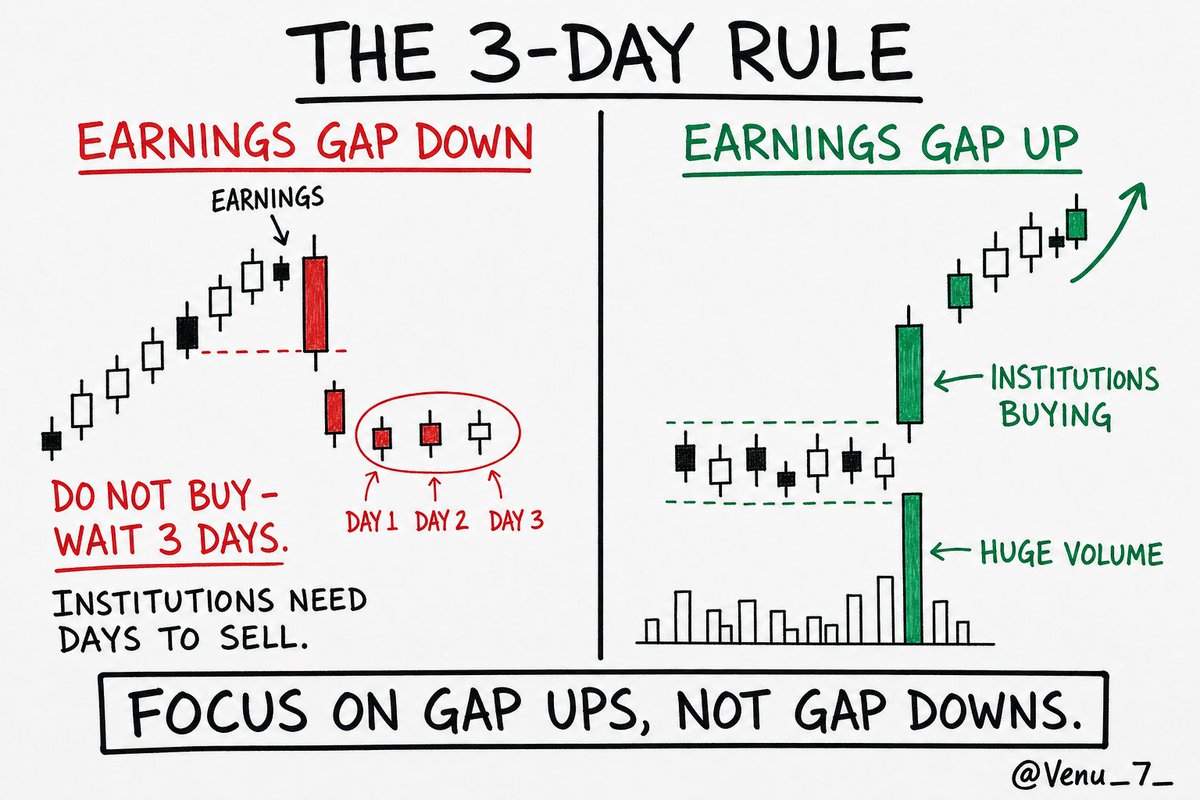
Buying a stock that gaps down after earnings.
It looks like a discount. It's usually a trap. To avoid falling into that trap, follow one simple rule:
The 3-Day Rule.
When a stock gaps down on earnings, wait at least 3 trading days before even thinking about buying.
Why?
Institutions holding millions of shares can't exit in one day. The gap down isn't the end of their selling - it's the beginning.
- Day 1: Bounce = dip buyers + short covering, not real demand.
- Days 2-3: You'll see whether the selling pressure actually dries up.
- After Day 3: The stock will tell you if it's stabilizing or still bleeding.
You're trading with evidence, not hope.
And remember:
Our focus should always be on earnings gap ups, not gap downs.
A gap up on heavy volume usually signals institutional buying like $PLTR - and their buying often takes days or even weeks to complete. That's the fuel behind many of the market's biggest winners.
Gap down = big money leaving.
Gap up = big money arriving.
Own what they're accumulating. Don't try to catch what they're distributing.
The Rule of 40 - The Quality Test for Software Businesses
One formula: Revenue Growth % + FCF Margin %
Above 40% = high-quality software business.
Why it works: It rewards companies that can grow profitably, not just grow at any cost. The formula doesn't care how you get there - only that the combination of growth and profitability is strong.
Simple example:
• Revenue growth: 28%
• FCF margin: 15%
• Rule of 40 = 28 + 15 = 43% -> pass
Now look at $PLTR's Q2:
• Revenue growth: +93% YoY
• FCF margin: 62%
• Rule of 40 = 155%
That's not passing the test. That's lapping it - nearly 4x the bar.
Most software companies fight to stay above 40. The rare ones compound growth AND cash generation at the same time. That's what the formula is built to find.
Why is $VPG my favorite robotics ticker?
Simple... EVERY humanoid robot needs precision force sensing. It needs to know how hard it's gripping a cup... how much weight it's carrying... how much torque its joints are producing... how its balance is shifting when it walks.
That is the fundamental layer that makes a humanoid actually functional in the REAL world.
Vishay Precision $VPG makes exactly that. Strain gauges. Load cells. Precision resistors. Force sensors. Motion measurement systems. The kind of components that get engineered into every humanoid platform being built right now.
Q1 2026 was the inflection quarter. Revenue hit $84.4M, up 17.6% year over year and above the $77M consensus. Bookings surged to $102.1M, the third highest quarterly level in company history. Book-to-bill came in at 1.21 with the Sensors segment hitting 1.36. Q2 guidance is $85M to $90M, well above the $79M Street expectation.
They're now actively engaged with FOUR different humanoid developers in various stages of design and qualification. Each of those relationships represents multi-year revenue potential once those platforms scale into commercial production.
The math on scaling matters. If humanoid production goes from thousands of units to millions of units over the next 5 years, and each humanoid uses dozens of precision sensors, the addressable market for a qualified supplier like $VPG expands by orders of magnitude.
Disclosure... we have $VPG positions.
We will buy/hold/sell/trade, as we see fit.
Not financial advice; do your own research.
Very few pure play humanoid supplier names exist in the public market right now...
$VPG is one of the cleanest IMO.
And BTW, gap filled. Bounce time?
Very interesting statement today: $MU CEO predicts a multi-decade memory demand cycle driven by humanoid robots.
"Humanoid robots, he says, will require roughly ten times more memory than today’s Level 2+ autonomous vehicles."
"And that demand wave is set to begin before the decade is out."
Something as well as was "Over time, we expect the value of on-device AI combined with pent-up unit replacement demand to drive memory demand growth"
Which is also another trend (Apple Intelligence is currently dog, but I'm sure we'll see innovations with localized/edge AI).
Feels like all the industry leaders from $TSM Chairman, $TSLA Elon Musk, to $MU CEO see humanoids as the next major trend so physical AI is probably next.
I wonder if the world is going to have enough memory. Or if we'll see enough breakthroughs to shrink memory usage.
Humanoids will need a lot more memory:
Which will drive the next leg for memory suppliers like $MU / $SNDK / SK hynix.
From Micron's CEO earnings transcript:
"Humanoid robots carry 10 times the amount of memory as an average L2+ vehicle."
"We expect a sustained, substantial, multi-decade memory demand cycle to begin in the latter part of this decade."
Things can change very quickly on a couple fronts though:
1. Will Micron etc. have enough capacity to meet demand from the humanoid ramp up?
2. Will there be some kind of innovation in humanoids that drives less overall memory usage?
Right now, Micron are expanding capacity to supply volumes to their 16 long-term agreements. Which represent ~20% of DRAM volumes & ~33% of NAND volumes.
So there'll potentially be some overlap between those LTAs and the upcoming humanoid ramp.
Regardless, it all paints a picture that memory demand will remain high even if hyperscalers like $GOOGL / $AMZN etc slow down capex one day.
In 1 year, $AMKR spiked from $18 to $90 so 500% but it can easily hit $300-$500.
Here's 8 reasons why it hasn't ran like $AVGO $AMD $NVDA $MRVL $GOOG $AMZN:
1. Advanced packaging sits directly on the critical path of AI infrastructure growth and is becoming more important as Moore's Law slows.
2. Management expects revenue to grow from $6.7B in 2025 to approximately $11B+ by 2030.
3. EPS is projected to increase from $1.50 to roughly $5.00+, implying more than 3x earnings growth.
4. AI servers, GPUs, ASICs, HBM memory, and chiplets all require increasingly complex packaging solutions.
5. $AMKR has 18 active 2.5D engagements and multiple HDFO programs already entering production.
6. The Arizona facility creates a strategic U.S. packaging monopoly-like position among scaled OSAT providers.
7. Deep relationships with $NVDA, $AAPL, $AMD, $AVGO, $QCOM, $TSM and other semiconductor leaders reduce customer risk.
Higher-value advanced packaging should drive gross margins from 14% toward 22%+ by 2030.
♻️ RESHARE this post and write 1 comment, I'll DM you 2 more plays that hasn't exploded under $10 still.