This is view of a Market Maker!
What does each row represent in
1. Cardano Global Order Book?
2. Cardano Ledger?
First 10 correct answer in comments will receive 100 ADA each!
Share & Like to show the world that Cardano is alive and kicking!
DeFi Kernel Rising
We launched https://t.co/3rFE2UbB10 beta — a concrete step toward Cardano’s Global Order Book.
We’re connecting DEXs, Lend & Borrow, Rusty DeFi Kernel, and every dapps so users can build any combination of actions in a single atomic transaction.
This is eUTxO as it was meant to be: true composability.
Our transaction building service + SDK makes it simple — publish your datum structures and we integrate.
Great UX ideas no longer need to fight the UTxO layer.
More connectivity = combined TVL + dramatically higher on-chain transaction volume.
That volume flows directly to the settlement layer and increases demand for ADA.
The Global Order Book is taking shape on Cardano.
🚨 Official Notice 🚨
Today we publicly announce we’re submitting a Cardano treasury withdrawal proposal to supply 7.5M ADA to our protocol.
The term is one year and the proposed full amount plus all yield will be returned to treasury.
Overview: 🛥️ https://t.co/pLGdqEHiRs
Most people learn about Cardano from headlines. Almost nobody actually understands why the extended UTxO model is interesting.
A new free interactive course fixes that. From “what is a UTxO?” to building your first eUTxO transaction.
https://t.co/RALFFqSbnP
Important Update :
We have been listening and we want to be clear about what we are doing next.
The feedback from DReps has been consistent.
You understand how important Peras is for Cardano and you want to see it reach mainnet, but the community made it clear that committing two years of funding is not the right approach for this governance cycle and the scope was too broad.
We heard that and we are acting on it. The revised proposal has a reduced budget, a shorter timeline, and a focused scope built around getting Peras to mainnet safely. Everything in it reflects the feedback we have received over the past few weeks.
Cardano needs Peras. Transaction finality from approximately 12 minutes down to approximately 2 minutes is not a marginal improvement. It is essential for L2s, partner chains, and exchanges.
The revised proposal is in its final stages of preparation and will be live very soon.
Getting this passed within the current NCL cycle is critical for the ecosystem and we need your support.
More details coming very soon
Taking the feedback from our first TW proposal, we structured our 2nd attempt with:
- A loan structure, with perpetual upside sharing to treasury
- Concrete plan for liquidity
- Defensive spending and aggressive capital return when not hitting KPIs
DeltaDeFi is an attempt to build a Cardano native serious exchange, where we already solved the tech. But serious exchange is a category need serious capital to bootstrap, not on spending, but merely bootstrapping.
Tho capital intensive initially, if we succeed, cardano treasury could establish an unprecedented cash inflow (just look at other serious exchanges in parallel ecosystems).
This is something beyond our team's will power alone, but need broader ecosystem consensus to push forth. We would also treat the result of this proposal as a signal to see if we would continue investing resources into such attempts, and humbly accept any final results.
Pick you builders to stay🫡
https://t.co/NzfH8Qonf3
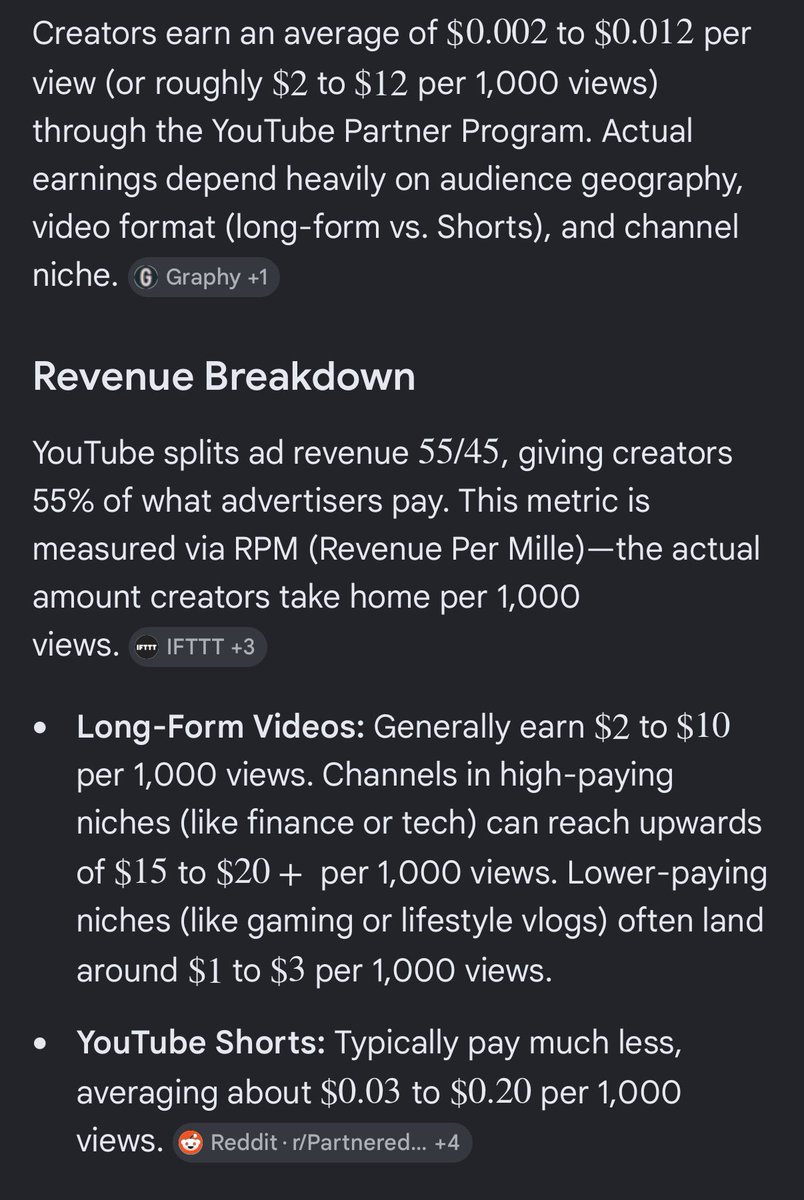
We have already explained plenty of times that crypto, and especially Cardano, is too niche to generate enough ad revenue on YouTube alone.
Even large mainstream YouTubers still rely heavily on brand sponsorships. Please see the image below.
So who is responsible to sponsor Cardano content? Cardano itself, right? And right now that’s through the treasury. As there are no other avenues on Cardano. The current Cardano ambassador program is not structured for something like this.
Most other blockchains like Solana, SUI, Algorand, Zcash, and many others have dedicated creator funds / ambassador programs to support content production. We do not have that.
The goal of this proposal is simply to provide a small amount of financial support so creators can continue producing content consistently. Otherwise Cardano content will continue to disappear from YouTube search results over time.
A large open marketing initiative where anyone can participate would require a significantly bigger funding request, much more management overhead, and likely leadership from an organisation like the Cardano Foundation. We did not think that was realistic at this stage, so we intentionally kept this proposal focused and minimal.
We’ve already been doing this work for free, while competing with creators in other ecosystems who often have entire funded teams behind them. Despite that many of us are still achieving comparable viewership and engagement. With some financial support, we could improve production quality, grow our audiences further, and expand Cardano’s reach into other ecosystems.
As for disclosure, all Cardano content produced will be funded through the treasury, meaning Cardano projects also won’t have to pay for marketing anymore and it will be done in a fair and balanced way.
As for KPIs, there is no reliable or honest way to directly attribute specific transaction growth, TVL increases, or ADA price movement to individual videos alone.
And as you said, I’m the best YouTube creator on Cardano. (Thank you, the others are amazing too) but if we tell you that we’re struggling and won’t be able to continue, wouldn’t you then want to financially support us just a little bit to keep that talent on Cardano then?
I hope that answers all of your questions.
Let me share a bit of a personal story. The first time I came across @IOGroup was through a brilliant developer in Korea, someone who had previously led one of the country's most well-known blockchain academic societies and ran several popular projects.
Back in graduate school, he mentioned in an interview that he wanted to build a company like IOHK, one centered around deep technical research. Even then, he understood how important peer-reviewed papers and verifiable academic research were as the foundation of a blockchain. Through him, I came to understand just how exceptional IOHK was as a company, and how deeply technical the Cardano network truly is.
As we all know, this market is fundamentally a technology-driven market, and at the core of every fundamental, technology is what stands. What drew me to Cardano was exactly that, its outstanding technology, and the deep thinking and philosophy that shaped its very beginning.
Lately, it feels like there's a lot of friction and dissonance within the ecosystem. But realistically speaking, IOG's presence in the Cardano ecosystem is irreplaceable. Their academic depth and engineering capabilities grounded in formal verification have produced technical breakthroughs that no other company has achieved. Put simply, without IOG's research and core development capabilities, I believe the very foundation of Cardano could be shaken.
What's fascinating is that they've been collaborating with multiple companies to gradually decentralize the network's dependency on IOG itself, while also nurturing more Cardano-specialized engineers along the way. In other words, they are voluntarily reducing their own influence and helping the ecosystem stand on its own. This is an act of intentionally letting go of their own power so that the ecosystem can evolve and grow organically.
I have never witnessed, in this entire market, a company willingly setting aside its power and influence for the sake of an ecosystem. I genuinely believe they are working for the long-term growth and decentralization of Cardano.
In that spirit, I hope we can move forward through dialogue rather than exclusion, and through understanding and constructive feedback rather than blame. As people who are building this ecosystem together, I believe differences in opinion should not be a reason for conflict, but rather a starting point for finding a better path forward.
Hey all DReps, we are almost at the threshold for the Plutus proposal, thank for all YES votes thusfar, truly!
For those who can still make the difference, please read the following.
Part of the proposal is about introducing a Poseidon hash built-in to Plutus.
🧵
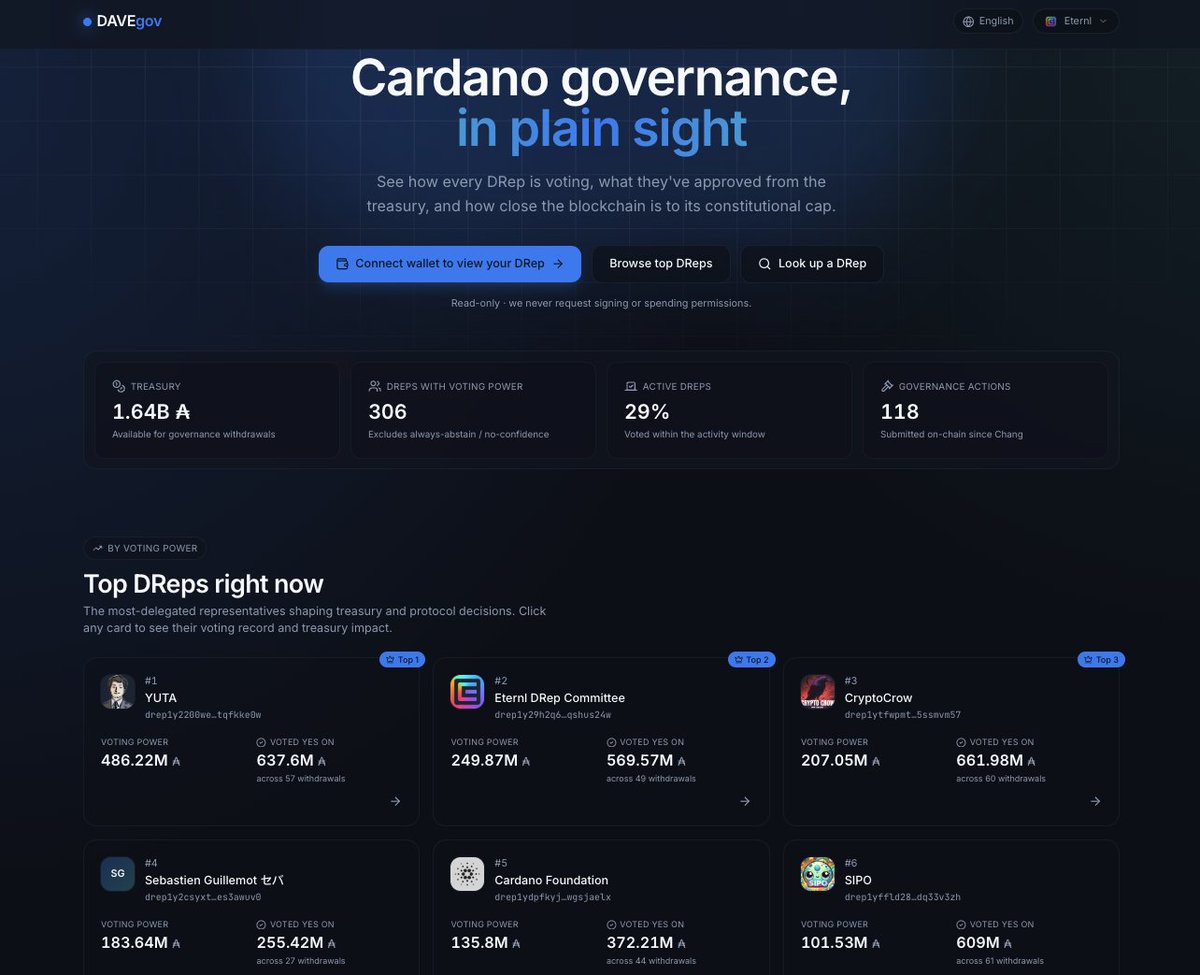
I've improved DaveGov so you can now dig much deeper into Cardano governance and DRep voting behaviour.
You can now see things like how much ADA your DRep has voted to spend historically, how much they have currently committed towards treasury withdrawals, how many proposals they have voted on, how many rationales they have provided, and broader voting behaviour across governance actions.
I've also added better analytics around treasury actions including enacted, pending, withdrawn and approved proposals, along with participation rates and pending yes vote inclusion tracking against treasury spend.
This morning I focused heavily on performance improvements as well. DRep search is now significantly faster, governance analytics are more responsive, and caching improvements mean the platform scales and feels better with every additional user.
There's also now historical comparison functionality, so you can compare how DReps voted during 2025 against current governance behaviour.
The goal is simple. Make Cardano governance more transparent, measurable and easier to understand at scale.
If you have any ideas, let me know and i'll try get them added, enjoy :)
https://t.co/shf9XrXeeT
Attention SPOs!!! We need you to update to 11.0.1. It has better performance, is hard fork ready and reduces chances of forks from larger blocks! Let's go folks! While there's still downstream tooling integrating, none of that affects block producers. Thanks all!!!
Over the years, we had many Plutus upgrades, and I would like to revisit some of them and remind you of their *concrete* impact.
Note that these improvements were not solely the work of IO but the labor of many wonderful developers across the community. ❤️ (2/10)
Let's push Leios over the threshold for Cardano 2026 funding, and continue our shared commitment to Cardano's scalability, you can find this under the proposal named: IO: Consensus Initiative.
Cardano will scale whist maintaining its security and decentralization, Cardano will compete.
After the recent LayerZero exploit, we are taking steps to ensure rsETH is fully secure, which is why we are migrating to @chainlink CCIP.
From the April 18 incident, it is clear that LayerZero's own infrastructure was exploited, resulting in $300M in losses across DeFi. Independent reports from SEAL 911, Chainalysis, and other major leading security researchers all point to the same origin.
There are questions that the ecosystem deserves answers to. And we are ensuring rsETH is secured by infrastructure that doesn't leave these questions open.
That’s why we’re setting the record straight.
Most of the L2 Scalability proposal's ask (80%) is for Hydra, so it's worth revisiting what Hydra is and what kinds of use cases it enables for Cardano.
Hydra is Cardano's Layer 2 state channel scaling solution. It lets participants open off-chain state channels where transactions settle in milliseconds with zero fees, while inheriting the full security of Cardano L1 as a backstop.
USPs:
Sub-second finality. No waiting for block confirmations inside a head.
Zero fees. Protocol-level, not a subsidy.
High TPS. Process thousands of TPS inside the head.
Isomorphic. Full smart contract support inside the head, same model as L1.
L1-anchored security. Disputes always settle on Cardano mainnet. Funds cannot be taken without unanimous consent.
Privacy. Intermediate states are known only to head participants.
Trust assumptions and use cases
Hydra operates in two modes. Conflating them leads to confusion.
Direct setup: participants run their own hydra-nodes.
Every participant co-signs every snapshot. The head state cannot advance without your signature. No operator trust at all.
This would ideal for institutional market makers, financial actors, and autonomous agents who already run infrastructure. Hydra is not meant for retail use in the direct setup mode. It can, though, in the delegated setup mentioned below.
Direct-setup use cases with high ROI:
Institutional OTC settlement. Market makers in a Hydra head arbitraging across DEXes by OTC trading between each other: sourcing liquidity, rebalancing inventory, executing liquidation-to-USD flows, all at sub-second finality with zero fees. In mature DeFi markets, institutional traders dominate trading volume even though retail dominates TVL. That volume is Hydra's market.
Agent-to-agent commerce. In Masumi's model, buyer and seller agents each run their own hydra-node. They are the participants. They sign every snapshot. This is direct setup because agents are software: running a hydra-node is operationally identical to running an API server. Circle launched Nanopayments in March 2026 for this exact market: off-chain aggregation, batched L1 settlement, the same architecture as Hydra. But Nanopayments is Circle-dependent, USDC-only, and payment-only. Masumi on Hydra is a full commerce layer: escrow, dispute resolution, programmable service contracts, continuous micropayment streams. x402 and Nanopayments let an agent pay for an API call. Masumi lets agents run actual commerce. Citi projects hundreds of billions in agent-driven transaction value by 2030. Cardano has a first-mover advantage here.
B2B payment rails. Known counterparties, contractual relationship, both run infrastructure. Net out flows throughout the day, settle to L1 once.
Delegated setup: operators run the head, users transact through an application layer. Operators control execution, but unanimous consensus means safety is preserved as long as one honest operator remains. This works where trust points already exist and Hydra adds no custodial risk on top:
Prediction markets already trust a resolver to settle outcomes. If the operator set overlaps with the resolver set, Hydra adds zero marginal trust. Polymarket's election cycle did $9 billion in volume.
Perp DEXes accept federated operator trust in exchange for CEX-like performance. Hyperliquid clears around $5 billion daily on a 25-validator BFT chain. Delta DeFi is the closest Cardano analog, with L1 settlement as a stronger backstop.
RWA platforms are federated by regulatory necessity: custodians, auditors, KYC'd participants. Hydra absorbs trust that already exists. BlackRock's BUIDL passed $2.5 billion in 2025, tokenized treasuries crossed $7 billion, BCG projects $16 trillion by 2030.
Other use cases include gaming, point of sales and general information processing like voting applications.
The pattern across all of these: trust already exists in the application layer. Hydra absorbs it into a structured protocol with cryptographic settlement guarantees rather than introducing new trust. The realistic comparison is not 'trustless versus custodial' but 'fully centralized service versus federated head with L1-anchored settlement.' Most of the L2 landscape including Optimism, Base, and Arbitrum runs on trusted sequencers today, and Hydra's delegated setup provides stronger custody guarantees through unanimous-consent settlement.
The proposal includes Hydra reference implementations for such patterns, so teams have a working starting point rather than building from scratch. Lowering deployment friction is key to adoption.
Protocol maturity
Hydra has been in R&D for a while. The past year changed the game:
Hydra Doom: massive success, huge buzz for Cardano
Glacier Drop: 30M+ users, 8 blockchains. Most rigorous stress test any Cardano L2 has faced
Delta DeFi: production perp DEX on Hydra
Masumi: agent-to-agent commerce, live
VTech Labs: building applications on top
Midgard: using Hydra for fast withdrawals
Intersect voting: runs on Hydra
Hydra Vending Machine
Hydra now has a growing production base.
Early adopters uncovered issues. Many fixed have been fixed. The difference now: we have real feedback loops from actual users which is helping production hardening. We did not have that before. The Hydra team has delivered:
v1.3: very stable and performant, addressing issues from production users
v2 alpha: out now, with directly opening heads (simpler workflow, lower costs)
Partial fanout: releasing soon, ahead of milestone deadline
Hydra is Cardano's most mature, stress-tested scaling solution. Actual users depend on it in production. The hardening work in this proposal closes the remaining gap those users have surfaced and ensures they get the support they need as users.
🚨 Important Point: Bitcoin
Let me remind you again, like I said two months ago.
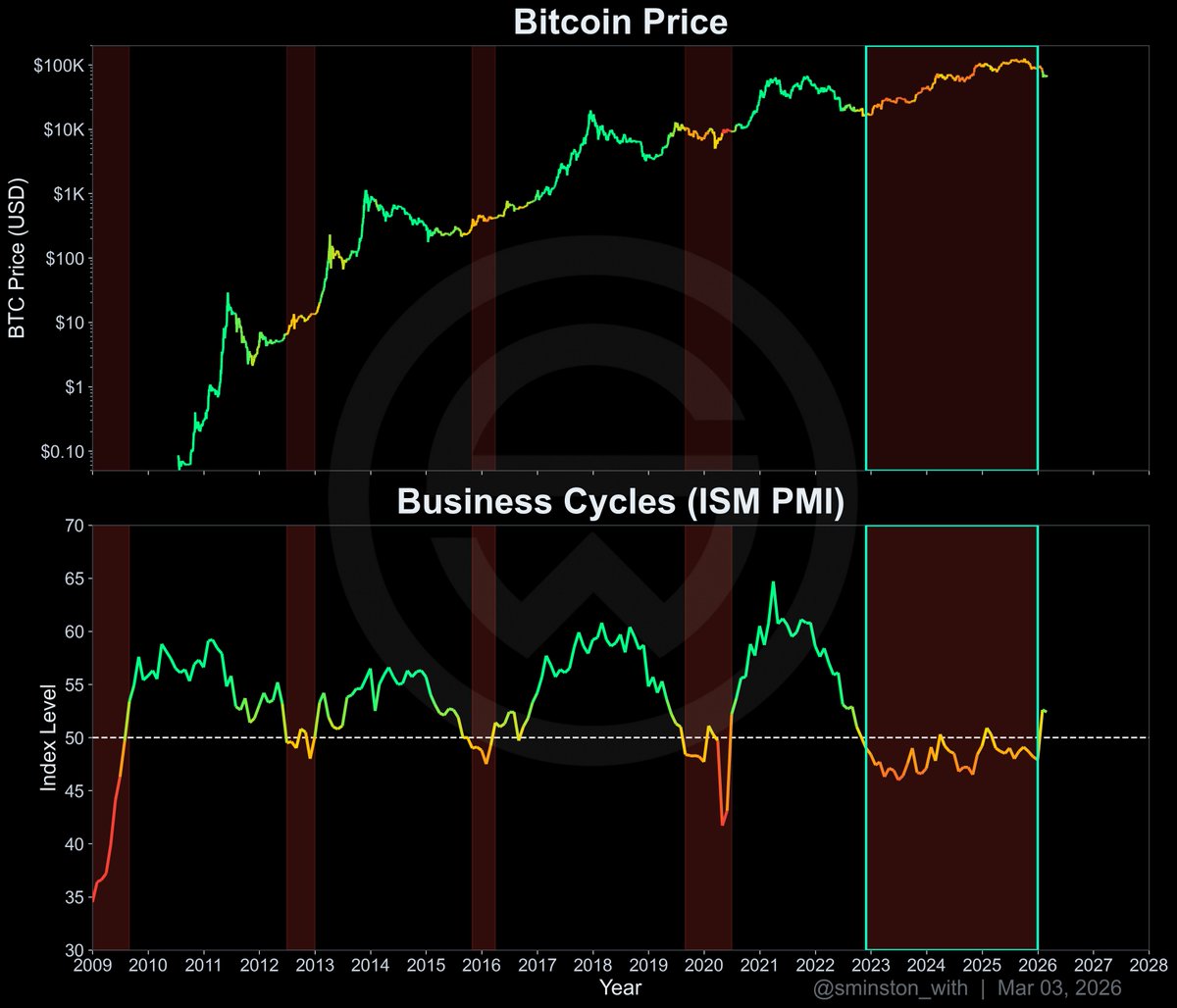
Bitcoin has NEVER had its FULL, complete bull market EVER while the PMI was below 50 the whole time.
It's wild that people honestly think Bitcoin will correct 50% from here...
It's not 2015, people. We're talking about a completely different asset.
Bitcoin also doesn't follow the 4-year cycle. It never has. It has always followed the business cycle, and once again it is.
Like clockwork.