Psychic children were supposedly taught to access their subconscious minds so they could move their consciousness out of their bodies into any object they wanted to according to whistleblower.
"They were more interested with getting me to subconsciously believe that awareness is essentially the substrate of this entire universe."
"Instead of trying to remote view into a room, there was subconscious training to help me understand that my awareness could become the door."
"I could become the room. I could become the filing cabinet where the documents are in and then extract the information that way."
"It was a lot less viewing. It was a lot more manipulating your own awareness to become the things that we see in the universe."
"You can port your own awareness into what we think of as even inanimate unconscious objects."
Full interview with Jordan Jozak out now.
This is wild.
NVIDIA just dropped MotionBricks at SIGGRAPH 2026.
This AI makes game characters and robots move with 350,000+ motion skills.
15,000 FPS. 2ms latency.
1. Smart locomotion - Characters can now switch movement styles on the fly.
𝗗𝘆𝘀𝗼𝗻 𝗶𝘀 𝗴𝗿𝗼𝘄𝗶𝗻𝗴 𝘀𝘁𝗿𝗮𝘄𝗯𝗲𝗿𝗿𝗶𝗲𝘀 𝗻𝗼𝘄. 𝗧𝗵𝗮𝘁 𝘀𝗵𝗼𝘂𝗹𝗱 𝗺𝗮𝗸𝗲 𝗲𝘃𝗲𝗿𝘆 𝗲𝘅𝗲𝗰𝘂𝘁𝗶𝘃𝗲 𝘂𝗻𝗰𝗼𝗺𝗳𝗼𝗿𝘁𝗮𝗯𝗹𝗲.
I'll be honest: when I think of Dyson, I think of vacuum cleaners, hair dryers, and beautifully designed machines that make ordinary things feel strangely futuristic.
I do not think of strawberries.
And yet Dyson has built a vertical farming system with rotating rigs, robots picking ripe fruit, UV light reducing mold, and recycled heat and CO₂ feeding the operation.
What surprised me is not that Dyson entered farming. It is how they looked at farming.
Most companies improve the visible process.
Dyson redesigned the hidden system.
That is the lesson many leaders miss. The next disruption in your industry may not come from a direct competitor. It may come from someone who looks at your "normal" workflow and sees an engineering problem.
The future will not belong to companies that automate old processes.
It will belong to companies brave enough to redesign them.
Where in your business are you still improving the process, when you should be redesigning the system?
#OrchestrationDesign #HybridManagement #AIReadiness #AgriTech
Sızıntı 🚨 GPT Images 2.0 Hilesi
ChatGPT'ye herhangi bir resim yükleyin,
ve ardından "Resmi JSON istemine dönüştür ve boyut ile ayrıntıları ekle" komutunu verin.
Bu, resmi yeniden oluşturmak için bir istem çıktısı verecek ve yalnızca değiştirmek istediğiniz kısımları değiştirmenize ve kullanmanıza olanak tanıyacaktır.
THIS IS ABSOLUTELY WILD 🤯
Jack Dorsey's new AI tool, Goose, is 100% FREE.
You type:
"Build me a website like YouTube."
And Goose gets to work on its own:
→ Creates the entire project
→ Writes all the code
→ Installs dependencies
→ Fixes errors automatically
→ Keeps going until it's working
The crazy part?
• No monthly subscription
• Runs on your own device
• Your code stays private
• Completely open-source
Just a few years ago, building software meant hiring developers or learning to code.
Now you can start with nothing but an idea.
We're entering a world where ideas are becoming more valuable than technical skills.
Harvard researchers gave people identical small bruises, then sat them in rooms with rigged clocks.
Some ran at normal speed. Some at half speed. Some at double speed. "The actual time in every room was identical: 28 minutes."
What happened next was completely unexpected: "The wounds healed faster when people thought more time passed and slower when they thought less time had passed."
"They all had the same injury and waited the same 28 minutes. The only variable was belief and expectation."
"The lead researcher even later admitted he did not think it would work. But it did."
If belief alone can change how fast you heal, what else is your perception of time doing to you?
Scientists Map 110 Quadrillion km of Underground Fungal Networks…
A billion Times The Distance From Earth to the Sun!
Earth’s Vast Underground “Carbon Superhighway”
A groundbreaking new study published today in the journal Science has revealed, for the first time, the global scale of one of Earth’s most important but hidden biological infrastructures: the networks of arbuscular mycorrhizal (AM) fungi.
These thread-like fungal structures, known as hyphae, form symbiotic partnerships with roughly 70% of land plant species—including major crops like wheat, corn, and rice.
In exchange for sugars from the plants, the fungi deliver essential nutrients (such as phosphorus and nitrogen) and water, while also playing a massive role in storing carbon underground.
Mind-Boggling Scale
Using data from more than 16,000 soil cores worldwide, machine-learning models, and high-resolution robotic imaging of fungal hyphae, researchers estimated:
•Total length: ~110 quadrillion kilometers (1.10 × 10¹⁷ km) of living hyphae in the top 15 cm of global soils—enough to stretch nearly a billion times the distance from Earth to the Sun (or about 10% of the diameter of the Milky Way if laid out in space).
•Biomass: ~300 megatons of carbon, equivalent to 4–6 times the biomass of all humans on Earth.
•These networks move about 1 billion metric tons of carbon per year into soils, acting as a critical “carbon circulatory system” that helps regulate the planet’s climate.
Densities are highest in grasslands, with notable hotspots in places like the Sudd wetlands in Africa and the Everglades.
The “Wood Wide Web” at Planetary Scale
This research builds on the popular “Wood Wide Web” concept, where fungi connect plants in shared resource networks.
The new global maps (available for exploration via the Society for the Protection of Underground Networks, or SPUN) show these connections operating at an ecosystem-wide level, supporting plant health, resilience to drought and disease, and food security.
These fungi are vital allies in the fight against climate change and for sustainable agriculture. However, they face threats from soil disturbance (like tillage), pesticides, and land-use changes.
The study also highlights gaps in sampling, particularly in undersampled ecosystems that need further research.
Read the full research paper (paywalled, but abstract freely available): https://t.co/6cu4UUFgxU
Global density and biomass of arbuscular mycorrhizal fungal networks
Explore interactive maps and learn more at https://t.co/P35alXz06O.
This discovery underscores how much of Earth’s life-support systems remain invisible to the naked eye yet operate on a truly planetary scale.
Protecting these underground networks could be one of the most effective ways to sustain healthy soils, productive crops, and a stable climate.
Another vaccine failure!
This time it’s Merck hit with a $50M settlement they’ve agreed to pay out as a result of their Gardasil HPV vaccine causing premature menopause, seizures, POTS, POI and other autoimmune disorders.
I’m glad they were held accountable!
When you listen to these fellows talk, keep 2 things in mind....
the second Hermetic principle of Correspondence...we inhabit a fractal Matterium. The same patterns are replicated at all levels.
And your body is a SOC .... a self-organizing collective intelligence.
https://t.co/oUGl3Pr8g1
Went to a new kind of movie today. One that cost $400,000 in AI compute to make. It was the San Francisco premiere.
If you hadn’t told me it was largely done with AI I wouldn’t have known.
The takeaway after listening to @higgsfield_ai’s CTO introduce it is that a competent movie can now be made for half a million dollars. Where they used to cost $100 million or more.
Here is the first few minutes of “Hell Grind” and that intro from @codentropy.
We are far from seeing the ultimate use of AI in movies.
As a touch point of where AI for creative people is this seems like an important time marker and one I will look back on frequently for years.
Coinbase launches yet another product launched by Veritaseum in 2018
Veritaseum sued Coinbase and Circle USDC for $350 million dollars each for using their IP without a license. Their lawyer passed away so the cases are on hold.
Meanwhile, Coinbase and Perkins Coie filled an IPR petition to try and invalidate the Veritaseum patents but were denied institutions, and denied their appeal by the PTAB - Case # IPR2023-00751
That denial and their willful use of this IP could expose them to triple damages and over $1 Billion dollars.
IMPORTANT:
Coinbase's User Agreement has Indemnity and Arbitration clauses that suggest users may be responsible for these costs. - See Article in Comments.
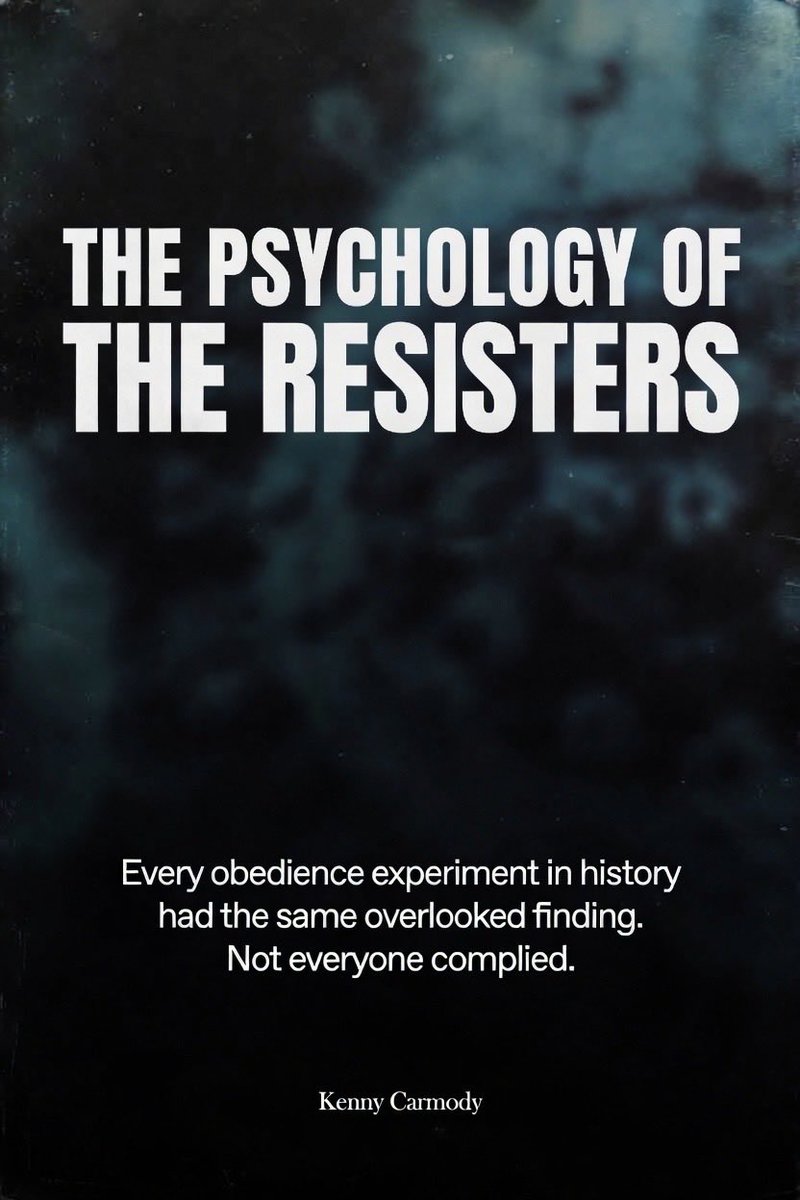
Every obedience experiment in history had the same overlooked finding.
Not everyone complied.
In Milgram’s lab, 35% refused to deliver the final shock. In Asch’s line experiments, 25% never conformed, not once, across any trial. In Zimbardo’s prison, at least one guard refused to dehumanize. One prisoner demanded a lawyer instead of a doctor and broke the psychological frame entirely.
We spent decades studying the ones who obeyed.
We barely asked what made the others different.
That question matters more now than it ever has.
The resisters in the COVID era were not difficult to find. Physicians who filed exemptions and lost their licenses. Nurses who walked away from careers rather than mandate patients into decisions they hadn’t genuinely chosen. Scientists who published contrary data knowing what it would cost them. Parents who stood alone at school board meetings. Ordinary people who simply said, quietly, without drama , no.
What made them different?
Research consistently identifies a cluster of factors. Not personality traits you either have or don’t. Situational and cognitive patterns that can be cultivated.
First: prior reflection on authority. The resisters had usually thought, before the crisis, about the limits of institutional trust. They weren’t cynics. They were people who had already asked the question “under what conditions would I refuse?” before anyone was asking them to comply.
Second: a concrete reference point outside the consensus. A value, a principle, an oath, a relationship that existed independently of the institutional structure demanding compliance. Something the system couldn’t reach.
Third: at least one other person. Milgram found that a single dissenting confederate reduced compliance dramatically. The resisters rarely stood entirely alone. They found each other. Sustained each other. Gave each other permission.
Fourth: the willingness to tolerate social pain. Not immunity to it. Tolerance of it. They felt the pressure. They felt the exclusion. They chose the discomfort of integrity over the comfort of belonging.
None of this is innate. All of it is learnable.
The most important thing Milgram, Asch, and Zimbardo taught us is not how fragile conscience is.
It’s that conscience can hold, if you’ve trained it, named its limits, and found even one other person willing to hold theirs beside you.
Build that now. Because the experiment is always running.
Until then stay humble.