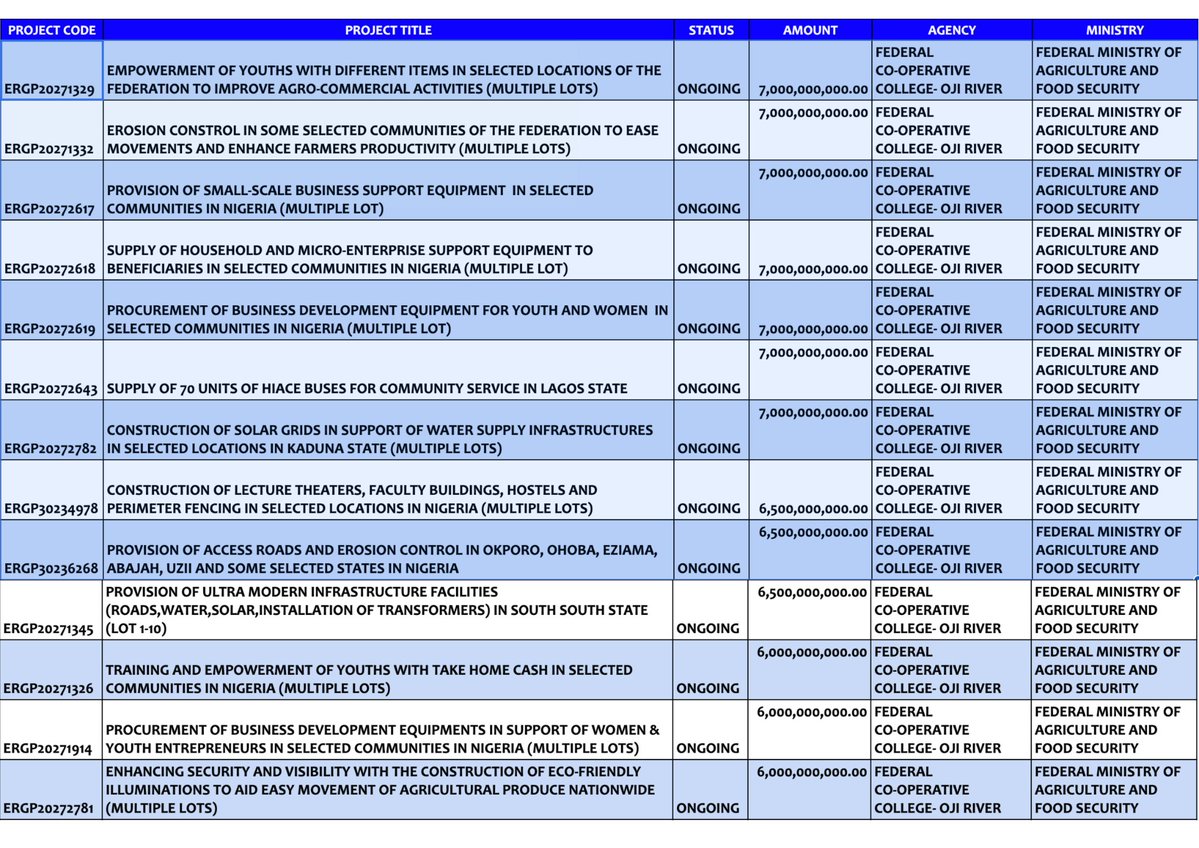
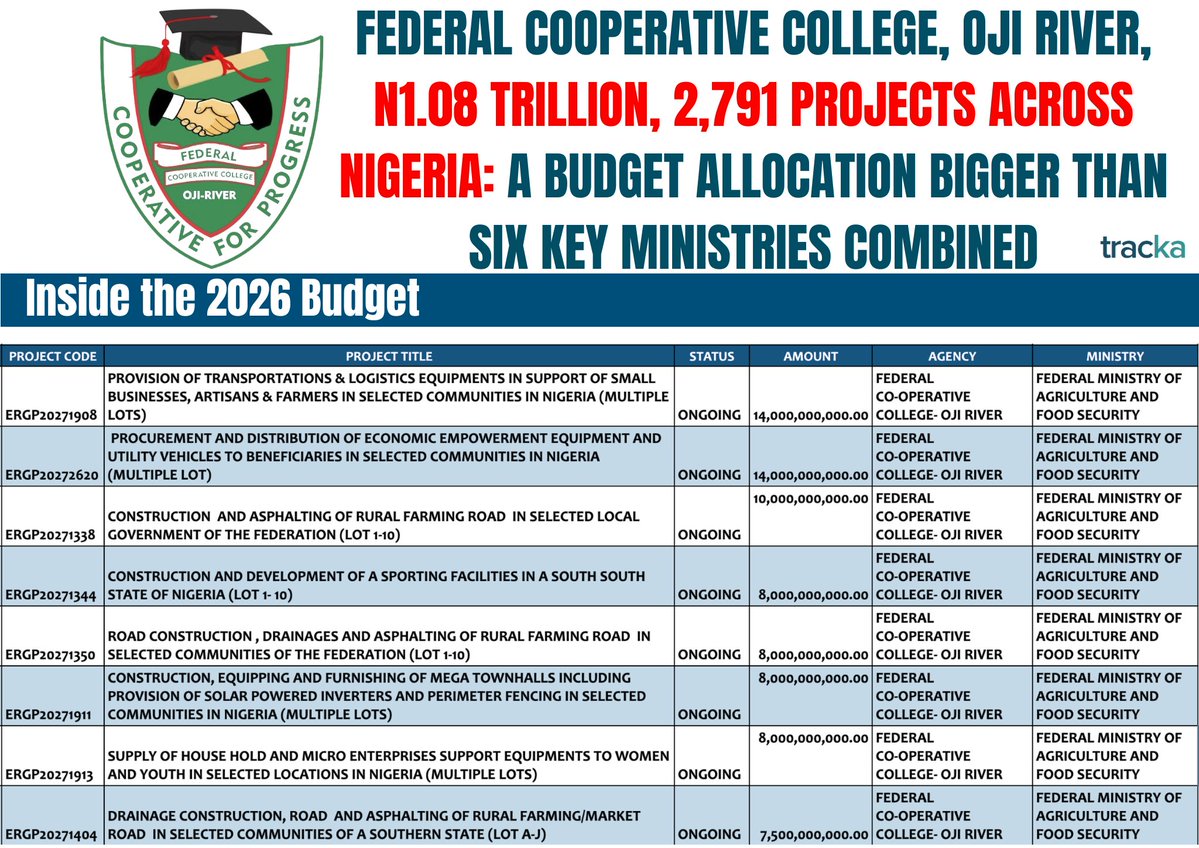
🚨 How Did a Cooperative College Get N1.08 Trillion for 2,791 Capital Projects?
Our review of the 2026 FG budget reveals that the Federal Cooperative College, Oji River (@fedccojiriver), has been allocated N1.08 trillion for 2,791 capital projects spread across the 36 states in Nigeria and the FCT. This means a single federal cooperative college is expected to implement thousands of projects with nationwide coverage from Abia to Zamfara, Sokoto to Bayelsa, Lagos to Borno, and across the FCT.
These projects include:
🛣️ Road and drainage constructions
💡 Solar streetlight installation,
🎓 Digital learning centres,
🌾 Supply of rice and empowerment materials,
⚽ Construction of football pitches,
🏥 Medical outreaches,
♻️ Plastic recycling and processing plants,
🩺 Dialysis centres,
🚑 Ambulance supply e.t.c
Yet, the College's core mandate is to advance cooperative education and practice through capacity building, research, innovation, leadership development, and support for sustainable livelihoods.
Even more concerning, many of these projects have no clearly stated implementation locations, making citizen oversight and project tracking extremely difficult.
To put this allocation in perspective, the N1.08tn earmarked for FCC Oji River alone is greater than the combined allocations to six key ministries:
🏝️ Federal Ministry of Tourism - N21.76bn
🎭 Federal Ministry of Arts - N70.53bn
📡 Federal Ministry of Communications - N85.56bn
⛏️ Federal Ministry of Solid Minerals Development - N156.84bn
🔐 All six agencies under the Federal Ministry of Interior - N723.62bn
This raises important questions:
❓ Why is a cooperative college implementing projects far beyond its statutory mandate?
❓ How were these projects assigned to the institution?
❓ How can citizens track projects with no clearly defined locations?
❓ What accountability mechanisms are in place to ensure value for money?
At a time when Nigeria faces significant fiscal pressures and relies heavily on borrowing to fund public expenditure, public resources must be allocated transparently, strategically, and through institutions with the capacity and legal mandate to deliver results.
A budget item without a clear location, defined beneficiaries, and a responsible implementing agency creates fertile ground for waste, inefficiency, and weak accountability.
📄 The comprehensive list of these allocations can be found on our website: https://t.co/I2JL8eByF7
Cc;
@NGRPresident@BudgetOfficeNG@nassnigeria
🚨 N962.83 Billion for SUVs and Empowerment Projects Exceeds the Combined Budget of Seven Key Federal Ministries in the 2026 Budget
Our review of the 2026 FG Budget uncovered another troubling pattern of opaque spending.
🚙 39 SUVs - N15.13 bn
👥 2,579 Empowerment Projects - N947.7 bn
Total: N962.83 bn
This is more than the combined N960.27bn allocation to seven key Federal Ministries:
🏭 Industry, Trade & Investment - N156.8bn
🏘️ Housing - N145.3bn
👩 Women Affairs - N169.39bn
⚖️ Justice - N150.7bn
🐄 Livestock Development - N177.6bn
✈️ Aviation & Aerospace Development - N87.3bn
🪔 Petroleum Resources - N73.1bn
Yet, only 70 of the 2,579 empowerment projects have clearly identified implementation locations.
This raises serious accountability concerns:
📍 How can citizens track projects with no stated location?
🔍 How can oversight institutions verify implementation?
💰 How can taxpayers know who ultimately benefits from these allocations?
The concerns don't end there, these projects are spread across 184 implementing agencies, many of which have no statutory mandate to execute empowerment programmes. Leading agencies 👇
📌 @fedccojiriver - 393 projects worth N127.1bn
📌 National Agricultural Development Fund - 6 projects worth N89.5bn
📌 @Fchdkgombe - 216 projects worth N88.1bn
📌 @officialfccib - 94 projects worth N36.9bn
Let us be clear, there is nothing inherently wrong with empowerment programmes! When well-designed and transparently implemented, they can improve livelihoods, create economic opportunities, and support vulnerable Nigerians.
However, experience over the years has shown that many poorly defined empowerment projects have become vehicles for political patronage, rewarding loyalists rather than delivering broad-based benefits to citizens. When projects have no clear location, no transparent beneficiary selection process, and are assigned to agencies without the appropriate mandate, public confidence is eroded, and accountability becomes difficult.
This concern is even more pressing given that the 2026 Budget is projected to be financed with a deficit of about 46%. At a time when government is borrowing heavily to fund public expenditure, every naira should be directed toward investments with clear development outcomes, measurable impact, and value for money, not opaque allocations that citizens cannot effectively track.
A budget should not only allocate resources, it should also inspire public confidence. Every budget item should have a clear purpose, a defined location, an implementing agency with the legal mandate to deliver it, identifiable beneficiaries, and measurable outcomes.
📄 The comprehensive list of these allocations is available on our website 👉https://t.co/I2JL8eByF7
#Publicfundsmustworkforthegoodofthepeople
#Askquestions
FG Budgets N22.15B To Build Palaces
Nigerians are reacting with outrage after the public accountability organisation Tracka revealed that the 2026 Proposed Budget set aside N22.15 billion for the construction of 106 royal palaces across the country.
The organisation found that billions of naira meant for traditional palaces appeared to be routed through unrelated agencies including the Nigerian Institute for Oceanography and even the National Institute for Cancer Research.
Watch What’s Trending With @OjyOkpe
There have been bad managers of the fiscal policies of this country. They removed subsidy and devalued currency, and they did not properly understand the wider implications of that on debt service.
- Seun Onigbinde, Co-founder of BudgIT, speaking on the Tinubu government’s budget process and Nigeria's economy
#PoliticsToday
Dear Nigerians, here's another question that deserves our collective attention.
The 2026 FG Budget earmarks N22.15 billion for the construction of 106 Palace buildings, with some including furniture and solar installations.
Our review raises serious accountability concerns:
📍 11 Palace projects worth N5.85 billion have no identified locations, making public oversight almost impossible.
📍 None of the 45 implementing MDAs has the statutory mandate to construct palaces.
Among the agencies budgeted to execute these projects are:
• Nigerian Building and Road Research Institute (N3.92bn)
• Federal Cooperative College, Ibadan (N3.29bn)
• Sheda Science and Technology Complex (N1.54bn)
• National Cereals Research Institute (N427m)
• Industrial Arbitration Panel (N369.4m)
• National Oil Spill Detection and Response Agency (N280m)
• Federal Neuro Psychiatric Hospital, Dawanau (N42m)
At a time of rising debt and limited fiscal space, should the Federal Government fund projects that are largely local in nature, while states and local governments constitutionally exist to address many community-level needs?
This is not about the importance of our traditional institutions. It is about ensuring that public budgets reflect constitutional responsibilities, institutional mandates, and Nigeria's development priorities.
The Federal Budget should not become a vehicle for financing projects outside the constitutional and statutory responsibilities of the institutions implementing them.
Nigeria deserves a budget that is lawful, transparent, and development-driven.
#Publicfundsmustworkforthegoodofthepeople
#Askquestions
Cc;
@NGRPresident@nassnigeria,
@HouseNGR
Can you imagine how many approvals, contracts, payments and signatures happen before public money becomes 48 properties owned by one man?
Corruption cases like this should leave Nigerians asking:
Where did the system fail?
Budget implementation?
Procurement?
Internal audit?
Asset declaration?
Accountability shouldn't begin with asset recovery. It should begin long before public resources can be diverted in the first place.
Yesterday, I spoke on @channelstv about the importance of voter registration ahead of the extended deadline of Friday, 24 July 2026.
If you are eligible to vote, register on your smartphone through @inecnigeria's CVR portal at https://t.co/xLdKAl8qtj. That is all you need to do before the deadline.
#CollectYourPower #RegisterToVote #GoNigeria
https://t.co/TPxwcdrZhk
I don’t interview guests to embarrass them. I interview them to test arguments. If an explanation can’t withstand scrutiny, the public deserves to know.
Comparing a fake agency scandal - along with a governance breakdown involving official institutions - to 9/11 isn’t an answer, it’s a distraction.
9/11 was a catastrophic terrorist attack. What Nigerians are asking about is institutional accountability. Those are not the same conversation. When we blur them, we don't illuminate the truth - we detract from it. There's a difference between explaining a failure, and excusing one.
Thank you to everyone who reached out. It’s clear many of us still believe in one simple thing: asking hard questions, and refusing to let bad analogies replace accountability.
Journalism isn't about winning arguments. It's about refusing to let bad arguments replace accountability. That’s the job!
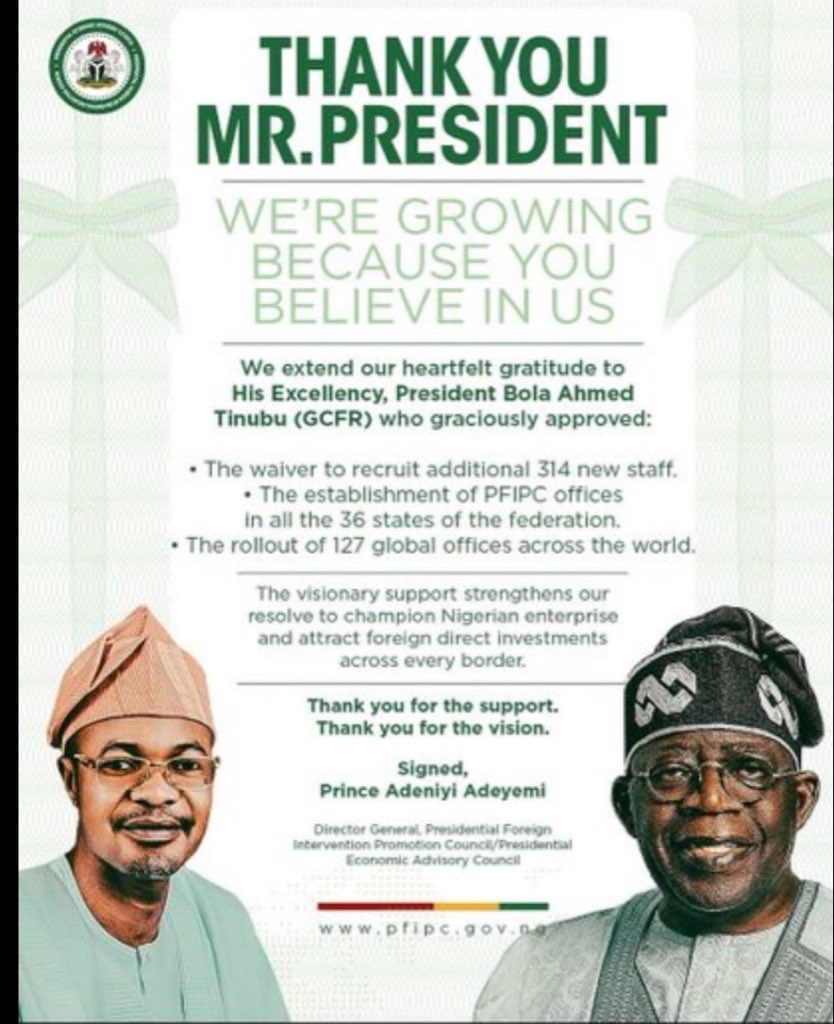
SPOTTED: Council @femigbaja claims doesn’t exist was allocated N1.3bn in 2026 budget
On June 11, Femi Gbajabiamila, chief of staff to President Bola Tinubu, issued a public disclaimer disowning the appointment of Adeniyi Adeyemi as the head of the Presidential Foreign Intervention Promotion Council.
“It has come to the notice of the Federal Government of Nigeria and specifically the Office of the Chief of Staff to His Excellency, President Bola Ahmed Tinubu, GCFR that a certain Prince Adeniyi Adeyemi, under the auspices of an alleged organisation styled as the ‘Presidential Foreign Intervention Promotion Council’ is portraying himself to the general public as having been appointed by my office,” Gbajabiamila said.
https://t.co/G8OoQW4X8a
🗣️Dear fellow Nigerians,
The 2026 Federal Government budget is the biggest in our history. N68.32 trillion approved. Let that number sit for a second.
But here is what they did not lead with. Nigeria is only expected to earn N36.87 trillion this year. That means the government can only fund 53.9% of its own budget from actual revenue. The remaining 46.1% will come from borrowing. And debt service alone will consume nearly 45% of everything we earn. That is N15.81 trillion going straight to paying back what we already owe, before a single road is fixed, before a single school is built, before a single hospital gets funded.
Every year, Nigeria sets revenue targets. Every year, we fall short. In 2025, the government projected N36.35 trillion in revenue. By June, only N10.92 trillion had come in. Yet the 2026 projections follow the same pattern, the same optimism, the same numbers that history tells us we will not meet.
Our full analysis of the 2026 Federal Government Approved Budget drops tomorrow. Do not miss it.
#FollowTheMoney #2026FGBudget #2026FGBudgetAnalysis
Human rights and security are not enemies; on the contrary, they are necessary partners because a government that respects human rights is a government that earns cooperation.
— Ayo Obe, Human Rights Activist
#June12
A legislature that cannot say no is not a legislature at all. A legislature which simply receives executive proposals, approves them without scrutiny, and goes home has not fulfilled its constitutional mandate.
— Bukola Saraki, former Senate president
#June12
Happy Democracy Day, Nigeria!
I just arrived at the Lagos Marriott Hotel, Ikeja for this year’s June 12 edition of @theplatformng. I will be sharing my thoughts on governance, democracy and national security, the very issues at the heart of what today stands for. #June12
I earned my "Introduction to Azure Cloud Shell" badge! I’m so proud to be celebrating this achievement and hope this inspires you to start your own @MicrosoftLearn journey!
https://t.co/mqkWsrQCEh #MSLearnBadge
June 12 The Platform
Governance, Democracy & National Security
Admission is free, but resgitration is required.
Register at https://t.co/I1qGq7e15u
Will be broadcast live on television less
@waleOayeni We have a good number of technical schools being ran by federal & state and private. I think it is a question of what is the current state of these vocational institutions?