Single Crystal CVD Diamond
Have no doubt, you are at the dawn of an industrial revolution. There is a string of breakthroughs happening throughout upstream industries that all compound.
Diamond manufacturing is now able to produce CPU size single crystals wafers.
Currently these are marketed as heat spreaders because they have thermal conductivity of 2,200 W/mK which means they move heat incredibly effectively.
However, that somewhat misses the wood for the trees…
Diamond has physical and electrical properties that exceed traditional silicon, making it uniquely suited for high demand applications.
Thermal Conductivity: Heat is the enemy of electronics. Diamond conducts heat better than almost any other known material, about 5 times better than copper and over 10 times better than silicon.
A diamond chip can act as its own heat sink.
Ultra Wide Bandgap: Diamond can handle massive amounts of voltage and operate at incredibly high temperatures without electrical breakdown.
This makes it perfect for high power applications like electric vehicle inverters, power grids, and aerospace technologies.
High Frequencies: Electrons move very quickly through diamond, allowing chips to operate at much higher frequencies, which is ideal for advanced telecommunications and radar.
Radiation Hardness: Diamond is incredibly resilient to radiation, making diamond based chips ideal for satellites, space exploration, and nuclear facilities.
To make a material act as a semiconductor, you have to "dope" it. To do this you inject impurities into the crystal lattice to create a positive (p-type) or negative (n-type) charge.
Diamond's atomic structure is so tightly packed that forcing other elements into it is hard. While p-type doping (with boron) has been figured out, reliable n-type doping (with phosphorus) remains a massive hurdle.
Theoretical ceilings
Band gap
Silicon wafer = 1.1 eV
Diamond CVD wafer = 5.5eV
Clock speed
Silicon wafer = 5-6 GHz clock wall
Diamond CVD wafer = 1-2 THz clock wall
Max Running Temp
Silicon wafer = 150°C
Diamond CVD wafer = 1,000°C
Whilst we etch silicon with photolithography and Extreme UV light, this doesn’t really work with chemically inert diamond.
Diamond CVD is currently etched with oxygen plasma etching, but this lacks the precision of EUV.
However, we can etch diamond to extreme precision with electron projection lithography. EPL was invented in the 90s by Bell Labs, IBM and Nikkon but abandoned as it was harder than EUV.
Electrons repel each other so the beams blurrs too readily.
What if we built a femto electron beam?
What if we built it to extreme such that it was a ‘single electron’ pulse?
What if we build a microscopic "bed of nails" containing millions of nanoscale tungsten or silicon tips (photocathodes). You shine a massive, highly complex femtosecond laser system across the entire array.
Every time the laser pulses, millions of tiny tips each fire a single, perfectly straight electron at the exact same time.
Turns out, research teams at likes of MIT and Stanford are currently experimenting with exactly this, laser driven nanotip electron emitters.
Pair that tool with Diamond CVD substrate tech and we approach the material limits of both semiconductors and nanotechnology.
Would require asynchronous logic to escape fatal clock skew and operate at full capability.
But I think I will live to see it.
Buddy of mine asked for resources to get up to speed on the last 6 months of AI, LLM development, +more.
Honestly, the best resource has been logging onto X every day over the last few years + podcasts from leading investors/people working at the labs or leading the hyperscalers + product releases & events from NVDA/Frontier Labs/etc.
I sent a ton of podcasts and sites which I'll link in here but figure I'd crowdsource some resources. Not meant to be exhaustive but more to flag for folks the outlets+people+podcasts to follow as a foundation. Imagine it'd be helpful for folks that don't live & breathe this daily or have access to sell-side.
@TMTLongShort@DratchCap@ContrarianCurse@PythiaR@justjoshinyou13@zephyr_z9@deredleritt3r
A robot arm basically has a rocket equation problem. Each motor closer to the root must support the weight of all the ones above it.
An advantage of cable robots is that the motors don’t have to be on the moving part. In a CDPR you can place all the main motors on the wall, and they can all be the same part with the same torque. You don’t even have to place one in each corner. In theory you could have a cable robot in every room in your house and put all the motors in the basement with the lines passing through PTFE tubes in the walls.
In Stringman, each anchor has a pair of motors, one direct, and one indirect, routed though a ceramic fishing eyelet in another corner. Consolidating the motors into fewer components drives the cost down, but two camera angles still gives a good view of the room.
The spool motors are Damiao direct drive actuators (DM-H6215). And unlike an arm, they’re all sharing the load, so they can be one of the smaller models, and having no reducer keeps the noise to a minimum.
If you want a cable robot in every room in your house by the way, I’m your guy. https://t.co/NISnwnUxVI
🏃♂️ I've gamified my own run so I can race my own ghost with the Meta Ray-Ban Display.
I built a web app for the glasses, loaded a previous GPX from Strava, and dropped game mechanics on top.
Pick up coins when you keep pace, sprint zones reward extra points if you push, and a mini leaderboard on the lens shows how you're tracking against your past self in real time.
Best part: it actually works. Seeing your ghost 20 m ahead is a way stronger nudge than any number on a watch. 😅
Deep inner suffering inevitably arises when the human person is reduced to performance, consumption, or a statistical datum. Many young people today live under the yoke of expectations to perform, immersed in an exasperated competitiveness that generates anxiety, fear of not measuring up, and disorientation.
PICARD: Data, shields up
DATA: Brilliant! Shields can reduce damage we sustain. Not immunity. Not hubris. Just prudence. It's not precaution—it's strategy.
[camera shakes]
WORF: HULL BREACHES ON NINE DECKS
DATA: Here's what happened: you told me to raise shields, and I didn't
We are in the early stage of an industrial revolution, first one was steam and lasted 80years, second electricity 50yrs, third semiconductors lasted 40.
The period of disruption gets shorter so current one might last into 2040s.
Also, the first one was substantially missed by those who lived through it, the second one had partial awareness “age of invention” and third was largely anticipated.
History suggests people get the direction correct, but the institutional shape and economic winners are harder to forecast.
For most people the best way to think beyond any industrial revolution from the “before” side, is to try and imagine a world where everyone around you gains magical powers.
If you are lazy, your laziness will be empowered, if you want to build, create, or do something all of these things will be empowered.
The results of your choices get amplified.
Mechanisation, electrification, computers, every prior industrial revolution did this. But these new magical powers very quickly become normal, become mundane and are just another part of the substrate.
It’s not so long ago that when nighttime came it was dark and there were no lights, and everyone just sat in the dark. That’s incomprehensible today.
My wife keeps pointing out how Chat works in little bits about goblins -- even last night when she was talking about how cute the baby is it was like "ahh yes what a sweet goblin child" ; i'm hopeful we learn more about this emergent preference.
Yes. It's very likely that much of the work we were doing can be automated with data centers and electricity.
I'm curious if that actually flows into material abundance given all the bottle necks we have in the real world.
It seems like the real world efforts (food, oil production, materials) could equally supply a human intellectual labor population or electricity for data centers, but it's not clear to me that it's actually creates additional abundance for humans.
So we get concerns about UBI permanent underclass, etc.
On the one hand AI should in theory allow us to have autonomous dozers robots etc and more quickly chew up the Earth resources to provide material abundance
On the other hand, underemployed humans will probably resist this through even more regulatory measures, creating a new equilibrium, which may be net worse for those who no longer work.
I feel like US society was in a middle period where we just kind of futzed around with overemploying people in hallucinatory white collar jobs and now we’re actually about to let it rip on a massive amount of electrical + data infrastructure and reveal how much of it wasn’t real
@Andercot Life maximises exergy and minimises entropy.
The reward function for life is something like the integral of exergy^2 / entropy
The ^2 rewards scale, the integral rewards time.
@RichardALJones@TheStalwart@heyitsarpit Great article. Biology is the "working expression" of functional nanotechnology. seems pretty magical to me.
we get little slivers of promise of "pure" nanotechnology
Poloroid, instant images
Chips, electron control
but the matter that matters remains wet, squishy, & weird.
The source of the myth is @_KarenHao she wrote a book called Empire of AI claiming a data center would use over 1,000x more water than a nearby city because she misunderstood the units of measurement.
It made international headlines and the mistake / lie has been unstoppable.
Neural networks might speak English, but they think in shapes.
Understanding their rich *neural geometry* is key to understanding how they work – and to debugging and controlling them with precision.
Starting today, we’re releasing a series of posts on this research agenda. 🧵
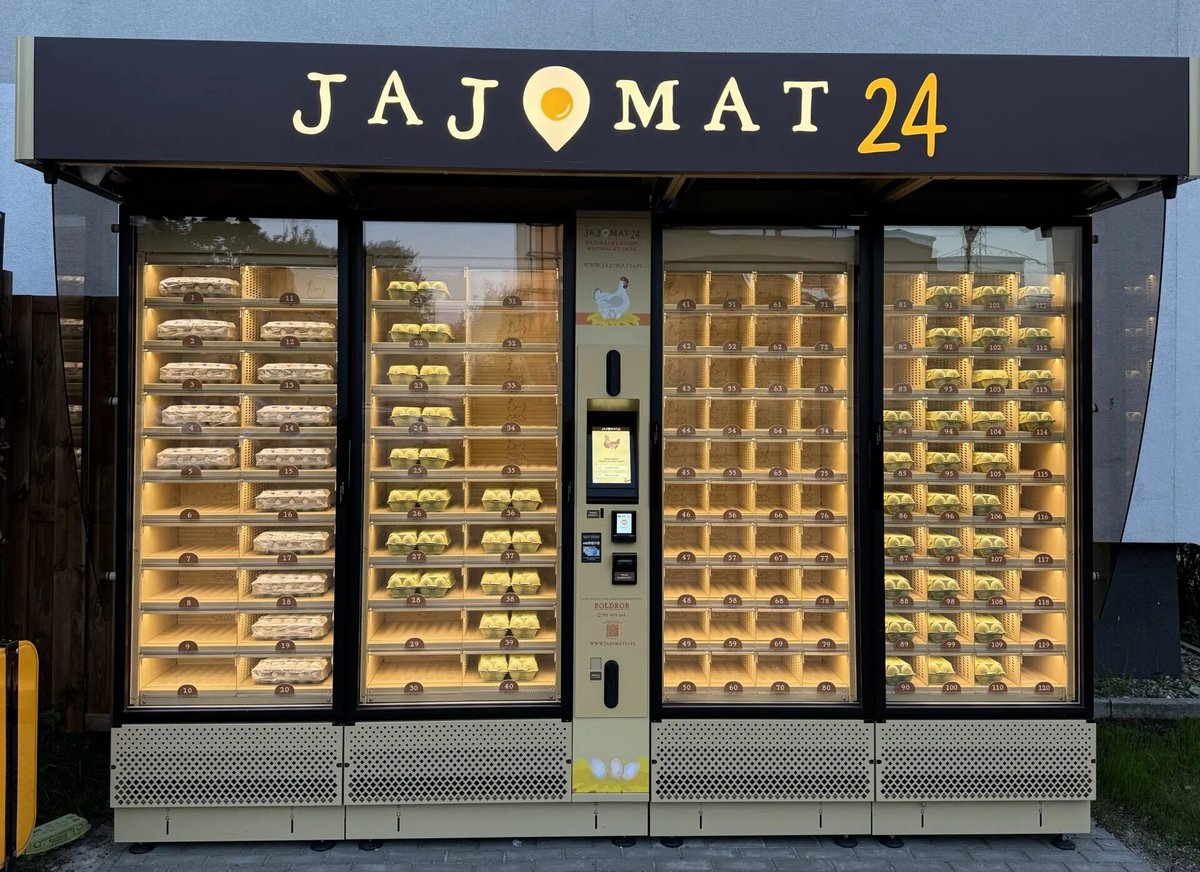
Egg vending machines (jajomaty) are becoming more popular in Poland.
They have transitioned from a niche curiosity to a common sight in both large cities (like Warsaw, Kraków, Poznań, Wrocław) and smaller towns. The primary driver is the desire for freshness. These machines are usually owned by local farmers, allowing them to sell directly to customers without a middleman. They operate 24/7, which appeals to people who want farm-fresh eggs outside of traditional market or grocery store hours. While older models were simple lockers, newer machines often feature touchscreens and support for contactless payments, fitting well into Poland's highly digitized payment culture.