Have spent 15+ yrs fostering a better ecosystem for life science entrepreneurship in NYC. Now Dir. Strategic Partnerships @Columbia. Tweets and opinions my own
For diseases to be “relics of the past” in 10 years… since clinical development timelines are 8-10 years… the drugs entering development right now need to be the ones curing everything… I’m a biotech optimist, but that feels unlikely.
I do appreciate the value of conveying excitement about new technologies and their possible impact, but the trough of disillusionment after over-hyped expectations is often a deep dark place for investors and innovators alike.
I see miracle ivermectin cures everywhere. "Nothing else worked." "Doctors are hiding it."
So I went through every human study I could find.
The biggest "real-world" study was pulled a month ago. Here's what's real and what's hype. https://t.co/GluE7Y1cIC
@AppleHelix Maybe some of the translatonal sections. But part of the (massive) loss has been in basic science, which is the stuff that literally no one else in the world will fund, and we won't know what parts of it will ever be valuable (but certain some will be...). We need that back.
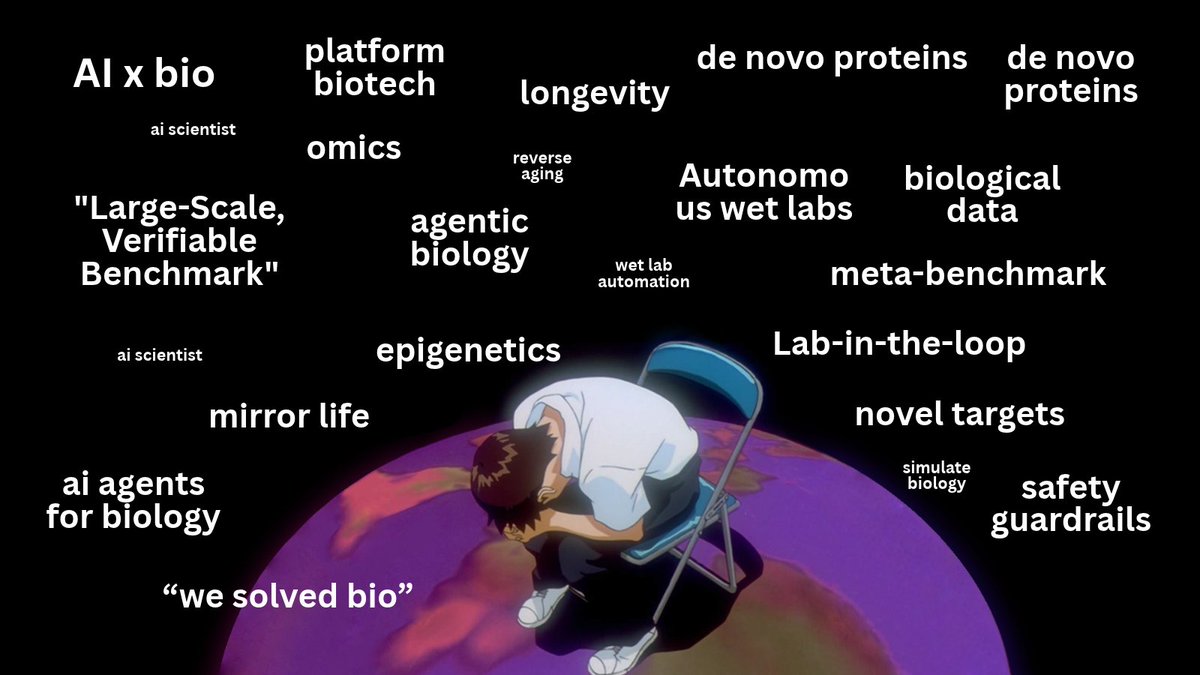
insane alpha to be a bio person going into tech bro, dude i swear we can just generate all of this biological data in autonomous wet labs with de novo systems based on the latest multi omics large scale benchmark and sell it to model providers and then solve cancer with novel targets via AI in drug discovery then build guardrails for mirror life because of ai scientist who's gonna live forever thanks to longevity, and actually, have you heard of agentic biology bro? insane sigma in being a tech bro who can solve biology through our meta-benchmarked proprietary bio model and also we're into biosecurity but we don't know what it means yet, and it doesn't matter because we benchmarked it bro
@dshahh@OmicsOmicsBlog@JMaraganore@Alnylam Bad Blood (Carryrou)
Bottle of Lies (Katherine Eban)
The Cell Game (Prud'homme)
The Antidote (not as good as Billion Dollar Molecule but should be read to understand what happens between discovery and growth)
Prob a couple more I am forgetting...
It's Halloween. Here's a trick-or-treat "thought experiment" for Anthropic (or OpenAI) going big into the Life Sciences. Probably more trick, than treat, but here goes...
Both have made making medicines a top priority, as described in Anthropic's S1. Right now they are taking some “small” bets in the space (~0.1% of expected market cap's). These are welcome moves and we are hopeful for more engagement in #biotech in general from the frontier lab companies.
But if you are a $2T public company (as they are likely to be post-IPO), how could you achieve scale in this life science domain? What’s the best way for maximum impact on bringing drugs to patients? [assuming that's the goal for their efforts in the life science]
I’d argue it's buying a large Pharma company and then radically changing the operating model to put compute and integration in the center.
Sort of like retrofitting a big Pharma R&D enterprise into a @NimbusTx model on steroids with compute and tech integration in the center, intercolated with deep biology and drug hunting capabilities, with operational execution on the periphery (impt, but not the driver). Own the learning loops, compress the DMTA cycle across a huge portfolio. Nucleate and empower teams around great potential medicines in a decentralized R&D model...
Let me get vaguely specific, for illustrative purposes.
Anthropic could buy $BMY for less than 10% of its market cap, an all-stock deal.
BMS has about 30,000 people. Trim commercial (a distraction to the radical change mission) by selling the long list of tail products (top 5 products are 70% of revenues).
Then apply frontier AI models to the business across the board - commercial, manufacturing, and R&D. Tons of data sits in these silos. With data, figure out where the bloat is in the corporate bureaucracy and remove it. Be especially aggressive on scaling back G&A and the lawyers, replacing headcount in those functions with AI-enablement. In the business functions, allow change-makers to focus on operational efficiency.
In R&D, BMS has about 3000 scientists/clinicians and operators on their R&D team. Keep or even grow this group - its where the magic has to start.
BMS has a legacy of great R&D advances and has tons of historical data. Frankly, they probably have some of the deepest datasets on mAb discovery (Mederex mouse one of the most prolific mAb platforms ever), induced proximity (CelMod and related datasets are without peer), cell therapy (Juno was a pioneer with one of largest CART datasets), radiopharma (more recently), and so much more. Deeply mine these datasets.
Take all the "me-too" R&D spend on crowded targets and dial it out of the portfolio... Refocus all that energy on building deep biology datasets to complement the historical modality data. Invest in deep cell and tissue profiling, all the ‘omics, at scale and in an integrated way. Put AI into the center of the operational workflow as an enabling tool for drug hunters, not replacing them. Work on fewer projects as a whole, but focus on “holy grail” drug targets and first-in-class/first-in-modality programs aiming for step-changes in treatment. And let AI operational efficiency compress clinical timelines as much as possible (10-20%).
Unleash teams of drug hunters with AI-powered R&D at scale on any/all therapeutic areas, not restricted to where commercial wants you to focus. A true science-first enterprise at scale. “A great medicine makes a commercial franchise, a commercial franchise doesn’t make great medicines” rings true to me here. Commercial voices, I'm told, dominate at BMS, even back in R&D. Maybe that's not optimal?
This would be a radical overhaul of a large R&D-intensive company. Give the experiment 5-7 years to alter the vector of R&D output. Long enough to see discovery-led changes percolate into early development and clinical PoC...
This kind of ongoing R&D investment would be tiny fraction of Anthropic’s revenues during that period, offset in part by the profits from the big commercial brands. A rounding error for them, but if it worked, this would fundamentally alter the industry’s trajectory.
Probably can’t be done - changing large legacy groups is hard - but seems like the only near-term way to truly test “AI at scale in drug R&D” is thru something audacious like this, rather than just thru small (and beautiful) case studies of program-focused biotech …
With $5T+ of anticipated market cap between the handful of frontier lab companies, this seems like a relatively small bet on a big prize.
And, lastly, make @Prof_Oak_ head of the BMS business unit of $ANT.
Trick or treat? Boo!!
I'm on team "I don't care how you made your damn drug" just show me: INDs filed, patients dosed, trials completed, BLAs filed, successful commercial launches, & patients able to access that drug that makes them better.
Everything else is noise, always has been, always will be.
@AppleHelix@Archimedes20311 In my experience, the main thing founders want after a decade of uncertainty and multiple instances of potential corporate destruction is to roll the dice on commercialization, which is a certain (and fast) way to improve returns vs an immediate life changing exit.
As someone who has helped companies pioneering the use of AI for drug discovery, this is BS. Sure, AI is a tool that we all should deploy to the best of our abilities, but the idea that AI is going to unveil new medicines at a stunning rate the way it will upend cinema, video games, financial services, advertising, gambling, etc., is a bit absurd. New medicine discovery will be one of the laggards in terms of AI revolution. Healthcare provision, diagnostics, and paperwork streamlining will all move ahead faster.
Biology will continue to eat everything, AI included.
A 700-year-old castle in Kent with a moat, a jousting yard, 42 acres and nine cottages, where Henry VIII dined with Anne Boleyn.
Just listed for $6.6 million.
In Manhattan, that buys you a two-bedroom with a doorman who reports to your wife.