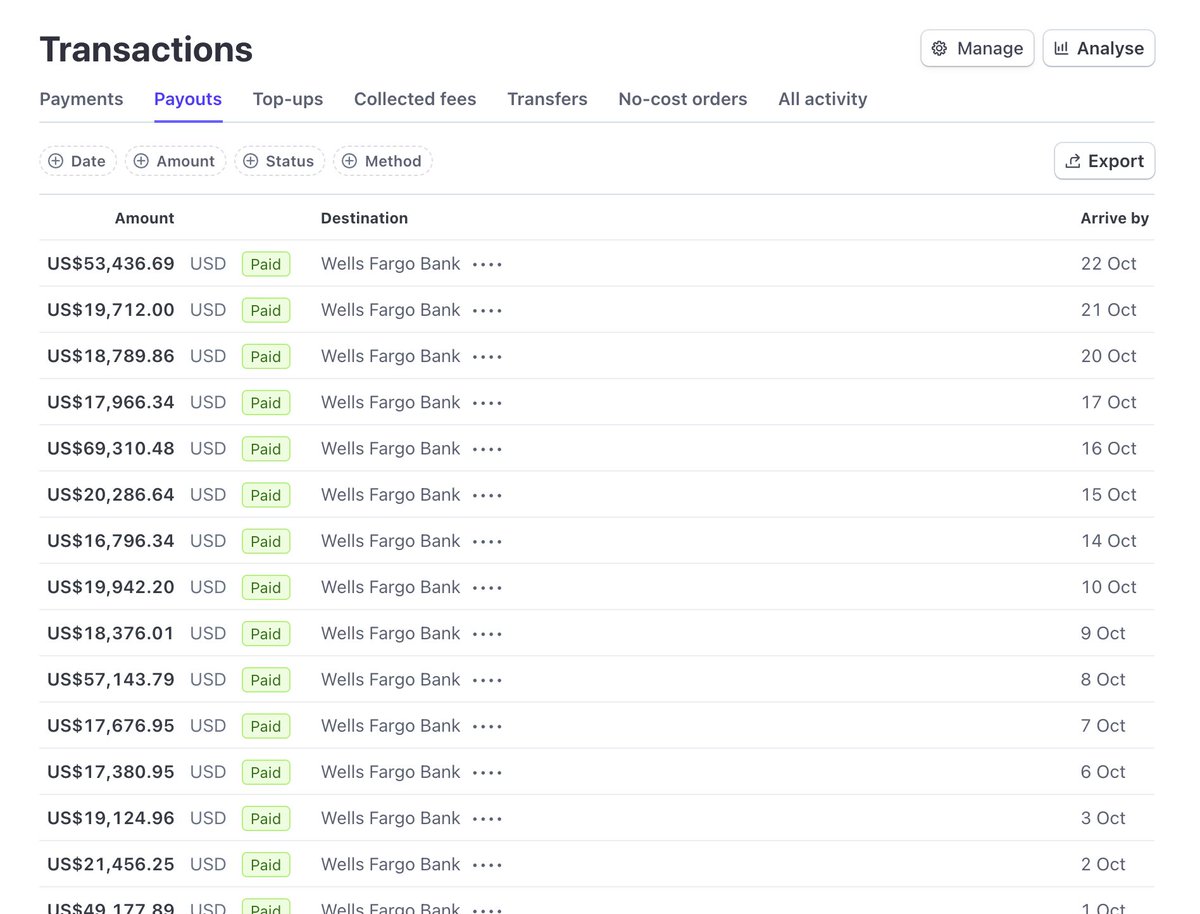
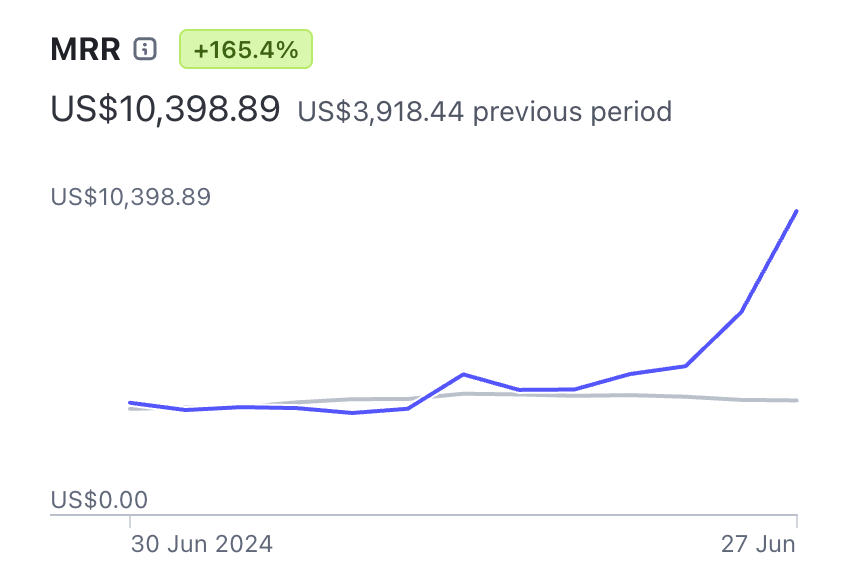
This is super interesting
You now have non-tech normal people outship tech people in terms of reaching revenue fast
I have lots of techy software engineer friends and they have been trying for years to get any MRR for their sideprojects and they still haven't
Here's an Indonesian girl, who's tapped into TikTok culture, knows what to ship, can't even code but ships it fast thanks to AI and gets to $800 MRR in the first month
So we're officially in a new time now: it's now literally just a competition of being as tapped into the culture as possible, to then be able spot a trend and rapidly built and launch a site/app/biz around it, and make money
There is little to any benefit being in tech now over normal people, maybe even the opposite as tech people are very up to date on tech things but often quite out of date on many non-tech cultural trends
This is a great thing, but a bitter pill to swallow: another gatekeeper wiped out and every tech builder has to now stop putting effort into tech skills, and instead put effort into understanding culture trends to see what to build next
And build it fast!
Let me explain exactly why parents pay $25,000 a year for youth sports their kid will never play professionally, because the math is more interesting than the headlines suggest.
The $25K is buying admissions arbitrage at elite colleges. Run it both ways.
Scholarship math first. The US has 8 million high school athletes. Roughly 7% play in college, 2% at D1. Total NCAA athletic scholarship spend is $3.6 billion across about 175,000 D1 athletes, mostly partial aid in the low teens per year. A family putting in $25K annually from age 6 to 18 spends $300K chasing a maximum return of about $80K. The expected value is a lottery ticket.
Admissions math second.
The SFFA v. Harvard trial disclosed that recruited athletes get admitted at 86%. The non-athlete rate sits around 5%. Even academically weak applicants jump to a 98% admit probability if recruited. A non-athlete with a 1397 SAT has roughly 0.08% odds at Harvard. The same kid recruited for crew has 70%+. The athletic hook is the largest single advantage in elite admissions, bigger than legacy or dean's list. Ivies don't even offer athletic scholarships. The value is purely the admissions ticket.
This is what $25K buys. Year-round travel ball is the qualifier round for an admissions process operating on different rules than the one your kid's classmates compete in. The "country club sports" pipeline (squash, lacrosse, crew, fencing, golf) is a feature. Barrier to entry is the product. 90% of Ivy League squash players come from $30K-a-year private high schools. The math works because the alternative pool is small.
PE arrived after the demand existed. Unrivaled Sports, Perfect Game, regional travel-ball roll-ups. Upper-middle-class parents had already turned youth sports into a class transmission mechanism. PE consolidated the supply chain and raised prices because the buyers were already there at $25K.
$300K to convert a 4% admit rate at an Ivy into an 86% one. Plus the alumni network and pre-professional sorting that follows. That's the actual equation.
The trade is rational at the top of the income distribution. Brutal everywhere else.
I took delivery of a beautiful new shiny HW4 Tesla Model X today, so I immediately took it out for an FSD test drive, a bit like I used to do almost daily for 5 years. Basically... I'm amazed - it drives really, really well, smooth, confident, noticeably better than what I'm used to on HW3 (my previous car) and eons ahead of the version I remember driving up highway 280 on my first day at Tesla ~9 years ago, where I had to intervene every time the road mildly curved or sloped. (note this is v13, my car hasn't been offered the latest v14 yet)
On the highway, I felt like a passenger in some super high tech Maglev train pod - the car is locked in the center of the lane while I'm looking out from Model X's higher vantage point and its panoramic front window, listening to the (incredible) sound system, or chatting with Grok. On city streets, the car casually handled a number of tricky scenarios that I remember losing sleep over just a few years ago. It negotiated incoming cars in tight lanes, it gracefully went around construction and temporarily in-lane stationary cars, it correctly timed tricky left turns with incoming traffic from both sides, it gracefully gave way to the car that went out of order in the 4-way stop sign, it found a way to squeeze into a bumper to bumper traffic to make its turn, it overtook the bus that was loading passengers but still stopped for the stop sign that was blocked by the bus, and at the end of the route it circled around a parking lot, found a spot and... parked. Basically a flawless drive.
For context, I'm used to going out for a brief test drive around the neighborhood to return with 20 clips of things that could be improved. It's new for me to do just that and exactly like I used to, but come back with nothing. Perfect drive, no notes. I expect there's still more work for the team in the long march of 9s, but it's just so cool to see that we're beyond finding issues on any individual ~1 hour drive around the neighborhood, you actually have to go to the fleet and mine them. Back then, I processed the incredible promise of vehicle autonomy at scale (in the fully scaleable, vision only, end-to-end Tesla way) only intellectually, but now it is possible to feel it intuitively too if you just go out for a drive. Wait, of course surround video stream at 60Hz processed by a fully dedicated "driving brain" neural net will work, and it will be so much better and safer than a human driver. Did anyone else think otherwise?
I also watched @aelluswamy 's new ICCV25 talk last week (https://t.co/RdaM23kvez) that hints at some of the recent under the hood technical components driving this progress. Sensor streams (videos, maps, kinematics, audio, ...) over long contexts (e.g. ~30 seconds) go into a big neural net, steering/acceleration comes out, optionally with visualization auxiliary data. This is the dream of the complete Software 1.0 -> Software 2.0 re-write that scales fully with data streaming from millions of cars in the fleet and the compute capacity of your chip, not some engineer's clever new DoubleParkedCarHandler C++ abstraction with undefined test-time characteristics of memory and runtime. There's a lot more hints in the video on where things are going with the emerging "robotics+AI at scale stack". World reconstructors, world simulators "dreaming" dynamics, RL, all of these components general, foundational, neural net based, how the car is really just one kind of robot... are people getting this yet?
Huge congrats to the team - you're building magic objects of the future, you rock! And I love my car <3.
When I was part of a korean accelerator there was this mentor that was supposed to meet with me weekly, but he just never showed up
Unfortunately, he realized that in order to get paid he had to show proof that he met with me
So he invited me to a zoom call out of the blue and then asked me to go find 3 different jackets
I thought the request was strange, but maybe this was some karate kid shit where he was training me to become a better salesman with strangers?
Either way, it seemed like an interesting challenge, so I went around the office and I successfully coerced 3 people to let me borrow their outerwear
When I returned, he told me to position myself in different poses with different jackets and he'd take screenshots (so that he could have evidence that appears as though he mentored me throughout the program)
At this point, I was a little uncomfortable because i could tell he was just trying to get paid, so I looked over at the VCs who ran the accelerator but they motioned for me to just do it
I didn't want to disrespect anybody, so I just did an impromptu fashion show with the 3 jackets
When the photoshoot was over, I hoped that he'd spend a few hours with me to make up for all of the missed mentoring time
Nope, he didn't say anything and he just left lmao
It was a true what the fuck moment and no one in the office batted an eye because apparently it's quite normal to fake pictures and proof for government funding requirements in Korea
I was a total startup noob and in a foreign country, so I just did as I was told (this was 4+ years ago)
Would never ever do this if it were to happen today
I'm reminded of this story because now I'm asked to be a mentor at some of these Korean accelerator programs
I usually decline, but when I accept, I try my best to show up and actually be a mentor lol
this time 3 years ago i was diagnosed with thyroid cancer
it's been so long that i honestly forget i even had it 99% of the time
grateful that time has erased most of the bad memories, and even more grateful to be cancer-free! 🤠
it took us around 46 months to hit $1M ARR btw
it may seem like everyone on the timeline effortlessly/instantly hits this milestone, but that's not normal or realistic
i was stuck at $2k MRR for 3 years!
Agency > Intelligence
I had this intuitively wrong for decades, I think due to a pervasive cultural veneration of intelligence, various entertainment/media, obsession with IQ etc. Agency is significantly more powerful and significantly more scarce. Are you hiring for agency? Are we educating for agency? Are you acting as if you had 10X agency?
Grok explanation is ~close:
“Agency, as a personality trait, refers to an individual's capacity to take initiative, make decisions, and exert control over their actions and environment. It’s about being proactive rather than reactive—someone with high agency doesn’t just let life happen to them; they shape it. Think of it as a blend of self-efficacy, determination, and a sense of ownership over one’s path.
People with strong agency tend to set goals and pursue them with confidence, even in the face of obstacles. They’re the type to say, “I’ll figure it out,” and then actually do it. On the flip side, someone low in agency might feel more like a passenger in their own life, waiting for external forces—like luck, other people, or circumstances—to dictate what happens next.
It’s not quite the same as assertiveness or ambition, though it can overlap. Agency is quieter, more internal—it’s the belief that you *can* act, paired with the will to follow through. Psychologists often tie it to concepts like locus of control: high-agency folks lean toward an internal locus, feeling they steer their fate, while low-agency folks might lean external, seeing life as something that happens *to* them.”
4 years of burning cash
got rejected by almost every VC
had to move back in with parents
posted hundreds of videos into the void
but eventually everything works out :)
Jenni has plateaued at ~$730k MRR for a year now
Kind of hurts my ego to type it out, but I prioritized creating a profitable + robust startup over explosive growth
I don't regret this decision, but when I see other products hitting insane growth milestones, I can't lie, I do get tempted to turn down the profitability knob and just speed run to $1M MRR lol
However, we were able to stick to our original strategy and now I'm super happy with the composition of Jenni group and the diverse growth channels that we've been able to build out
The systems are now in place where we'll be able to keep our profit margins and start growing modestly month over month
There aren't too many seed strapped companies and even fewer that build in public like us
It'd be great if we could be an example for future startups that there are a myriad of paths that you can take as a founder (besides just bootstrapping vs raising capital)
Will be posting our new MRR total in 6 days at the end of the month and that'll be the first of hopefully many months where it's clear we are on our way to $1M MRR profitably
It's definitely going to be a lot of work, but v excited for what's to come!
✨ Photo AI just reached a new record of $150,000/mo
💳 2,573 active subscribers
💸 87% profit margin
👌 100% bootstrapped + $0 funding
😊 Employees: 1 = just me on my laptop
🥞 Tech: PHP + jQuery + SQLite on a Hetzner VPS with Nginx and Ubuntu
It took 2 years, 7 months, 14 days, or almost 1000 days to get there
Photo AI started out in 2022 as Avatar AI (the first app to make those gimmicky avatars which started that trend)
Then I pivoted it into Photo AI a year later to take real AI photos of yourself. Because I thought that might be possible next. In a way I was way too early and the photos were actually pretty bad for about 2 years (remember the hands?). Faces were distorted and it didn't resemble you much. I used Stable Diffusion back then and it was the best model but it wasn't so good at people. But with a lot of help from @philz1337x I then built a giant pipeline of models on top of other models to fix faces, hands, and bodies and upscaling it to make it look somewhat good, but still it wasn't great
In a way I had product-market-fit (PMF) but without the product. Because I knew the demand would be there but the product, well the technology, definitely wasn't there (yet!)
Then in 2024, a new AI image model called Flux was launched and overnight Photo AI was now good enough: the photos actually really resembled you, the quality was high and hands, faces and bodies looked real
I now did have PMF!
Since then Photo AI has grown a lot and it's now become a highly realistic AI photo and video production studio for content that features real people. There's other AI image generators, but they're not as good with people as mine, because that's my focus and niche
Photo AI is now used by fashion designers (to try on clothes), ad makers (for talking videos), marketers (to show people presenting physical products), education companies (to teach people courses), short film makers (making videos with real actors) and game designers (to create 3d characters from people)
And even just people who want to do a photo shoot for their social media profile or dating app and can't afford an expensive $1000 photographer (you get 1000 pics for $49, so about 20x-50x cheaper)
The app itself is standing on the shoulders of giants, that I am grateful every day for, which are the countless AI models I use and combine which are made by companies like Black Forest Labs, Bytedance, Kuaishou and more recently Google (with Nano Banana) made by very smart AI researchers and my GPU providers FAL and Wavespeed hosting them reliably
When I started people kept telling me I just made a "GPT wrapper" (of course it didn't even use ChatGPT), then a "Flux wrapper". I now use a lot more models than Flux, so yes I guess it's more like "shitloads of models duct taped together with a lot of frontend and backend logic added wrapper" but that doesn't roll of the tongue so easily 😂
Most of my traffic comes from SEO and specifically pSEO, there's a lot of sub pages I added (like the photo packs and individual phtoos) which capture a lot of traffic and sign ups. X is about 9% of traffic and even less of paid signups, so a lot less than people usually think. I'm mostly on here to tell my story, X doesn't actually help so much revenue wise. Increasingly ChatGPT etc is becoming a bigger referrer of traffic and paid signups though
There's so many other AI apps out there, and mostly we all use the same models, and I guess Photo AI shows there is enough pie for everyone, it's not the biggest either, but it's big for me and it's nice in its own way and I get happy working on it
It's been a wild ride, and stressful at times (especially during 2023 trying to get Stable Diffusion to work), but mostly just really exciting to be able to work with groundbreaking technology every day and get paid for it too
I remember in 2021 with my businesses Nomad List and Remote OK sitting and thinking "after almost a decade coding, everything is finally kind of stable now, now I am satisfied" but then the AI wave started in mid 2022 and I just knew I had to jump on it and catch that wave and I did with my entire being :D
And I caught it I think!
🏄♂️ Surf's uppppppppp 🤠
What’s the difference between a $10m, $100m, and $1b lifestyle?
Asked this question in Hampton's Slack community since we have people worth $10m - $2b.
A few takeaways from the 50+ replies:
$50k – $100k liquid
• The first “I feel rich” for many in 20s.
• Bills stop hurting. You breathe.
• $1M net worth rarely changes anything. In high-cost cities, it’s just “comfortable professional.” Still very income-dependent.
$10M liquid - This is the first real unlock.
• Safety net feels permanent
• You stop looking at the right side of the menu
• Business-class by default, 5 hotels when you want
• You can cover friends’ flights to make trips happen
• Life doesn’t run you anymore.
$20M–$25M liquid:
• “I can spend $50k/mo forever and still compound.”
• Nicer primary home (or rent ultra-nice; fewer ownership headaches)
• Staff for convenience (nanny, cleaners)
• Family support start to be normal, not “splurge”
$50M liquid
• Cash flow is thick and hard to fully redeploy.
• 2nd homes, extended travel
• Serious privacy planning begins
• You’re learning trusts, tax vehicles, and who to not trust
$100M:
• Life becomes frictionless.
• Fly private often (some buy; many rent because ownership is work)
• Full household team + exec assistants + specialists
• Family office(s), capital allocation becomes a job
• You choose projects; problems get solved without you
Past $100M
• personal lifestyle doesn’t change much—scale and privacy do.
• Land for privacy buffers
• Private gyms/courts/spas at home
• You’ll never fly commercial unless you want to
$1 billion
• Money becomes institutional.
• You never see a bill
• Global properties, fully private travel
• Governments, universities, and CEOs court you
• It’s legacy season: foundations, endowments, monuments
A few real anecdotes from the thread:
• A billionaire bought a pro sports team mid-flight on his jet. His right-hand guy became COO.
• A friend group dropped $200k–$300k on a yacht week just to get everyone together.
• Multiple members set up dual family offices (JPM + independent) to manage life + investments.
The biggest trap everyone warned about:
• “Coming into money without accomplishing anything is a curse.”
• Lottery-winner energy breaks people. Purpose > purchases.
Cash flow > net worth (psychologically).
• Even people with $50M–$100M feel “poor” during low-cashflow years. Meaning, even if you have a high net worth -- if your business income goes away even if you don't need it, it feels horrible. Mentally brutal.
What actually brings joy at scale:
• Buying back time (coaches, chefs, pilots, concierge)
• Funding memories (fly the whole crew, pick up every tab)
• Being present (one member took a year as a stay-at-home dad - “wouldn’t trade it for anything”)
What gets old fast:
• More “stuff” to manage
• Identity tied to net worth
• Chasing bigger dopamine (toys) instead of deeper meaning (health, family, service, community)
--
Ok, that's it - that's my ChatGPT summary of all the replies!
complexity first, simplicity second
people say “keep it simple,” but most approach it backwards. they start from simple, then add on complexity without seeing the whole. that’s how you end up with frankenstein products: clean-looking components awkwardly stitched together, held in place by duct tape and wishful thinking.
true simplicity emerges only after you’ve grasped the full complexity first. you can’t abstract away what you don’t fully comprehend. once you deeply understand the entire system — the edge cases, feedback loops, emergent behaviors — then the elegant patterns start to surface, creating solutions that genuinely click.
people often misunderstand complexity as the enemy of simplicity. but complexity isn’t the enemy, it’s reality. your goal isn’t to ignore complexity, but to master it. when you think holistically, you create systems whose parts reinforce each other rather than clash. the UI naturally mirrors the underlying data model. the API aligns seamlessly with how users think. the entire product feels inevitable.
real builders dive into the messy reality and embrace it. they map out the bizarre edge cases, user mental models, technical constraints, and business pressures. they sit patiently with complexity until the right patterns emerge. only then do they craft the simple, intuitive interface that makes all that complexity invisible. it’s like a swan, serene on the surface but paddling like hell beneath.
this is why Notion succeeds where most productivity apps fail. we didn’t start by saying, “let’s build a simple notes app.” we asked, “how would people organize and share information, with the fewest primitives” then we built abstractions that aligned with those conceptual models.
systems thinking is essential because it’s the only path to building products that scale — not just technically, but cognitively. users shouldn’t need to grasp your internal complexities to extract value. that’s the paradox: the more deeply you embrace complexity in your thinking, the simpler the experience becomes.
Our third tool has now passed $10K MRR!
We were able to hit $10k MRR this time around by just focusing on how to convert more of our free users to paid
Here's how we did it:
Identify what it is that the user actually wants
In every product there is usually one killer feature that users love
As your product gets more mature you can demonstrate value on multiple levels, but in the beginning you should just zero in on a singular delightful experience that you give to your users
There are usually three issues that arise at this step:
- The killer feature is too diluted amongst your other features (users get confused)
- The killer feature is given too abundantly on a free plan (your users bankrupt you)
- The killer feature is behind a paywall
You can increase your free to paid conversion by identifying what the killer feature is of your product and reducing time to reaching this feature as much as possible
Timing of when to paywall
Since you’ve discovered your killer feature, now you want to start A/B testing when to throw a paywall
You can make educated guesses on when to paywall people, perhaps you notice on average people use your product 3 times per session?
You could run an A/B test of paywalling after the first generation or maybe even heavily watermarking the first generation
Your framework should be:
“Why do users come to my app? What is it they’re trying to accomplish? How do I demonstrate that we can clearly help them accomplish this?”
Once it is apparent that you can solve their problem, generally that is the best time to paywall
The Paywall itself (or upgrade modal)
Small tweaks to the paywall itself can have significant downstream effects
There are obvious levers you can pull:
- Pricing
- Duration (monthly, quarterly, annual)
- Features
Then there are more nuanced levers:
- Displaying pricing in their local currency
- Adding PPP (Purchasing Power Parity)
- Changing text on buttons (Upgrade vs Go Pro vs Upgrade Now)
But the best way to understand how to improve the paywall is to just sit and watch user recordings
You may find that they are hit with the paywall and then they immediately click out and try to take some other action, or perhaps they click back to your landing page and try to read your testimonials
In the two examples:
- You could consider adding a testimonial right next to the paywall so that they don’t need to search for some proof that the product is legitimate
- You could maybe allow them to take a second action and blur the result and hit them with a paywall again
Immediately when a user clicks a paywall you have a short amount of time before their buying intent falters
Watching user recordings gives you valuable clues as to why your users aren’t converting and allows you to address these doubts pre-emptively
Payment
Typically after the upgrade modal they are taken to a screen to pay
This is also where you can experience leakage as people decide last minute not to put in their information
The easiest way to fix 90% of problems is to simply send them to a Stripe checkout page (for web apps)
We’ve acquired companies that had their own custom checkout and they always look either scammy or they’re riddled with random bugs
You can do a fair amount of testing here as well, but here are some examples:
- What payment options are available to them? (This matters more if you’re selling to a global audience)
- Is there consistency in the name of your company displayed on Stripe vs the name of your product?
- Did you display the annual price broken down as monthly payments? Are users shocked when they see the annual price when they get to the Stripe page?
The conversion flow is pretty fascinating to me because people spend so much time trying to create an amazing experience for their users and then their company fails because nobody paid for it
If you’ve created something valuable you should be bullish on trying to get it into as many hands as possible, and this is not possible if you’re continually bleeding cash
I want to end with the Naval quote:
“Don’t make things so you can make money, make money so you can make things”
I write these posts not so that you can solely maximize revenue, but because revenue serves as a vehicle to keep improving your product and actualizing your goals
Hope this helped!
Two years ago I woke up to my friends frantically messaging me that a huge competitor just entered my space
I opened Instagram to see that a brand new AI writing product somehow partnered with iShowSpeed and David Dobrik to give away 10 teslas just to promote the launch of their product
I was impressed that they not only secured Speed and Dobrik for a partnership, but that it was actually going extremely viral
Their marketing campaign lasted for weeks where Dobrik and Speed would personally FaceTime random people and give away Teslas
It was difficult to not root for their success when such charismatic people were promoting the product with such generous activities
To make matters worse, their product was pretty good for an early-stage team and they had a sophisticated marketing strategy + a large budget, so for the next 6 months I considered them to be one of our most competent competitors
But tragically for them, cracks started to form
Their organic social accounts slowly descended into views purgatory, their product moved at a snail’s pace, and slowly but surely their momentum stopped entirely
I just tried their site today and their product is completely unusable
I see a lot of founders complain that they can’t get anywhere because they don’t have an audience, don’t have capital, or don’t have the right connections
I sympathize with that, but this is a great example of how none of that matters if you can’t iterate into a great product or solve distribution
We couldn’t afford these big name partnerships so we had to scrounge TikTok for the diamonds in the rough and create our own in-house content
Since their launch, Jenni grew 10x and they are now a zombie startup
It can be a blessing to be a nobody, to be a college dropout, and to have no other options
Necessity breeds innovation and innovation is key when you are bottlenecked by resources
Throughout the years, countless other people have entered the AI writing space
Jordan Peterson quote tweeted one of our influencer posts and promoted his own AI writing tool at one point
Talented founders would DM me asking for advice for their ‘startup’ only to launch a Jenni clone a few months later (no hate, I respect the hustle)
Unfortunately, many of these competitors are dead, and we are now only one 10x away from an IPO
I’d like to think that we got here because we focused primarily on product + distribution and not on our competitors
(I can see how this is ironic considering this is an entire post about a competitor, but I'll defend myself by saying 95%+ of the time is spent on our internal milestones lol)
I have a clear idea on how we 10x Jenni from where we are today, and I’m excited for the day we become such a dominant market leader that we no longer receive frantic texts when a new startup starts giving away Teslas
With all the hard work our team is putting in, hopefully it happens sooner rather than later :)
No I don't think so
I was very doubtful any of this worked out and was generally quite anxious and stressed as I saw my income from my YouTube music channel drop every month ~2013 so I had to come up with new ways to make money
I remember being extremely lost and unsure what I was doing the whole time which actually culminated in the lowest point when I returned to Netherlands in 2014 after 1 year of digital nomading in Asia, now having failed to build a life outside but also not feeling at home in my own country anymore
I then left back to Asia to Bali in June 2014 I think
Only when Nomad List started taking off a few months later did I feel a bit more certain but still not a lot
Even then I never reached these MRR levels before AI
So no I would not have imagined it I think!
The people who believe in you most get the worst version of you
The true believers “invest” their time/love/affection early, often when it isn’t clear that you’re deserving of it
The VCs who invest in the first few startups that you burn to the ground, the cofounders who expect you to take care of the “business-side” when you have no “business” experience, and the team that has to patiently build features only for them to be thrown away shortly after launch
On the personal side, your parents who loved you during your most troublesome and rebellious years, your friends who forgave you for deprioritizing them, and your romantic partners who also forgave you for deprioritizing them (but really shouldn’t have)
The very first people who believed in me will likely get no financial upside from the compounding years of my startup experience
For example, anyone tied to any of my previous startups I built excluding my most recent one got nothing out of them
I lashed out at my friends/partners because my external successes didn’t mirror what I felt I should be accomplishing
It’s unfair that these people who really are the most deserving of the upside don’t get anything
I’ll do my best personally to try and re-balance the karmic scales over time, but some things cannot be fixed retroactively
These realizations have made me much more liberal with how much I take care of the people who were there for me in the early stages of my life
This is primarily parents, early mentors, and friends
The gravity of regret is powerful, so I try to examine it outside of orbit, far enough to not get dragged in
I feel myself teetering at the edge of the atmosphere, so I’m going to stop writing before I get pulled all the way in
Thanks to everyone who believed in me early (and happy fathers day dad, love you)
How to get your first customer (and millions more)
I wrote this after talking to a friend who’s spent a year trying to monetize his app
When I asked how he’s monetizing, he said: “I’m not. I haven’t added anything, but maybe soon”
I was surprised
Here is the exact advice I gave him:
1. Add a paywall
This may seem obvious, but many founders resist by asking:
“Well, how do I know if what I built is even worth paying for?”
That’s exactly why you should add a paywall, to verify whether what you built is valuable
The common rebuttal:
“That’s fair, but I want to add one more feature before charging.”
In my opinion, this is a pointless exercise because you have no idea how much value your app provides currently, nor do you know why it provides value
So adding an additional feature without know what will make people convert, could potentially make your app worse
For context, our product only started converting after we ripped out tons of features, our early version was way too cluttered and confusing
Had we launched with just our core feature we would have saved 1-2 years of time and be double the size we are today
Just do your best guess on where to throw a paywall and let it rip
2. Inject 100+ users into your app
In order to make any directionally correct product decision you need to build based on user data. So I’m also confused when founders resist marketing so vehemently
They say things like:
- “I’m camera shy and can’t do UGC.”
- “Influencers ignore my emails or charge too much.”
- “Paid ads are expensive and confusing.”
I empathize with all of these complaints, but nothing is more expensive than wasting a year in an endless cycle of adding features
Compared to that outcome, overpaying an influencer to get your first few users is completely fine
I also wrote a long post on how to negotiate with influencers, which will, at the very least, help you to not get scammed
Either way, your goal is not to get the best deal at this point, it’s to get to a valuable product ASAP
You may get stuck at this step because influencers legitimately don’t want to promote your tool because it's too tacky, or your instagram page has zero followers, or in general your product seems like a scam
This is extremely valuable information, and you can take whatever feedback you get and make tweaks to improve this perception
After making some changes you can make the rounds again and again until you find an influencer willing to take a chance on you
If the Instagram DM's don't work from the company account, DM from your account or a friend's account. Or send an email or a LinkedIn message
If they seem suspicious in email replies, try to pinpoint exactly what part of your product seems sus and revamp that section to their liking
If the influencer who is incentivized to take money to talk about your product doesn't like it, it's highly likely their followers also won't like it
Eventually you'll get an influencer to accept a deal, then you're in business
3. Look at the data
So your influencer has made their video or you've posted a ton of your own videos on some social platform
Now you have some users flowing through your funnel and the fun begins
Every product has a funnel. Yours will be slightly different, but a simple one looks like this:
Landing page → Create account → Try product → Hit paywall → Pay (or don’t)
If it’s your first time with traffic, expect a ton of drop-off at steps 1 or 2. That’s normal
Your job is to figure out where your funnel leaks and why
Make a list of hypotheses:
- No one’s signing up? Maybe you need testimonials. Maybe your landing page is unclear.
- No one hits the paywall? Maybe your onboarding flow is confusing. Maybe you’re giving away too much for free.
- No one pays? Maybe they never reached the “aha” moment. Maybe they’re price-sensitive. Maybe they’re just making new accounts.
Note down where the funnels are most weak and carry these hypotheses into user interviews.
4. Talk to your users
There should be a few users who signed up with their email. You must get on call with them
Personalize the fuck out of your emails like your life depends on it. Google their email to see if you can find anything about them. See what their likes and interests are. Offer a Starbucks card, V-Bucks, an obscure concert ticket, whatever it takes. It’s okay to overpay slightly at this stage too.
On the call:
- Have them share their screen and go through your app
- Let them roast you. Ask what they hate and what they were expecting.
- Ask about your competitors. If they haven’t heard of them, have them create an account with your competitor’s service on the call
- Watch what they love about your competitors. Ask what could be better.
In general, avoid leading questions. Stay cool when they tell you your product is ugly. If you look defensive, they’ll start sugarcoating everything and you won’t get real answers
Read The Mom Test to avoid all noob mistakes
Before the call ends, ask them:
“If I fix these things, would you pay for it?”
If you’re bold, ask them to prepay on the spot. This is what I do, but I find that this is pretty uncomfortable for most people so it’s also fine to collect payment later.
Then tell them you’ll call back in 24–48 hours after you ship the changes.
Grab their iMessage, Whatsapp, or Instagram before ending the call, it just makes future follow-ups easier
Later that day, send a meme or reference something from your chat
Be grateful they got on the call. Seek to give them a concierge 7-star treatment between calls
5. Deploy changes
You should have a good idea of what changes need to be made from both the data and user calls
It’s very tempting to get carried away and start adding a ton of bells and whistles
Perhaps a new API just came out as you were between calls with users
Don’t get tempted to add a random feature for no fucking reason. You should add things purely based on what you learned from calls
This step has the least amount of text because I don’t want you to get carried away. Only do what the user asked.
6. Go back to those users
Show them what you built. Walk them through the app
They’ll probably be polite. That’s fine.
But remind them: “You said you’d happily pay if we made these changes, here is the stripe link!”
Their answer is your litmus test.
If they say no, ask why. Then loop through Steps 4–6 again. This time, don’t hesitate to ask for prepayment
You can say you’re a poor founder and need the pre-payment for the next round of changes
If they lied to you before, this step will force them to genuinely reveal what changes they need to see for the app to be valuable because they realize they now have to actually pay for it
If you do this right, eventually you will have one customer who likes your product
This may seem like a small victory, but you have now completed what a majority of founders fail to accomplish, a product that somebody actually gets value from
7. Repeat Steps 2–6
This now becomes your cycle:
Inject users → Diagnose funnel → Interview → Improve → Re-engage → Repeat
As you scale, these steps will eventually bleed into each other and you’ll be doing them all simultaneously.
You’ll be continuously:
- Monitoring metrics
- Running user interviews weekly
- Distribution channels growing autonomously (creators posting videos weekly, SEO traffic growing, adding affiliate programs, etc)
Eventually, you’ll experience the over-used under-understood phenomenon called Product-Market Fit
There is no textbook definition of PMF, but once you achieve it will feel as though your software is almost starting to grow by itself
It sounds like this far-fetched thing, but it really isn't
The more you ship based on user pain, the higher your odds of hitting PMF
Conclusion:
My friend told me that the advice was helpful, so I typed it up in case it helps anyone else in a similar spot
You need a splash of confidence if you want to transition from a pre-revenue to revenue-generating product
To get anywhere you have to get used to releasing imperfect products, getting rejected by influencers/investors/partners, and being roasted by users
It will bruise your ego, but bruises heal
I hope that this post gives you that splash of confidence
The pain from shipping will always be outweighed by the euphoria of growing your startup
You got this!