Big win in a major consolidated PMTA denial challenge: the 5th Circuit vacated the petitioners’ MDOs and held @FDATobacco can’t impose its comparative-efficacy standard for flavored ENDS without APA notice-and-comment rulemaking. https://t.co/fI4mZItlLV
This slide from the excellent Monitoring The Future survey, shows the future of cigarette use in the United States. You see a similar pattern in 18-28 year-olds in other surveys. Daily smoking in 12th graders was 24.6% in 1997. Now it is 0.8% !! https://t.co/0e1UoskStf
I encourage companies to participate in the PMTA process, but this decision doesn’t change FDA’s APPH calculus or make comparative-efficacy studies unnecessary. It says FDA can’t treat lack of CE evidence as an automatic denial trigger without APA rulemaking and full scientific review.
There is something amiss on Capitol Hill.
Senator Richard Blumenthal and Rep. Debbie Wasserman Schultz have introduced the "Preventing Opportunities for Teen E-Cigarette and Tobacco Addiction (PROTECT) Act" to address what they call an "alarming rise in e-cigarette use among youth."
It proposes spending $500 million on a CDC initiative "to address this alarming trend" through research, grants, "the development of evidence-based policies," and other activities "to combat the rise in e-cigarette use among youth."
The acronym may be impressive, but the premise is false.
The latest federal data say exactly the opposite.
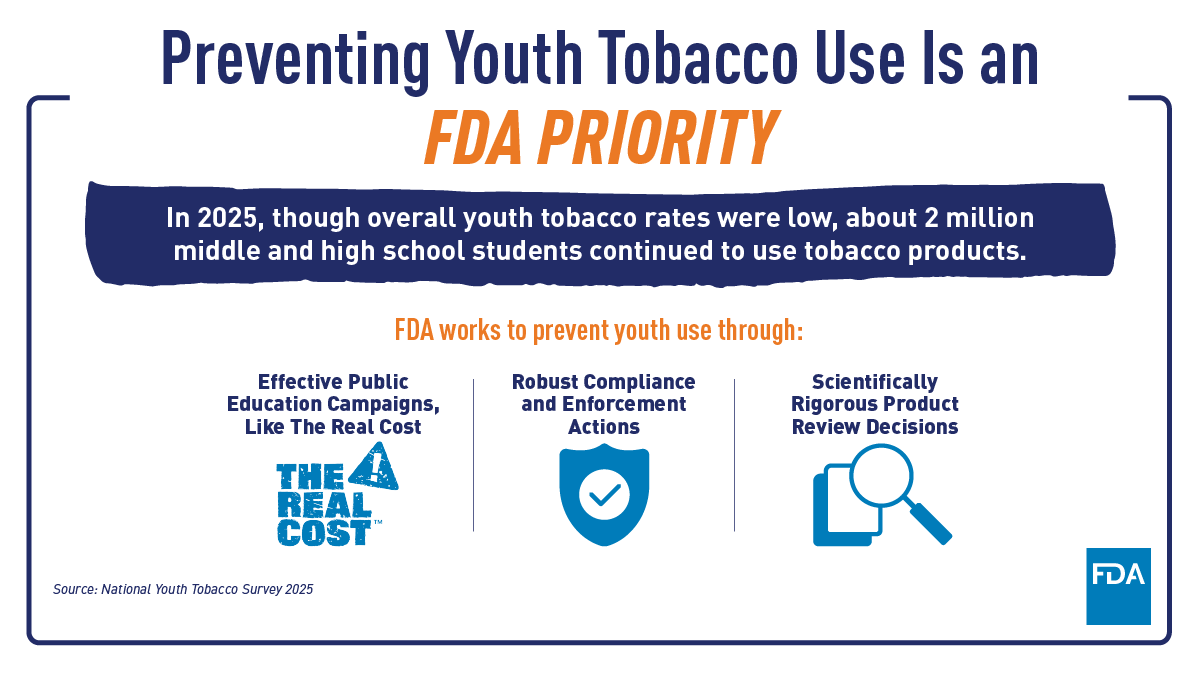
Youth vaping has fallen dramatically—nearly 70% from 5.38 million users in 2019 to 1.63 million in 2024—and declined further to about 1.44 million in 2025.
And some context for that 1.44 million figure matters: "current use" in the federal survey means having used an e-cigarette on at least one day in the past 30 days—not necessarily regular use.
While 5.2% of all middle and high school students reported any e-cigarette use in the past 30 days, about 2.1% of all students used e-cigarettes on 20 or more of those 30 days, and only 1.4% used them daily.
Youth vaping remains an important public health concern, and continued efforts to prevent youth use are important. But describing a steep, sustained decline as an "alarming rise" or "alarming trend" misrepresents the reality. It also obscures the extraordinary public health progress we have made in reducing youth vaping while youth cigarette smoking has fallen to historically low levels.
So why portray a dramatic decline as an alarming rise?
Sound public health policy—and the messaging around it—should be driven by accurate public health evidence.
Hi, everyone! I am back from my X purgatory following a hack (very sorry if I got anyone infected), just in time to announce the latest episode of Keller & Heckman’s podcast, “The Nicotine Scene: PMTAs, Pouches and Policy”.
https://t.co/rWgJaUxYj7
Veteran investigative journalist @MarcGunther examines one of public health's most consequential controversies: why some leading tobacco control organizations continue to resist or fail to accurately communicate the evidence on tobacco harm reduction and the FDA's rigorous review of authorized smoke-free products.
Having worked closely with @LungAssociation over many years, I contributed to his investigation not as an adversary, but as someone who deeply respects ALA's mission to prevent lung disease. That's why I'm genuinely puzzled and disappointed by its position. Millions of lives depend on public health policies and communications reflecting the best available science.
"In closing, I find it appalling that the American Lung Association finds it appalling that the FDA is allowing Swedish Match to tell consumers the truth about the relative health risks of Zyn compared to combustible cigarettes."
https://t.co/4bLONt78xC
Significant post-Jarkesy ruling from the Fifth Circuit: civil penalties for allegedly selling unauthorized vape products must be pursued before an Article III court and jury—not imposed by an HHS administrative tribunal
https://t.co/0MeHQoFj10
🔎 Audio of today's 5th Circuit oral argument in Triton v. FDA (on remand from SCOTUS), including our rough transcript of the session. 1/
👀
https://t.co/UXdXnJZrma
This deserves extra special attention. In the U.S., according to the most recent data:
* 3 of every 100 high school students use nicotine vaping products 20 or more days per month.
* Less than one-half of one high school student out of 100 (in other words, about 1 of every 200) smokes cigarettes 20 or more days per month.
* One-half of one high school student out of 100 (in other words, 1 of every 200) uses nicotine pouches 20 or more days per month.
🚨SCOOP🚨
AVM has obtained a letter from @FDATobacco rescinding the agency's prior rejection of a vape company's products -- a possibly unprecedented reversal outside of litigation. Is FDA finally coming to its senses? Let's examine.
1/🧵
Marty Makary's irrational resistance to flavored nicotine vapes drove his FDA resignation. He let his emotions override his avowed commitment to following the science. https://t.co/4FTMtG3XXC