BREAKING NEWS: Anthropic's latest model will NOT help you if it thinks your ML research/ML engineering is interesting, and/or will secretly degrade its IQ so that the average engineer won't notice. We are already seeing Anthropic's latest model's moderation filters our GPU inference research and programming 😭
Today I'm publishing a new essay, Policy on the AI Exponential. AI is progressing extremely fast—much faster than the policy process was built to handle. The essay lays out where I think the technology is now, and the action needed to close the gap: https://t.co/Lh6PWae178
Introducing Claude Fable 5: a Mythos-class model that we’ve made safe for general use.
Its capabilities exceed those of any model we’ve ever made generally available.
New Science Blog: Why has AI advanced faster in coding than in biology?
To agents, bio databases are like cities built before cars—maddening to drive in because they're designed for different traffic.
How do we build infrastructure agents can use?
https://t.co/PQaNQ4GRJZ
Introducing a more powerful NotebookLM 🚀
Massive upgrades deliver agentic capabilities in chat, more advanced reasoning, and a suite of new output formats. Tackling complex, multi-step research problems has never been easier.
Rolling out now to Google AI Ultra subscribers.
Introducing our new agentic RAG framework. A collab with Google Cloud, our multi-agent workflow goes beyond standard RAG by breaking down complex enterprise queries & iteratively searching for sufficient context before generating dependable responses.
📜→https://t.co/A8l499bLrj
ChatGPT is getting better at remembering what matters: your preferences, constraints, and the context that helps you pick things up where you left off. And with memory summaries, you can review and steer what it remembers.
Rolling to all users over the next few weeks, starting today with Plus and Pro users in the US.
We’ve been researching new ways for ChatGPT memory to carry context across conversations and keep it useful over time.
Today, that work is rolling out as a more capable memory system in ChatGPT. https://t.co/0MyFKCe2Mu
We’re bringing new capabilities to GPT-Rosalind, a model series purpose-built for life sciences research at enterprise scale.
It brings GPT-5.5’s agentic coding and tool use together with stronger intelligence for drug discovery, analysis, design, and experimental workflows.
https://t.co/SrAJ3Mt7ka
Today we’re introducing Gemma 4 12B — our latest open model that brings advanced agentic reasoning, vision and audio directly to your laptop.
It delivers performance nearing our larger Gemma models with a much smaller total memory footprint, while being small enough to run locally with just 16GB of VRAM. It’s open and accessible for everyone to use under a permissive Apache 2.0 license.
This is all made possible by our new, unified architecture that removes separate multimodal encoders. Here’s how we did it 🧵
OpenJarvis: a local-first personal AI is now available to run with Ollama
Built by Stanford’s @HazyResearch and Scaling Intelligence labs, as part of their “Intelligence Per Watt” research into efficient local AI. @Stanford
Learn more in the blog post 👇👇👇
Private MCP servers 🤝 OpenAI products
Your team can keep MCP servers inside your network while ChatGPT, Codex, and the Responses API connect through outbound-only HTTPS.
🔗 https://t.co/UVq0KpT0km
🚨 BREAKING: Claude has a feature called Red Team Mode.
You can use it to attack your own business the way a competitor, investor, or angry customer would, and fix the weak spots before they become real problems.
Here are 7 prompts to access it: 👇
We’ve shipped a security-guidance plugin for Claude Code that helps identify and fix vulnerabilities as you’re writing code.
Available for all Claude Code users. Install from the plugin marketplace (/plugins).
Claude Code is about to release a feature called /workflows that I think will be extremely significant.
Especially for Enterprise AI.
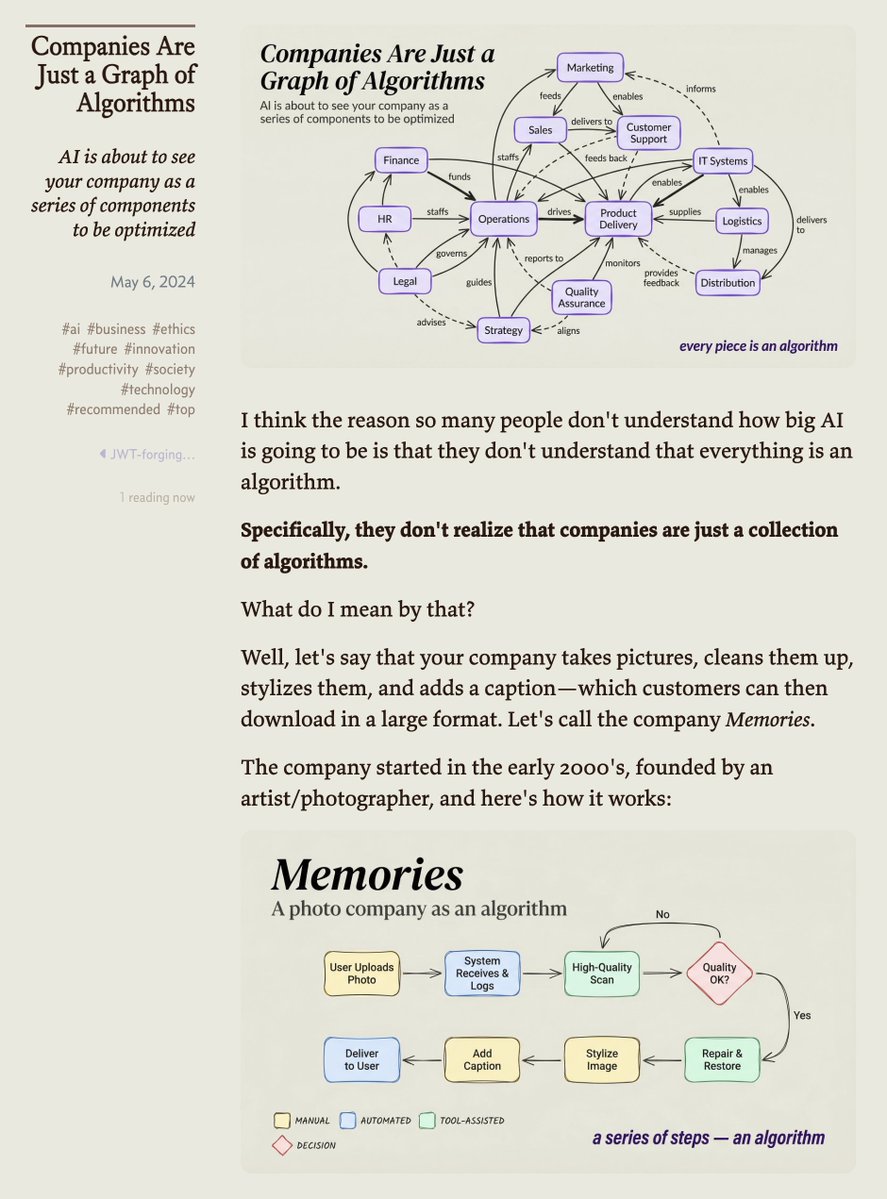
I talked about this in 2024 in a post called Companies Are Just Graphs of Algorithms.
Basically the idea is that all work is just an algorithm, i.e., a series of steps to accomplish a goal.
Skills and Cowork have been heading in this direction already, and we've seen what that's done to company valuations in various spaces.
Well this is closer to the final form.
It's turning the regular, expected work that's done in companies into pseudo-deterministic workflows that follow defined SOPs.
The human role will be determining what problems to solve (taste, expeirence, etc), building new products from that, and then optimizing these workflows from above.
But the work itself will be these workflows executed according to SOPs.
Introducing Gemini for Science — a collection of AI tools to help accelerate the scientific process. Gemini can already assist in solving complex problems, but our new @GoogleLabs prototypes can help streamline more daily scientific tasks, including:
📃 Staying on top of new papers
🧑💻 Transforming research goals into usable code
💡Generating new hypotheses
#GoogleIO