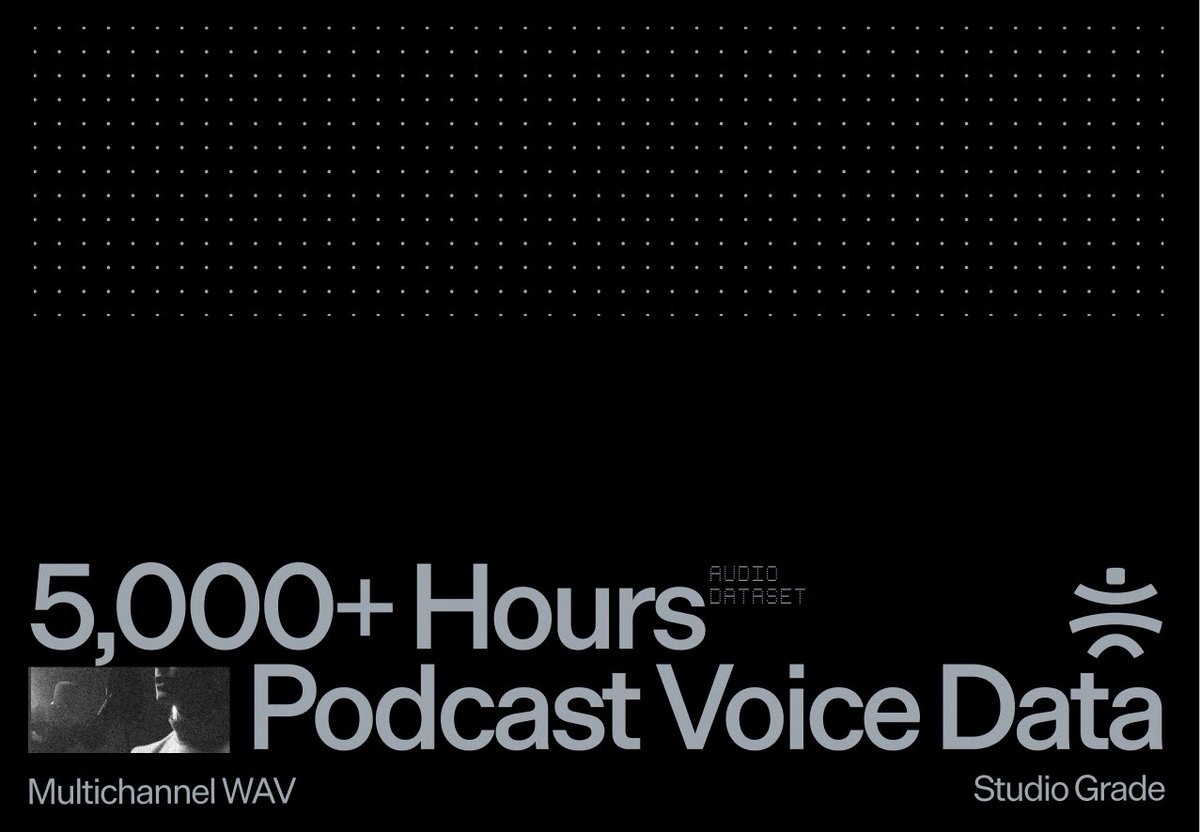
5,000+ hours of multichannel podcast audio sourced from our growing network of creators.
If you're looking for audio data, reach out to us at [email protected]
I have some news: After five years, Syndicate Labs is winding down. Unfortunately, our customer traction was not enough to make a viable business or sustain us as a contributor to Syndicate Network. I’m proud of what we contributed to this space over the prior half a decade, from helping Constitution DAO place a bid at Sotheby’s to powering smart contracts for Fortune 100s to providing transaction broadcasting and rollups to hundreds of startups.
Our focus for the past few years has been customizable appchains. To put it bluntly, the rollup market has not been thriving. L2s/L3s have a place for applications that have hit scale, but very few applications meet that threshold. This is especially true as the market has been consolidating around institutional finance, with declining consumer use cases. There have been countless chain wind-downs, often done quietly. I’d estimate that for every one new rollup being created today, several more are winding down. The ones that are thriving are highly custom, with execution environments built completely from scratch (e.g. Hyperliquid). Generalized EVM rollups are struggling, as is everything that’s not effectively a custom backend.
In this market, we only had one option left: pursue an orderly wind-down.
We considered whether we could restructure to wait for a resurgence in the rollup market. Most of the Rollup as a Service providers today are pivoting to a consulting model. (Often called “solutions” or “services” teams, these are deeply custom builds for new chains.) We evaluated our technology to see whether it would be a good fit for this custom rollup market.
In particular, we allow for sequencer customization, so that block building or transaction inclusion can be heavily modified. We do not customize the execution environment, which is an EVM execution environment (+ Rust in WebAssembly via Stylus) on top of Arbitrum Orbit. All of these transactions are sequenced to Syndicate Network. More transactions flowing through our framework = greater network usage.
Most of the customization for chains today is customization of execution environments. This is custom code written into the execution client for different use cases (Hyperliquid for trading, Tempo for stablecoin swaps and transfers, etc). This is so specific to each use case that it’s hard to build into a reusable framework. You either need to build very general primitives (as Commonware and Sovereign do) or you need to have an extensible execution client (as Reth does). Since we build sequencers and do not build execution clients, our rollup framework doesn���t fall into either category. It’s too specific to work as a generic primitive, and not close enough to the execution client to be extended into specific apps.
As such, we decided that we couldn’t hold out for the rollup market to improve. Our framework matters a lot for things like MEV pipelines and permissioned rollups for enterprises. The new customers coming across our radar were not that, and instead wanted consultants to build them a custom app, and they did not want a framework. Our prior work would not be relevant, and it would not use Syndicate Network given that it would not use our tech. At the same time, we’d be competing as consultants with half a dozen other teams that have recently pivoted to being consultants. If the work benefited Syndicate Network, it would have been different, but we didn’t see a path toward this kind of consulting leading to network value.
Instead, we decided on an orderly wind-down. This helps us:
1. Ensure that we can handle all obligations to our customers
2. Make our work widely accessible for those who want to continue building on Syndicate Network
On the first point, we are helping customers migrate after a recent bridge compromise. They can set up a new bridge and self-host on Syndicate Network (which was unaffected) or they can migrate to a third-party hosting provider and optionally back up their data to Syndicate Network. We are working with them right now on the options that they want to pursue. (This wind-down decision was separate from the compromise and reimbursement. We have sufficient buffer that it was not a factor in deciding between these two paths.)
On the second point, we have created a toolkit for anyone who wants to carry our work forward with Syndicate Network. If someone does step up, all of our code and tooling is open source and available for them to pick up our work. We will also advocate for them to receive generous token allocations to support their efforts. If no one steps up, we will proceed with an orderly wind-down of the DUNA and our current hosting for Syndicate Network, which is our current projected path. The SYND token is a smart contract that will always exist, and it can be plugged into any future hosting provider for Syndicate Network. We expect the wind-down process to finish before the end of the year.
I wish that we had a different outcome after five years. We sought every single path that could continue to provide value to Syndicate Network. Ultimately, the rollup market did not support paths that would lead to usage of SYND. Team members and investors remain locked, and no team member or investor affiliated with us has been able to access their token allocations. We set up our vesting to align us with long-term incentives, and I do want to reassure community members that there have been zero short-term benefits for any team member or investor. All of our efforts have been focused on helping Syndicate Labs continue to support Syndicate Network, and I wish that we had paths that allowed us to do this.
I’ll have more on what’s next for me soon. The contributors to Syndicate and I are staying in the industry and will contribute to it for the long term. In the meantime, my priority is our team, customers, and community members. We will continue to work on a smooth and orderly wind-down process.
We're sunsetting tETH and tUSD.
All users should redeem their tETH and tUSD on Eclipse immediately.
Users may redeem by visiting the respective sites for each token.
tETH: https://t.co/X0EwRuhAol
tUSD: https://t.co/GlZTMgkB4T
The last day to redeem from the frontend is December 31, 2025. After that, users will need to redeem directly from the smart contract, but all funds will remain available.
Infrastructure companies that stay infrastructure die.
The winners build products on top of their infrastructure advantage.
We're not staying infrastructure.
What if the next trillion-dollar company has zero employees?
AI agents are getting close. But they still can’t finish the job. In this interview with @humanapi CEO @0xSydney, she breaks down:
• The last-mile problem of AI
• Why agents still need humans
• How “zero-person companies” might actually work
Full conversation ↓
AI agents might automate tasks, but they still need humans.
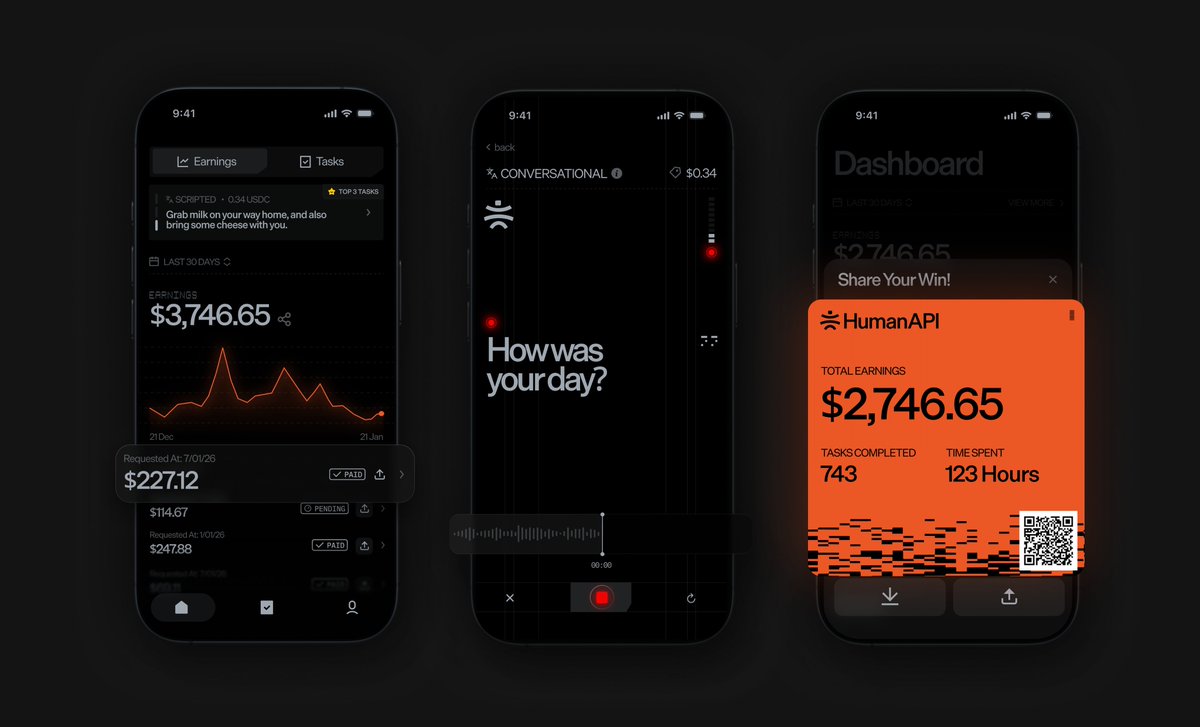
@0xSydney, Founder of @humanapi, joined @DavidThaDegen to talk about building a platform where AI agents can hire humans.
0:46 - What HumanAPI Is
3:04 - Human Presence In An AI World
5:00 - Speeding Up The Hiring Process
5:49 - Where The Project Stands Today
7:23 - Their Focus On Voice AI
10:58 - What To Be Excited About
13:48 - Sydney’s Background
14:47 - Hurdles They’ve Overcome
15:18 - User Feedback So Far
19:33 - What You Should Know
Watch the full conversation below!