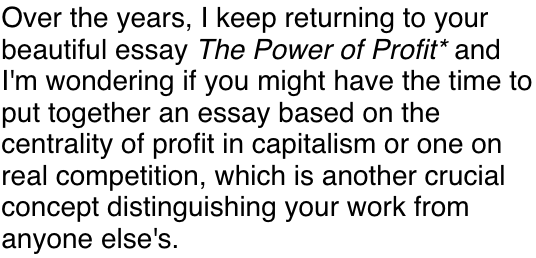
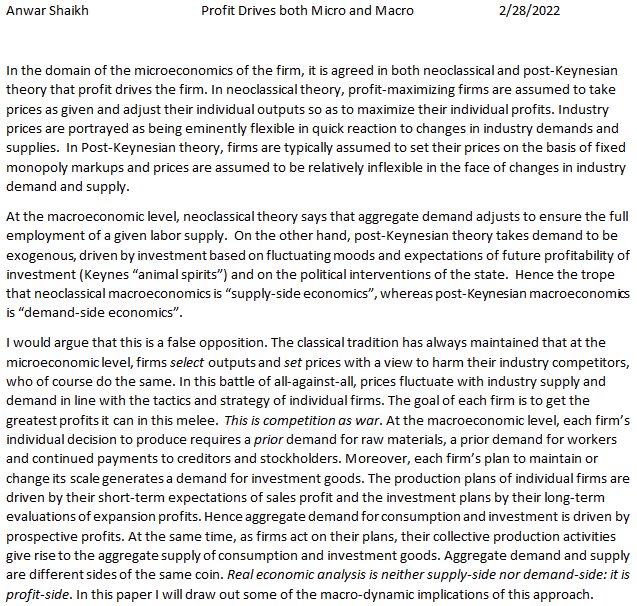
Anwar Shaikh hat viel marxistische Ökonomie gemacht, sich aber nicht mehr als marxistischen Ökonom bezeichnet. Stattdessen hat er marxistische, keynesianische und postkeynesianische Beiträge zur "klassischen politischen Ökonomie" zusammengefügt, wie in diesem Beitrag von 1989.
I couldn't stop thinking about all the recent deaths so I've spent the last couple of hours writing. I am about 2/3rds done, should be out in the morning.
A certain small corner of the world won't want to miss this.
https://t.co/VHElrpAJ0i
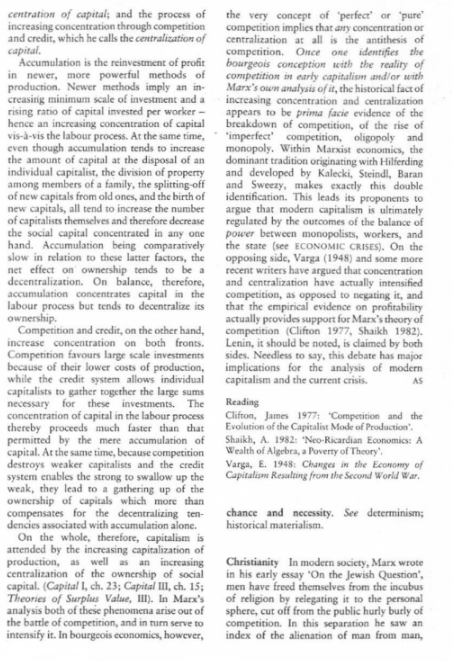
Anwar Shaikh war ein entschiedener Kritiker der Monopolkapitalismus- und imperfekter Wettbewerb-Theorien in der heterodoxen Ökonomie. Gleichzeitig hat er Marx' Analyse der Konzentration von großen Kapitalen ernst genommen - zum Beispiel in diesem Buchkapitel von 1983.
Nachgelesen: Perry Mehrling
1. Inherent Hierarchy of Money – https://t.co/01uYNa7aP7
2. Payment vs Funding – https://t.co/uUM120MieE
3. Re-imagining the Lender of Last Resort – https://t.co/qcTwQRYt1V
4. Money View of International Lender of Last Resort – https://t.co/i3DTZvm57s
Mehrling was a creative and original heterodox economist, and a community builder. Both his popularization of the money view and his work on the Young Scholars Initiative were crucial contributions that we can only hope live on, and keep evolving.
Farewell, Anwar. Thank you for helping us believe that another political economy was possible. – Emiliano López and Facundo Barrera Insua / Tricontinental Political Economy
https://t.co/46TaXHKTxB
Dado el interés por el Nobel paso a recordar que existe una Microeconomía Macro fundada.
Microeconomía heterodoxa, Gabriel Montes Rojas https://t.co/ylr04ZWLbB
Throughout my PhD, I kept returning to the problem of how to estimate capacity utilization using cointegration methods, initially inspired by Anwar Shaikh’s work.
That work is now a UMass Econ Working Paper:
https://t.co/WU9hrSXTTF
🧵in honor and memory of Anwar Shaikh
It's inevitable to fall on self-centered recollections when thinking about guys like this. This is the major email he sent me, in 2024, when I shared drafts of my book with @anninak82 and @RiccardoDOrsi. I hope he managed to finish his own book. RIP, Perry.
ANWAR SHAIKH, 1945-2026
1 week ago, Anwar Shaikh, University in Exile Professor Emeritus of Economics, passed away. A preeminent political economist, Anwar was a towering intellectual figure both on the global stage and here at The New School --
For people doing SFC models in Python, I'm building a solver. The main advantage is that it's easy to use and very fast.
Still a draft, not yet on pip, but check it out here: https://t.co/KZhp4njUUQ
The "Nobel" prize in economics explained:
"A central bank is ritualistically blessing academic research which, in turn, ritualistically blesses all central banks."
New Keynesian economics, along with Woodford’s theoretical framework, should have died in 2008. Yet here we are in 2026, and New Keynesians still cannot convincingly explain the global financial crisis within their theoretical models, despite its being one of the most extensively documented economic crises in history.
The reason NK survived its own intellectual bankruptcy is to be found less in economic theory than in political economy: the people lost the struggle to fundamentally transform society.
Amazing bit of revisionism - the intellectual authors of the models that allowed central banks to ignore the shadow banking instability that exploded into 2008 global financial crisis are now presented as 'transformers of crisis central banking'
https://t.co/QJoH2GHXiS via @ft
Keynes of the GT does not belong in this list. Keynes is Wicksellian up to the Treatise but he is very explicitly breaking with this approach in the GT. The GT of employment, interest and money is that there is no well-defined "natural" unique rate of interest and employment.
Anwar Shaikh hat seine Ökonomie nicht zum Rechthaben sondern zum Verstehen zusammengestellt. Er hat sich immer wieder sorgfältig an die großen Fragen herangearbeitet. Zum Beispiel die strukturellen Anteile der Einkommensungleichheit in diesem Papier von 2014 im Journal Physica A.
Emiliano López y Facundo Barrera: 'Anwar Shaikh nos demostró que la crítica de la economía política no podía limitarse a repetir las conclusiones de los pensadores clásicos.'
https://t.co/DzzxLsIAW9
A propósito del anuncio del Premio del Sveriges Riksbank y el posible regreso de los DSGE models, les comparto este artículo en donde se presentan las limitaciones de utilizar estos modelos para el análisis Macro-Ecológico. https://t.co/pZVeWtBWTJ