@simongerman600 Seems like the gap between the median age of the US population and the median age of legislators has remained constant, and may even have declined recently.
@simongerman600 I can only state that this is absolutely astounding in terms of demographic shift. Even though the One Child Policy was abandoned in 2016. It tells a lot about the underlying social and economic conditions post-2020.
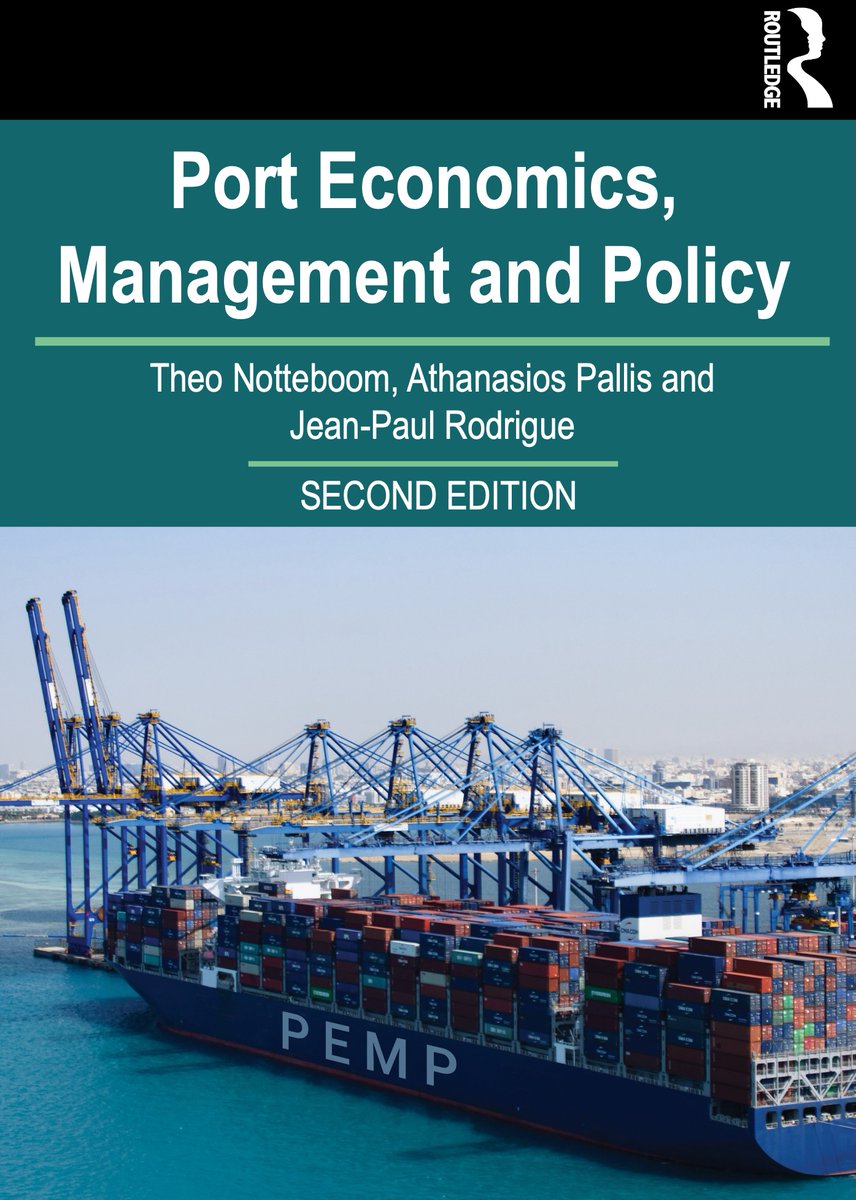
The 2nd edition of Port Economics, Management & Policy is available (hardback/ paperback/ebook formats➡️ order your copy: https://t.co/rAozrTuoVl➡️ Web-companion: https://t.co/BI0nnMmPPf ➡️authored by: @TheoNotteboom@apallis, @ecojpr.
@simongerman600@researchremora Interesting. Limited level of integration into a national grid? Regional suppliers that do not trade electricity surplus?
@cremieuxrecueil Sorry to say, but not a very good projection choice (cylindrical) for the purpose. A conic projection, such as Albers Equal Area, would have done a better representation of the distances involved.
My department is hiring for TWO tenure-track assistant professor positions in maritime business!
◾ Position 1 (MARITIME LOGISTICS)
◾ Position 2 (MARITIME MANAGEMENT)
For additional details and to apply:
https://t.co/pDZYbaw8QF
From Jean-Paul Rodrigue of @AggiesByTheSea:
The United States has 6 #automated#container#terminals; 3 on the East Coast (one in New York and 2 in Norfolk) and 3 on the West Coast (all in the LA/LB port complex).
◾ While terminal automation on the West Coast includes horizontal movements (AGVs or Autostrads) and stacking (ASCs), only automated stacking (ASCs) is used on the East Coast.
◾ Automated terminals are significantly larger than the global average (55 ha). This underlines the scale effect of their deployment, particularly in light of limited options for terminal expansion in LA/LB and New York. 2 million TEUs and above of capacity is common.
◾ The northern part of NIT is currently being upgraded to ASCs (from straddle carriers), which will likely double its capacity.
◾There is no apparent commonality in the storage of empties and reefers in an automated terminal.
◾Four terminals keep empties within their automated stacks (VIG, NIT, APMT & LBCT) while two terminals also keep empties in separate non-automated stacks (GTC & TRAP).
◾Four terminals keep their reefers within their automated stacks (NIT, TRAP, APMT & LBCT), one in a hybrid fashion (VIG), and one outside its automated stacks (GTC).