Resumen detallado del terremoto en Venezuela (24 de junio de 2026)
El 24 de junio de 2026, a las aproximadamente 18:04-18:05 hora local (Venezuela, UTC-4), se registró un doble sismo (doublet) en la costa norte del país. El primero alcanzó magnitud 7,2 (Mw), con epicentro a unos 24 km al este-noreste de San Felipe (estado Yaracuy), a una profundidad de 21,9 km. Apenas 39 segundos después llegó el principal, de magnitud 7,5 (Mw), con epicentro a 23 km al sureste de Yumare, a solo 10 km de profundidad (más superficial y, por tanto, más destructivo).45
Este evento se considera el más fuerte registrado cerca de Venezuela en décadas (el mayor desde al menos 1900 en registros históricos de la zona). El USGS (Servicio Geológico de Estados Unidos) emitió una alerta PAGER ROJA para el sismo principal, lo que indica alta probabilidad de muchas víctimas y daños extensos, con un desastre generalizado probable debido a la magnitud, la poca profundidad y la exposición de población en zonas urbanas. El sismo generó intensidades de hasta IX (violento) cerca del epicentro y fue sentido con fuerza en Caracas y otras ciudades del norte y centro del país, así como en partes de Colombia.38
Daños e impactos inmediatos
•Múltiples edificios colapsaron o sufrieron daños graves, especialmente en Caracas y áreas cercanas (reportes incluyen estructuras derrumbadas, escombros y afectaciones en infraestructura como carreteras y zonas cercanas al aeropuerto de Caracas).
•Equipos de rescate (bomberos, policía y voluntarios) iniciaron operaciones de búsqueda entre los escombros pocas horas después.
•El movimiento telúrico se sintió ampliamente; circularon videos de personas reaccionando al fuerte temblor en la capital y otras localidades.
•Se emitieron alertas de tsunami para la costa de Venezuela y islas del Caribe (Aruba, Bonaire, Curazao y otras), aunque fueron de corta duración y no se reportaron olas significativas.40
Situación de víctimas y rescates Hasta las primeras horas del 25 de junio de 2026 no existe una cifra oficial confirmada de fallecidos. Las autoridades venezolanas y organismos internacionales están realizando evaluaciones. Reportes iniciales en redes y medios locales mencionan víctimas fatales en edificios colapsados (incluyendo referencias a al menos un edificio con muertos), pero sin totales agregados.
La alerta PAGER ROJA del USGS sugiere que decenas o cientos de víctimas (o más) son probables, considerando la intensidad del sismo, los colapsos reportados y el tipo de construcciones en la zona afectada. Los rescates continúan y las cifras podrían actualizarse en las próximas horas o días. No se reportaron víctimas en sismos menores previos de junio de 2026 en la misma región.36
Contexto y pronóstico Venezuela se ubica en una zona sísmicamente activa (interacción de placas Caribe y Sudamericana). Este doble sismo superó en magnitud eventos recientes y generó réplicas esperadas. El USGS estima:
•Probabilidad de ~43 % de una réplica de magnitud 6+ en la próxima semana.
•Casi 100 % de probabilidad de réplicas de magnitud 4+ o 3+.
El sismo afectó a millones de personas en un radio amplio. Las autoridades recomiendan precaución por réplicas, evitar edificios dañados y seguir indicaciones de protección civil.
Anoche cenamos en Miami. Llega la cuenta: 20% de propina incluida. Perfecto. Entonces viene el camarero y nos explica que esa propina se reparte entre todo el personal, y nos anima a dejarle una adicional solo para él. Llámame tacaña, pero esto ya me parece abusivo. No es cuestión de dinero; es la sensación de que cada vez te están pidiendo un poco más. Me hizo sentir incómoda. ¿Soy la única a la que esto le parece excesivo?
🚨 SHOCKING: An ex-Anthropic researcher just leaked the exact internal prompting framework the team uses.
Most people treat Claude like a basic chatbot and leave 60–70% of its reasoning power on the table.
These 10 prompts are how the pros actually use it — tested internally for maximum clarity, honesty, and depth.
Copy-paste ready. Zero fluff.
Save this thread. Your Claude game is about to change forever.
(Pro tip: use them in order for compound results)
Anthropic pays engineers $750,000+ a year to understand how LLMs work.
Stanford just put a 2 hour lecture that covers 80% of it for FREE.
Bookmark this. Give it 2 hours today.
It might be the highest ROI thing you do this month:
An Anthropic engineer watched me trade from across the table at a WeWork in SF
I had my laptop open. Four agents running. Green charts. Live trades scrolling.
He was on a Zoom call. Muted himself. Walked over.
"Are you running Claude against live prediction markets right now"
I told him. Claude Code. Two repos. $25 a month.
He pulled up a chair.
"I helped build the model you're using. I've never seen anyone wire it to live trades like this"
I showed him the dataset.
https://t.co/klxt0tuTYF
86 million trades. Every wallet. Every entry. Every exit.
He stared at it.
"We tested this internally. You give Claude a dataset and don't tell it what to look for. It finds the winning wallets. Then it finds WHY they win. Then it copies the pattern. We never shipped it because legal killed it"
I told him I did exactly that. One weekend. Claude Code found the exit logic on its own.
Top wallets exit before resolution 91% of the time. They capture 86% of expected value. Cut losers at 12%. Everyone else captures 58% and holds to 41%.
"That's the exact finding from our internal eval. Except ours took a team of eight and four months"
I showed him the scanner.
https://t.co/SbyxXxEMbe
Three commands. 500+ markets. No API key. Claude scores them all in 20 minutes.
"You're using our model to beat markets we're not allowed to touch. On infra that costs less than my lunch"
My setup:
Claude API - $20/mo
VPS - $5/mo
poly_data - free
polymarket-cli - free
214 trades. 74% win rate. +$9,400. 19 days.
I showed him the full breakdown. Every repo. Every command. Every dollar.
Copytrade here: https://t.co/N2byLbLHH9
He read it for five minutes. Then looked up.
"If my manager sees this he's going to lose his mind. You just proved our model works in production and we've been sitting on it for a year"
He DM'd me that night.
"Take this down before someone at Anthropic finds it"
Too late.
In 14 minutes, this Anthropic engineer who wrote "Building Effective Agents" will
teach you more about building them right than most developers figure out on their own
in months.
Bookmark this for the weekend. Then read the builder's guide below.
This 2-hour Stanford lecture breaks down how models like ChatGPT and Claude are actually built, clearer than what many people in top AI roles ever get exposed to.
Save this and set aside two hours today. It might end up being the most valuable thing you learn all week.
Here's some advice that no banker will ever give you, because no banker makes money recommending this:Just put most of your long-term money into QQQ (the Nasdaq-100 ETF) as I do, and hold it for decades.Why? Because it's simple, ultra-low cost (0.20% fee), and has delivered incredible results with almost no effort.
Example:
If you had invested $100,000 in QQQ on January 1, 2020 (with dividends reinvested), you would have ≈ $298,000 – $300,000 today (as of mid-April 2026). Today QQQ reached an all time high.
That's nearly tripling your money in a little over 6 years.Compounded annual return (CAGR) since then: ≈ 19.8% – 20.0% per year.
Even after surviving the -32.6% drawdown in 2022, the long-term compounding is powerful.If you are my follower you know that I’ve been recommending this approach for years.
Another advantage is that if you buy and sell stocks, even if you do well, you pay taxes on the profits. But if you buy QQQ and hold it, QQQ trades but those trades are not taxable to you. So not only is stock picking generally worse than owning QQQ, but it is also taxed at higher rates.
Lastly tell me any fund you own that has done better than QQQ, that is liquid and available to everyone and I buy you an ice cream here in Miami :) There is none as far as I know.
This 2 hour Stanford lecture shows exactly how Stanford trains it's engineers to build AI systems. It's more practical than every Claude tutorial & prompting threads you've seen.
Bookmark & give it 2 hours, no matter what. It'll be the most productive thing you do this weekend.
BYD’s 1.5 MW charging matters more than another LLM benchmark. When an EV goes from 10 to 97 percent in 9 minutes, the product stops being a car and becomes infrastructure. Western automakers still think they sell vehicles. BYD is selling a power stack.
The biggest AI price collapse is not model access. It is expertise. When frontier intelligence costs less than a junior hire, every industry with bloated white collar overhead gets repriced. The winners will be the firms that rebuild workflows first.
This actually happened in Korea.
A convenience store worker left in the middle of the night. Just... left. No replacement. No notice.
The store stayed open. Unattended. For 8 hours.
What happened?
A customer walked in, saw no one at the register, waited... then just went behind the counter and started scanning items for other customers.
For 8 hours, random customers took turns running the register.
Every item was paid for. Nothing was stolen.
The owner checked the CCTV the next morning and couldn't believe it.
8 hours. No staff. No theft. Customers literally ran the store for free.
This went viral overseas before it even blew up in Korea. People couldn't believe a store could sit empty for a whole night and nothing would go missing.
Anthropic leaked 512,000 lines of Claude Code source code yesterday.
What happened in the next 12 hours is absolutely wild.
4 AM. Anthropic pushes an update to npm. Inside the package: their entire codebase. A 60 MB debugging file accidentally bundled in.
23 minutes later, researcher Chaofan Shou spots it. Downloads the zip.
Posts it on X. Within 6 hours: 3 million views.
By the time Anthropic’s team woke up, the code was forked 41,000+ times across GitHub. Anthropic started firing DMCA takedowns. Too late.
A Korean developer named Sigrid Jin woke up to his phone exploding. He’s Claude Code’s biggest power user.
WSJ reported he burned through 25 billion tokens last year.
He read the leaked code.
Rewrote the entire thing in Python in 8 hours. His repo hit 30,000 stars faster than any GitHub project in history.
Then he rewrote it again in Rust. That version now has 49,000 stars.
Someone mirrored it to a decentralized platform with one message: “will never be taken down.” The code is permanent. Anthropic cannot get it back.
Here’s the part I can’t stop thinking about: Anthropic built something called “Undercover Mode.” Its only job: prevent Claude from accidentally leaking internal secrets.
They shipped an entire anti-leak system in their own product. Then leaked their own source code in a .map file. Irony is beautiful
In 2019, MIT professor Patrick Winston gave a legendary 1-hour lecture called “How to Speak.”
It has 18M+ views for a reason.
His frameworks:
• Your ideas are like your children
• The 5-minute rule for job talks
• Why jokes fail at the start
15 lessons on communication:
When Charles de Gaulle led France, he treated public money as something untouchable.
At the Élysée Palace, there was a strict rule for him: no personal expense could ever be paid for by the state.
His wife, Yvonne, kept a small notebook in which she meticulously recorded all family expenses — from food and electricity to clothing and even soap.
At the end of each month, she would send a check to the state treasury, reimbursing every last cent.
Once, an accountant remarked that this was not really necessary.
She calmly replied:
“Everything that is not public is personal.
And for personal matters, we pay ourselves.”
This principle applied without exception.
Their children and grandchildren were not allowed to use official cars for private matters.
De Gaulle himself refused any privileges of office: he paid his own bills at the palace — even for the smallest things, such as soap or family meals.
Moreover, he did not use his presidential salary, living only on his military pension.
After his death, there was no wealth or luxury left behind — only a modest house in Colombey-les-Deux-Églises, purchased before the war.
It is said that he would sometimes personally send money to the treasury if he suspected that any personal expense might have accidentally been covered by the state budget.
This was not a formality.
It was a principle.
✨ An example of true integrity, honor, and responsibility in public service.
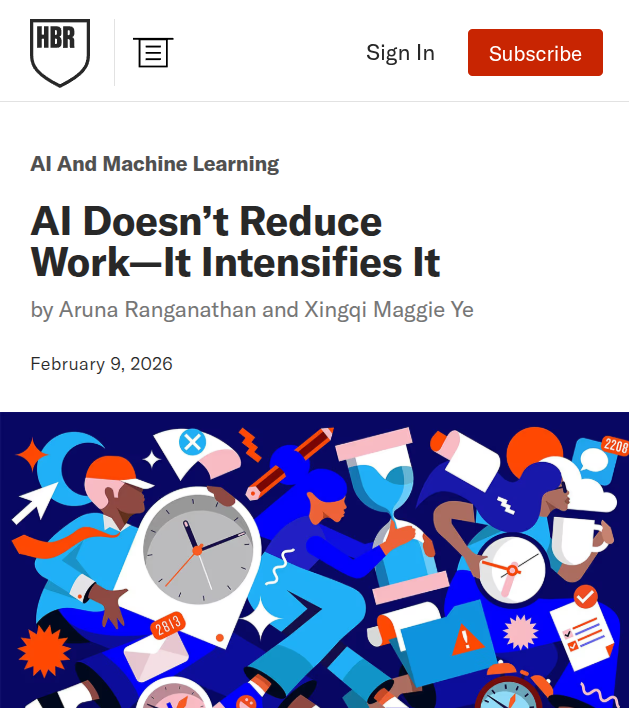
A super interesting new study from Harvard Business Review.
A 8-month field study at a US tech company with about 200 employees found that AI use did not shrink work, it intensified it, and made employees busier.
Task expansion happened because AI filled in gaps in knowledge, so people started doing work that used to belong to other roles or would have been outsourced or deferred.
That shift created extra coordination and review work for specialists, including fixing AI-assisted drafts and coaching colleagues whose work was only partly correct or complete.
Boundaries blurred because starting became as easy as writing a prompt, so work slipped into lunch, meetings, and the minutes right before stepping away.
Multitasking rose because people ran multiple AI threads at once and kept checking outputs, which increased attention switching and mental load.
Over time, this faster rhythm raised expectations for speed through what became visible and normal, even without explicit pressure from managers.
I live in Sweden.
And I work more than half of my time in the United States.
I know both systems — not from headlines, but from daily life.
Sweden has a capitalist market economy.
Private ownership. Competition.
Global companies.
We also have social reforms: healthcare, paid parental leave, paid vacation, and social security.
This is not socialism.
This is not communism.
It’s capitalism with guardrails.
The market creates wealth.
Society prevents bad luck from becoming a life sentence.
Our freedoms are intact.
Our economy is competitive.
And no — this isn’t theory.
I live it.