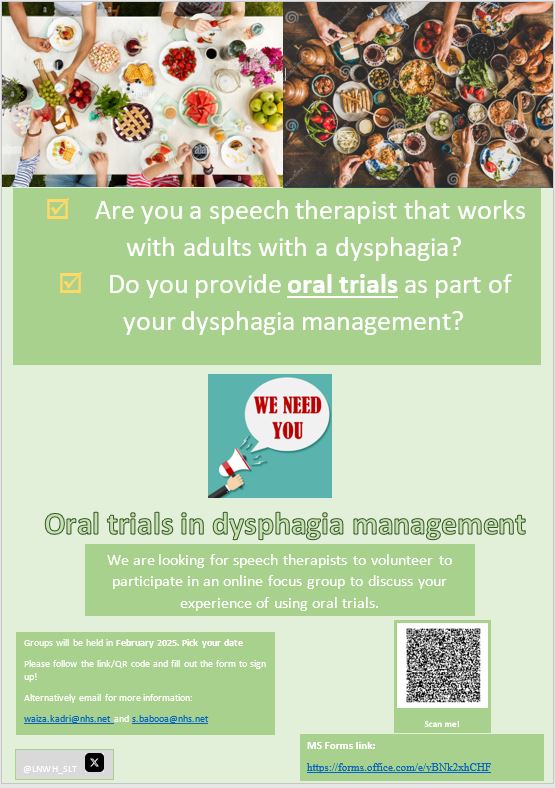
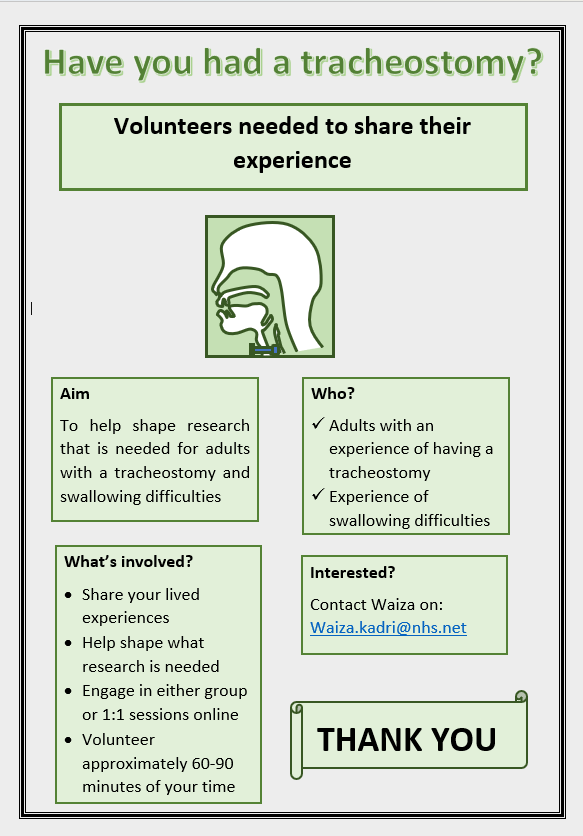
Thank you to everyone that has already signed up. If you are an #SLT working with adults in the U.K please take part in our focus groups exploring oral trials in the: i) stroke and ii) tracheostomy population. Feb 2025 dates!
@RCSLTTracheCEN@LNWH_SLT
https://t.co/4dg5Ax5ydj
Recruiting volunteers (adults with experience of having a #tracheostomy). Please share and encourage people to share their experiences.
The results will help build meaningful research for people with a tracheostomy. #PPI@RCSLTTracheCEN@RCSLTResearch
Such an exciting and empowering chat with @EDIT_Research today - SO many exciting questions popping up about dysphagia and tracheostomy, therapy interventions and next steps
NEW NATIONAL STROKE GUIDELINES: Patients with tracheostomy and severe dysphagia after stroke may be considered for pharyngeal electrical stimulation to aid decannulation
@Phagenesis @TheStrokeAssoc@Deborah71247971#thinkphagenyx
https://t.co/ZE66lDh2qF
#Dysphagia in adults with a #trache has been reported as between 30% & 70%. Several factors can increase this risk: pre-existing swallowing impairment, neurological disorders, age, sedation and hypercarbia
@RCSLTTracheCEN
https://t.co/ZZnKA5NNUi
A very exciting #dysphagia#therapy feasibility protocol. A study that can hopefully be extended to adults with a #tracheostomy to learn more about how to facilitate rehab in this population.
https://t.co/xFnqpWd5Xu
A prospective study (n=14) evaluated a swallowing rehabilitation programme. Ten patients (71%) were able to receive oral intake, with 6 (42%) having complete resolution of dysphagia, and 2 (14%) experiencing partial improvement.
#Therapy#Dysphagia
https://t.co/TJWTgQJ60u
Research needed in: Impact of early cuff deflation/cuffless tubes: weaning outcomes & optimisation of oral intake; Clinical trials of ACV: benefits on swallowing rehab; Screening of oral trials & factors for delays; Patient experience of oral intake
https://t.co/ZZnKA5wcvI
Some clinicians view cuff deflation as a late step in the weaning process. Evidence indicates: early cuff deflation is widely tolerated and facilitates oral intake, reduces time to weaning and decannulation & can reduce rates of resp infections.
https://t.co/ZZnKA5NNUi
A scoping review found: only 43% (n=54/126) of patients had commenced oral intake in the ICU.
Research protocols identifying how we can increase this is needed #tracheostomy#Dysphagia#Therapy@RCSLTResearch@RCSLTTracheCEN
https://t.co/ZZnKA5wcvI
A clinical trial comparing cuff deflation & inflation during spon breathing trials found cuff deflation resulted in a significantly shorter wean time (3 vs 8 days, p<0.01) with significantly lower incidence of respiratory infection (20 vs 36%, p=0.02).
https://t.co/ZMgH3gq9oL
"Tracheostomy tube type and inner cannula selection affected pressure and resistance to air flow during inspiration and expiration"
#Trache tube type should be taken into consideration when developing a #dysphagia#therapy programme @RCSLTTracheCEN
https://t.co/9ABqroaz1s
"There was a statistically significant reduction in length of cannulation for those patients who utilised AAC to communicate."
Dual research protocols in #dysphagia & communication is needed to support reducing LOC #tracheostomy@RCSLTResearch
https://t.co/Bry8vMovtH
Interventions to facilitate decannulation included 74% of patients (n = 231/376) utilising a one way speaking valve.
Further research is needed into other dysphagia therapy interventions that can support decannulation
#Dysphagia@RCSLTTracheCEN
https://t.co/Bry8vM6U57
From #tracheostomy insertion to starting oral intake = 24 days. A fifth (n = 49/243; 20%) of patients with data commenced oral intake prior to decannulation. Of these, half (n= 23/46) with data received texture-modified oral intake. @RCSLTTracheCEN
https://t.co/Bry8vM6U57