10 yrs since the Nature evolution debate, the article is cited >1000 times. Another specifying the structure, assumptions and predictions of an extended evolutionary synthesis is cited >1400 times (https://t.co/RaEppNAZBj). Such citation must mean something.
@rfsaldanhario Olá, Rafael. Estou recebendo o seguinte erro:
IOError: google::cloud::Status(NOT_FOUND: Permanent error ListObjects: The specified bucket does not exist. error_info={reason=notFound, domain=global, metadata={http_status_code=404}}). Detail: [errno 2] No such file or directory
So happy to have this paper out! Say goodbye to ⍺ = 0.05 and learn how justify the significance levels in terms of sample size. The paper comes with complete guidelines, examples, a shiny app and an R-package. Everything you need to get started!!
Você estuda espécies da Mata Atlântica e os processos relcionados a elas? Ja conhecia a série DATAPAPERS da Ecology? Então talvez se interesse pelo ATLANTIC SPATIAL.
Prazer em ter feito uma pequena contribuição nesse data paper!
In what may be one of Earth’s craziest forms of mimicry, researchers have discovered a new species of rove beetle that grows a termite puppet on its back to fool real termites into feeding it. https://t.co/iY1cAUTDBL @NewsfromScience
Plz RT: One month is left to apply for a postdoc in my research group to work on theory of social foraging. It is for two years and subject to extensions. Looking for someone with a PhD in a quantitative field @CBehav Apply here: https://t.co/zdCXuDL26m
Fully funded 2yr postdoc on the evolution of fleshy fruits. Work at @idiv - THE hotspot of biodiversity research, together with @RenskeOnstein (@Naturalis_Sci), Martin Mascher (@LeibnizIPK), and Belinda Kahnt (@UniLeipzig). Apply by Aug 18; email/DM me for more info
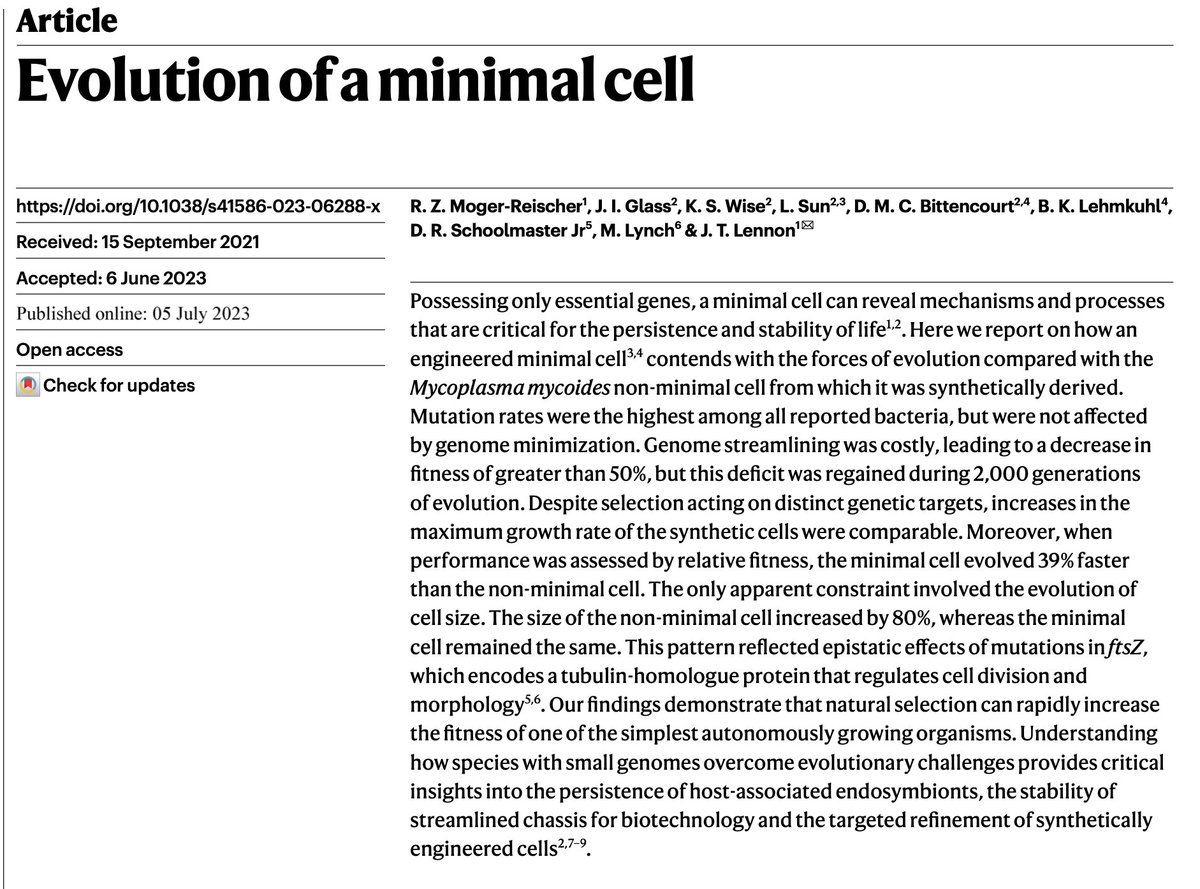
A mind-blowing paper has come out today in @Nature
In 2016, JC Venter Institute scientists trimmed a bacterial genome to its barest minimum required for life to synthesize what they called a "minimal genome" (https://t.co/Rk8oZJ0bUj).
Today, a group of scientists from Indiana University reports how that minimal genome evolved over 2000 generations in comparison to the non-minimal genome.
The authors found that even when you reduce a bacterial genome to its absolute minimum where every nucleotide matters, the genome undergoes mutational events generation after generation as much as the non-minimal genome. One simply cannot stop the evolution.
Just over 300 days of evolution (equivalent to 40,000 years in humans) the minimal cell has gained everything it lacked in fitness on day one in comparison to the non-minimal cell.
When comparing the evolved traits between the minimal and non-minimal cells, the scientists found something striking. The evolutionary process increased the cell size of non-minimal cells but not that of the minimal cell. But that is not the striking part.
The scientists were able to identify the key mutation that resulted in cell size evolution. And it turned out that the mutation that helped the non-minimal cells to grow bigger is the same that helped the minimal cells to stay smaller. Growing bigger had a survival advantage for non-minimal cells and not growing bigger had a survival advantage for minimal cells. So, the mutation had a context-dependent effect. This just demonstrates that the evolutionary effects on traits have no absolute direction. All that matter is what is beneficial for the organism's survival.
The conclusion of the paper is metaphorically a quote from the Jurassic Park movie:
“Listen, if there’s one thing the history of evolution has taught us is that life will not be contained. Life breaks free. It expands to new territories, and it crashes through barriers painfully, maybe even dangerously, but . . . life finds a way". (https://t.co/UlxRlb86CT)
https://t.co/zA9OAqSoAu
Check out this really interesting commentary piece on the underground palm (Pinanga subterranea) led by @BenKuhnhaeuser in @plantspplplanet 5/5
https://t.co/oMfBp9EuGC