Elon Musk thinks the entire education system is built on a broken assumption.
That every student should learn the same thing. At the same speed. In the same order. At the same time.
Musk: “Everyone goes through from like 5th grade to 6th grade to 7th grade like it’s an assembly line. But people are not objects on an assembly line.”
The model was designed for a factory economy. Standardized inputs. Predictable outputs.
That economy is gone. The assembly line is gone.
But the education system still runs on its logic.
A student who masters algebra in two weeks sits through eight more weeks because the calendar says so. A student who struggles gets dragged forward because the schedule doesn’t wait.
Neither is being served. Both are being processed.
Musk: “Allow people to progress at the fastest pace that they can or are interested in, in each subject.”
AI doesn’t teach a classroom. It teaches a student.
One at a time. Every time.
It skips what a student already knows. It finds where they’re stuck and approaches it from a different angle.
It adjusts in real time. Not at the end of a semester when the damage is already done.
A student obsessed with basketball learns fractions through shooting percentages. A student who builds in Minecraft learns geometry through architecture.
The subject doesn’t change. The entry point does.
No teacher with thirty students can do this. Not because they lack skill.
Because the math doesn’t work.
AI doesn’t have that constraint.
Musk: “You do not need to tell your kid to play video games. They will play video games on autopilot all day. So if you can make it interactive and engaging, then you can make education far more compelling.”
The brain isn’t broken. The format is.
Kids learn complex systems and strategic thinking for hours voluntarily. Then walk into a classroom and can’t focus for twenty minutes.
That’s not a discipline problem. That’s a design problem.
Musk: “A university education is often unnecessary. You probably learn the vast majority of what you’re going to learn there in the first two years. And most of it is from your classmates.”
Four years. Six figures of debt.
And the real value comes from the people sitting next to you. Not the institution charging you.
The degree doesn’t certify knowledge. It certifies endurance.
Musk: “If the goal is to start a company, I would say no point in finishing college.”
The system was built to train employees. If you’re not trying to be one, it has nothing left to offer you.
Every lecture. Every textbook. Every curriculum. Now available instantly. Personalized to any learner. Adapted to any pace.
The question isn’t whether the old model survives.
It’s how long we keep forcing students through it while the replacement already exists.
There's a physicist at Stanford named Safi Bahcall who modeled this exact principle and the math is wild.
He calls it "phase transitions in human networks." When you're stationary, your probability of a lucky event is limited to your existing surface area: the people you already know, the places you already go, the ideas you've already been exposed to. Your opportunity window is fixed.
When you move, your collision rate with new nodes in a network increases nonlinearly. Double your movement (new conversations, new cities, new projects) and your probability of a serendipitous encounter doesn't double. It roughly quadruples. Because each new node connects you to their entire network, not just to them.
Richard Wiseman ran a 10-year study at the University of Hertfordshire tracking self-described "lucky" and "unlucky" people. The single biggest differentiator wasn't IQ, education, or family money. Lucky people scored significantly higher on one trait: openness to experience. They talked to strangers more, varied their routines more, and said yes to invitations at nearly twice the rate.
The "unlucky" group followed the same routes, ate at the same restaurants, and talked to the same 5 people. Their networks were closed loops. No new inputs, no new collisions.
Luck isn't random. Luck is surface area. And surface area is a function of movement.
The lobster emoji is doing more work than most people realize. Lobsters grow by shedding their shell when it gets too tight. The growth requires a period of total vulnerability. No protection, no armor, soft body exposed to the ocean.
That's the cost of movement nobody posts about. You have to be uncomfortable first. The new shell only hardens after you've already moved.
In 2019, MIT professor Patrick Winston gave a legendary 1-hour lecture called “How to Speak.”
It has 18M+ views for a reason.
His frameworks:
• Your ideas are like your children
• The 5-minute rule for job talks
• Why jokes fail at the start
15 lessons on communication:
Introducing Perplexity Computer.
Computer unifies every current AI capability into one system.
It can research, design, code, deploy, and manage any project end-to-end.
Structure your Socratic prompts in 3 parts:
PART 1: Theoretical Question
"What makes [output type] effective?"
PART 2: Framework Question
"What principles or frameworks apply here?"
PART 3: Application Question
"Now apply those insights to [your specific task]"
This forces step-by-step reasoning.
OpenAI and Anthropic engineers leaked a prompting technique that separates beginners from experts.
It's called "Socratic prompting" and it's insanely simple.
Instead of telling the AI what to do, you ask it questions.
My output quality: 6.2/10 → 9.1/10
Here's how it works:
HOLY SHIT
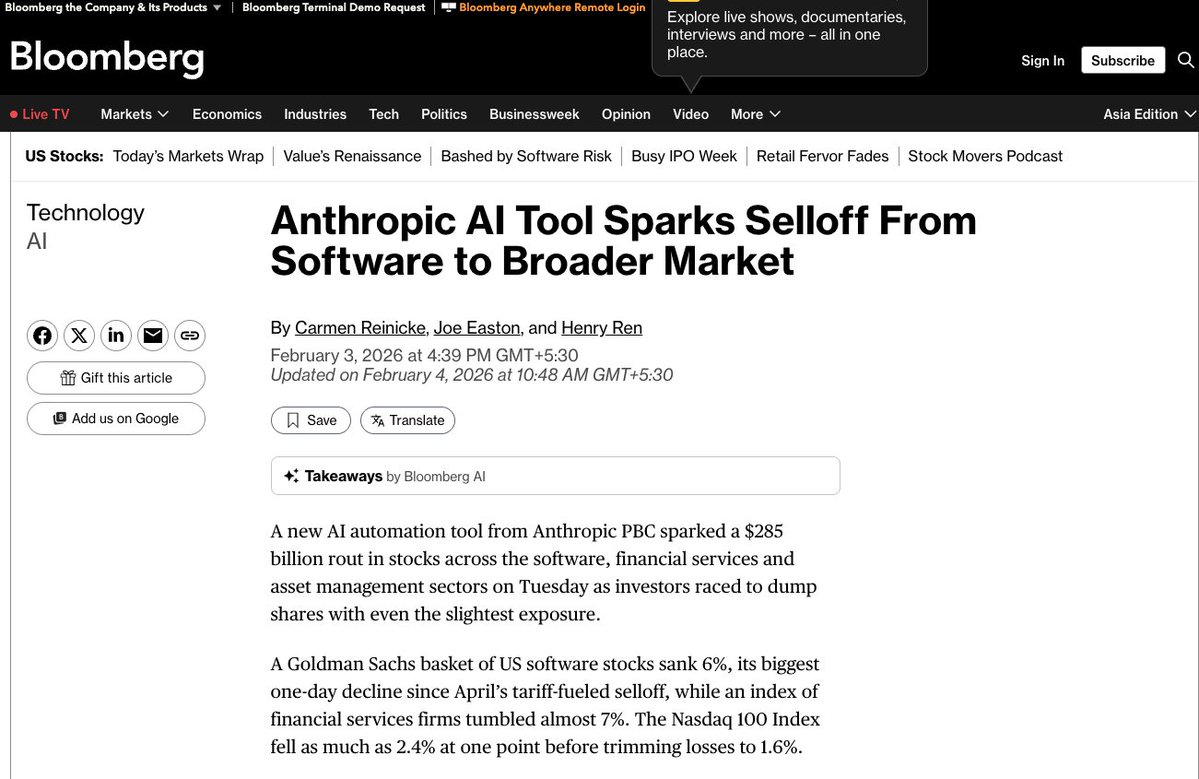
Anthropic Just Triggered a $285B Market Crash 😳
Bloomberg just reported that Anthropic released a new AI tool that caused:
• $285 billion wiped out across software, finance, and asset management stocks
• 6% drop in Goldman's software basket (biggest since April)
• 7% crash in financial services index
• Nasdaq down 2.4% at its worst
This is MASSIVE. The market literally panicked over an AI automation tool.
If you work in software, legal, or IT services, this changes everything.
You just don't know it yet.
On Jan 30, Anthropic quietly released 11 plugins for Claude Cowork.
Not a new model , but plugins.
But these plugins don't work inside your software.
They replace it entirely.
things like financial modeling & sales workflows, which lead to;
• RELX (LexisNexis): -14%
• Infosys: -7%
• TCS: -6%
• Wolters Kluwer: -13%
Wall Street is calling it the "SaaSpocalypse."
Because for the first time, a foundation model company didn't just build the AI.
They built the application layer too.
Anthropic isn't selling APIs anymore.
They're owning entire workflows.
Why pay $50K/year for legal software when Claude does it for $20/month?
Why hire 500 IT consultants when one AI agent works 24/7?
& the scary part?
This is just 11 plugins in a research preview.
Imagine what's coming next.
If your company's value prop is "we automate X"...
You're now competing with Claude.
And Claude costs 1% of what you do.
You're either building with AI, or getting replaced by it.
No middle ground anymore.
On Sunday:
Novak Djokovic wins a 25th Grand Slam title
Or
Carlos Alcaraz becomes the youngest ever player to complete the Career Slam in men’s singles
HISTORY on the line.
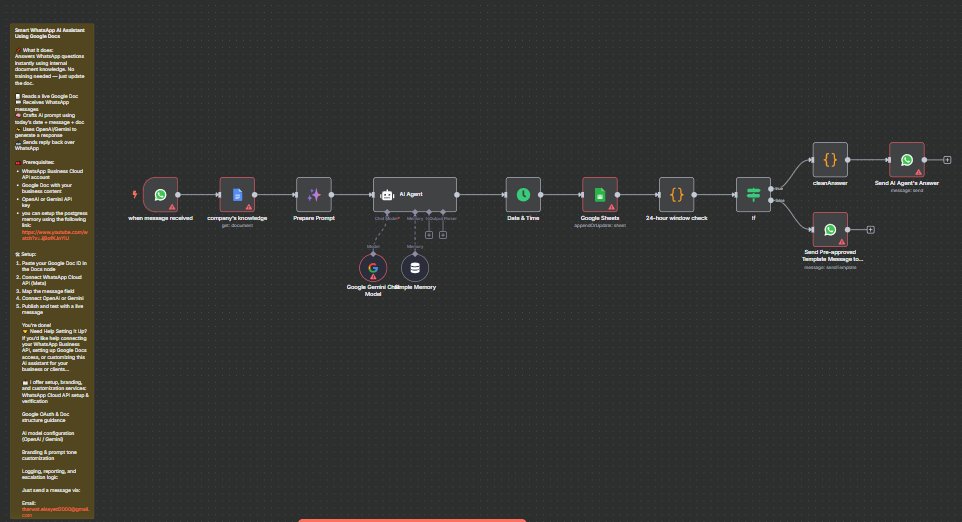
Just built a WhatsApp AI agent that replaced an entire customer support team.
Sold the setup for $2,000 + $500/mo and clients are begging for more.
Here’s what it does:
– Reads your company’s Google Doc (FAQs, policies, service info)
– Lets customers ask anything on WhatsApp
– Replies instantly using ChatGPT or Gemini
– Handles hours, pricing, bookings, even dynamic logic like closure dates
– No retraining, no dev work just update the Doc and it works
Perfect for gyms, clinics, restaurants, service businesses, or anyone tired of answering the same 20 questions daily
Built it in n8n + WhatsApp Cloud API: no code, no friction.
Follow + RT+ Comment “CHAT”
I’ll DM you the entire plug and play workflow