When I write about the long-run consequences of population decline, I’ve noticed that most people cannot grasp what a total fertility rate (TFR) of 1.1 means. Many of my readers look at 1.1 and treat it as not that different from 2.1. This is the wrong way to think about it: TFRs are like interest rates; they compound over time.
To make the point, I ran the following simulation. I built the population structure of a country with 1 million inhabitants, a TFR of 2.1 (just at replacement level), and a life expectancy of 85 (with realistic survival rates). Thus, this country has a stationary population over time.
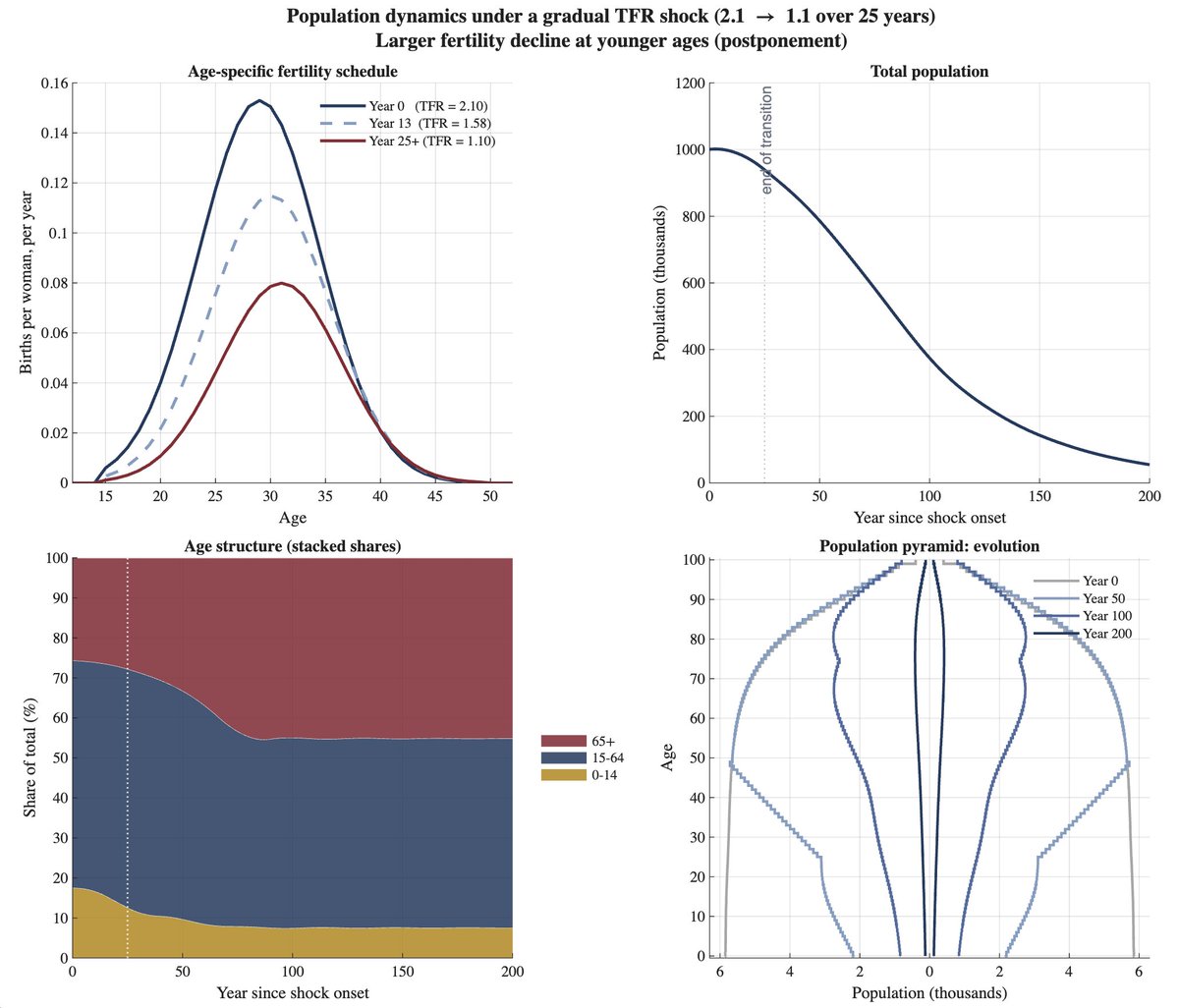
I then hit this country with a reduction in the TFR from 2.1 to 1.1. The reduction, which takes 25 years to complete, is similar in size and duration to what we’ve seen in many advanced and middle-income economies. It is also concentrated among younger women, with fertility postponed to later years. I plot the initial, middle, and final TFR in the top-left panel of the figure.
I then simulate the next 200 years of this population. By the year 200, the original 1 million has fallen to 54,900, a 95.5% reduction. The top-right panel illustrates this evolution. This is not a minor adjustment: it means closing 95 of every 100 universities, hospitals, and shops. Since the population is likely to concentrate in a few remaining cities, nearly the whole country becomes a population desert.
The bottom two panels show the population structure and pyramids. The population stabilizes at a median age of 61 and an old-age dependency ratio of 95.21%.
You might argue that TFR is unlikely to remain at 1.1 for so long because higher-fertility subgroups (e.g., the highly religious) would grow as a share of the population. Fair enough. But I am not offering this simulation as a forecast. I am illustrating how, at current rates, countries of 50 million people (roughly South Korea or Spain) would become countries of 2.75 million, ignoring immigration.
These are the issues for the next century.
Assemblers were faster at writing binary than humans were.
Compilers were faster at writing assembly than humans were.
AIs are faster at writing compiled languages then humans are.
Deal with it. There's still plenty left for you to do.
Tengo 35 años y cancer de mama metastásico, un caso raro, menos del 1% de tumores de mama son como el mío y hay poca documentación sobre ello.
Por eso me gustaría encontrar personas que se dediquen a esto y que quieran investigar con mi caso. Twitter haz tu magia
Liftoff.
The Artemis II mission launched from @NASAKennedy at 6:35pm ET (2235 UTC), propelling four astronauts on a journey around the Moon.
Artemis II will pave the way for future Moon landings, as well as the next giant leap — astronauts on Mars.
Claude Code leaked their source map, effectively giving you a look into the codebase.
I immediately went for the one thing that mattered: spinner verbs
There are 187
Paquetazo de nieve durante estos días en la sierra de Guadarrama.Pocas veces se ve la Maliciosa 🏔️ con tanta nieve.📸 4 torres de Madrid con la sierra de guadarrama de fondo , foto realizada con un teleobjetivo y una #sonyalpha
𝐓𝐨𝐩 𝟓 𝐦𝐨𝐬𝐭 𝐩𝐨𝐩𝐮𝐥𝐚𝐫 𝐬𝐭𝐚𝐭𝐬 𝐨𝐟 𝐭𝐡𝐞 𝐲𝐞𝐚𝐫! 🎉📊
1️⃣
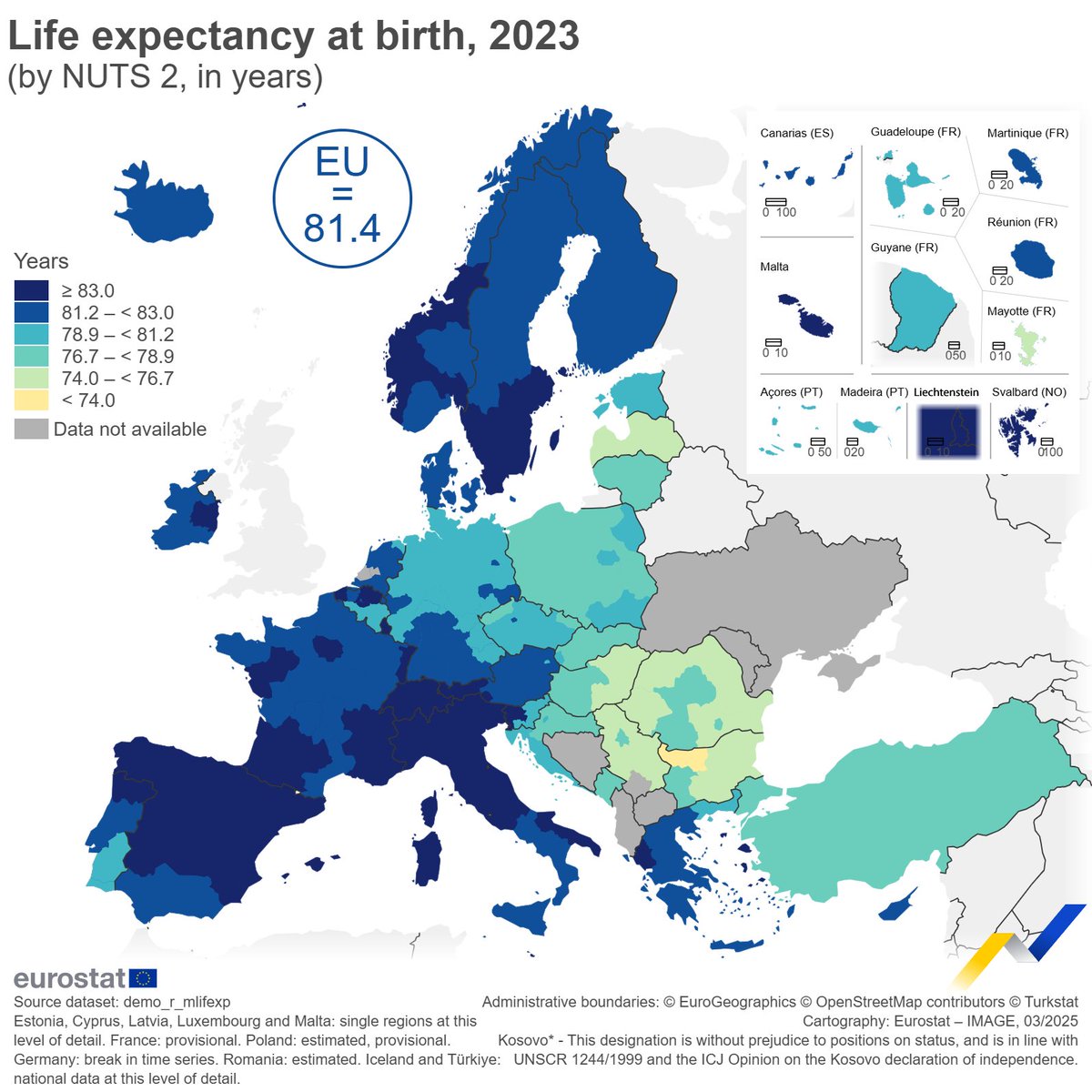
In 2023, life expectancy at birth in the EU was 81.4 years. 📈👨👩👧
Highest in:
🇪🇸Comunidad de Madrid (86.1 years)
Lowest in:
🇧🇬Severozapaden (73.9 years)
👉 https://t.co/IYtQWJQjf6
#EurostatTopPosts
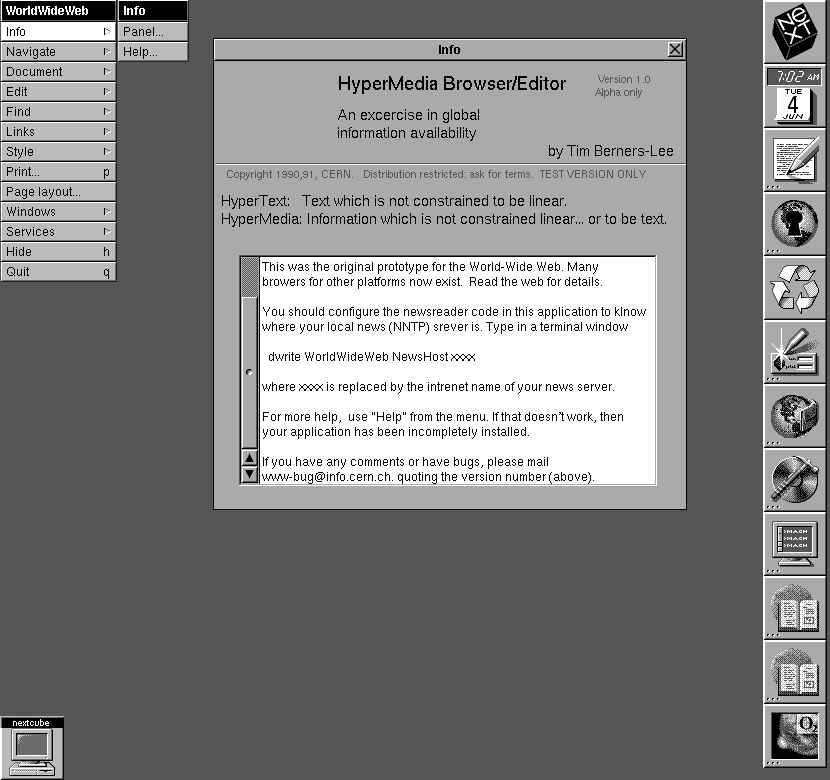
Happy 35th Birthday WorldWideWeb – the first browser!
On December 25, 1990, at CERN, a British physicist and internet pioneer Tim Berners-Lee created the world's first web browser, called WorldWideWeb.
Try the browser emulator https://t.co/1ZxhMhVTFj
#InternetHistory
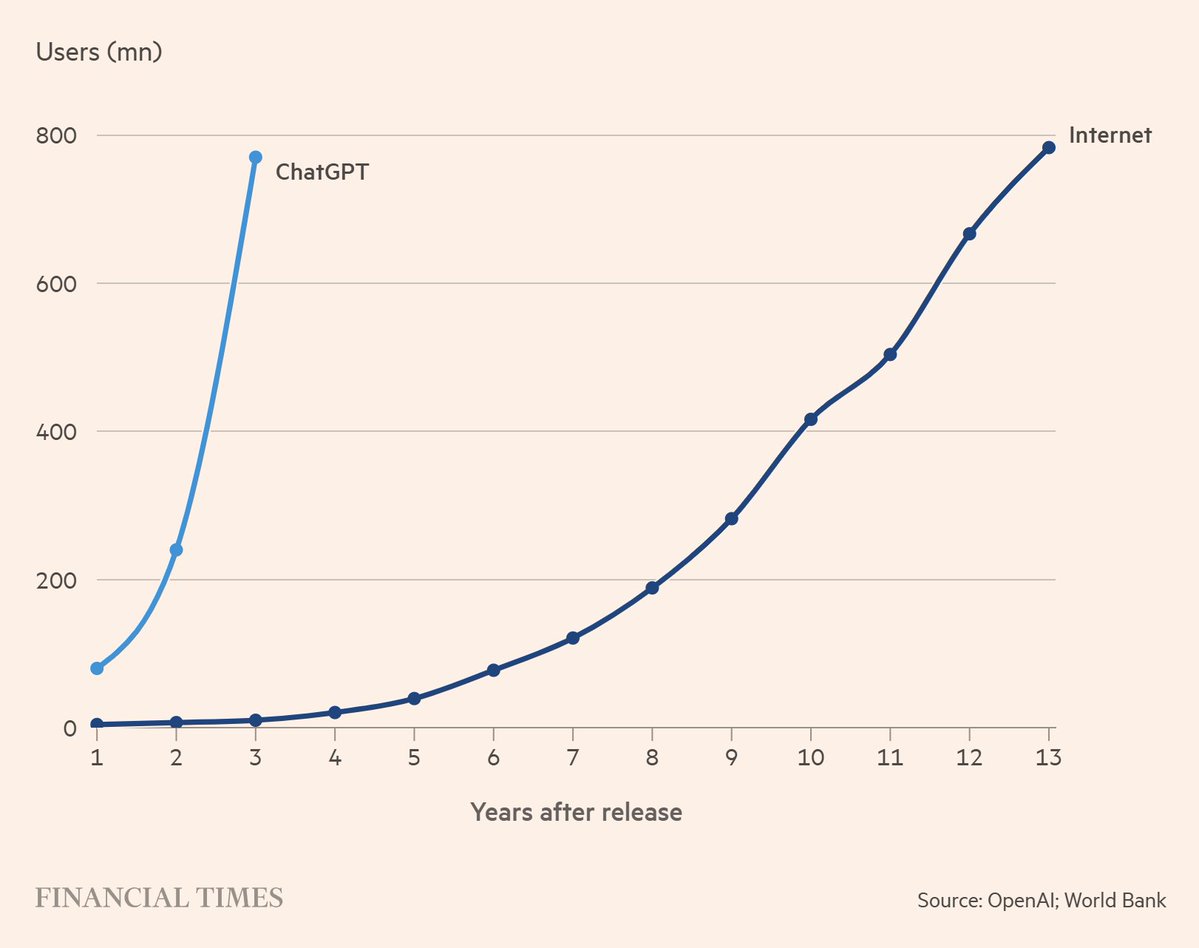
Happy 3rd birthday, ChatGPT.
I was at Google then, leading two products: AI Test Kitchen and NotebookLM (there was no Bard/Gemini yet).
We had launched AITK much earlier than ChatGPT, but it was a heavily constrained experience in comparison. It was a cool demo of LaMDA but that was all: a demo.
On the other hand, NotebookLM was in its infancy. We’d just done an internal launch (dogfood) and still very much felt like a 20% project. It was difficult to land the concept broadly with people because, well, you needed the concept of LLMs to land first - and it was just so very early. The only people that really “got it” in those early days were students (and that gave me enough conviction to keep going).
When ChatGPT arrived, I felt a sense of getting beat - their simple, open ended demo was just way more viral than AITK, and we’d spent so much energy getting it out the door. I knew I’d missed the mark.
In that moment I felt dejected but honestly looking back, it was the best thing that could’ve happened. ChatGPT led to such a fast and broad awareness of AI that it made it easier to convey the value of applications built on top of LLMs.
It also gave me this competitive drive - the game can’t possibly be over, right? There’s hundreds, if not thousands more of apps to be built, and it lit this fire in me to just keep exploring, tinkering, building.
3 years later here we are - and while the world largely still only has a handful of (consumer) AI apps, I do think that’s about to meaningfully change.
Happy birthday, ChatGPT, thanks for changing the world.
Empresas que tienen un modelo de negocio distinto al que podríamos pensar inicialmente:
1. Starbucks es un banco
Retiene más de $1,600 millones de dólares en tarjetas y recargas.
Ese dinero es crédito sin intereses: Starbucks lo usa como flujo de caja antes de entregar el café.
Funciona como un banco sin licencia, con clientes que adelantan dinero.
2. Apple es una marca de lujo
Margen bruto: 45.9% (similar a joyería o moda de lujo).
No vende solo tecnología, sino estatus y exclusividad.
Control total del ecosistema (hardware + software + servicios).
3. Google es una agencia de publicidad
78% de sus ingresos proviene de anuncios.
La búsqueda es gratuita, el negocio real es vender atención segmentada.
Su producto no es el buscador: somos nosotros.
4. Amazon es una empresa de datos
AWS genera 62% de las utilidades, pero solo 16% de ingresos.
El corazón de Amazon no son las ventas minoristas, sino la infraestructura digital y la información de comportamiento.
5. Red Bull es una empresa de medios
Más allá de la bebida, construyó un imperio mediático de deportes extremos.
Producciones como el salto desde la estratósfera (50M de vistas en vivo).
Vende estilo de vida tanto como bebida energética.
6. McDonald's es una inmobiliaria
36% de sus ingresos proviene de rentas a franquiciados.
Posee $39,000 millones en bienes raíces.
El negocio no está en la hamburguesa, sino en la tierra.
7. Facebook es una empresa de vigilancia
98% de ingresos vienen de publicidad hipersegmentada.
Observa y perfila a más de 3,000 millones de usuarios.
Su producto es el rastreo y monetización de la vida privada.
Today's date, 9/25/2025, is probably the last date of our lifetime where the month, day, and year are all square numbers 😱 Next time this will happen is 1/1/2116.