I found the SpaceX IPO surprisingly emotional today. It reminded me of why I came to the US as an 18-year-old. Even then, I knew that I wanted to build stuff, and that the place to do it was America. There was no second option in the world.
The concept of American exceptionalism is nothing new, but I have come to appreciate the culture that justifies it. SpaceX is yet another case in point. America’s risk-taking culture celebrates wild successes while embracing the legitimacy of hard-earned failure. American culture doesn’t celebrate inherited wealth, nor does it frown upon inherited poverty. It doesn’t seek to create equal outcomes, but rather equal opportunity.
It is not immediately obvious that this is unique in the world. Truly unique. I’m Canadian, and I love many aspects of Canadian culture, but Canadian culture does not offer people the same environment in which to take risks.
I write this because I was dismayed to see US politicians complaining of the extreme wealth created by the SpaceX IPO. Say what you will about wealth inequality, or a single man’s politics, but don’t tell me that immense wealth creation in America is bad. Do not tell me you’d rather SpaceX not exist, exactly as it does. That you’d rather this company exist in some other country or culture.
Thankfully, despite today’s politics, SpaceX could not have been a Chinese company, or a Canadian one, or a French one. It could only ever have been an American one.
If nationalism is pride in your birthplace, then it’s merely tribalism, which serves to divide us. But if it’s pride in your culture, a culture that lets people achieve incredible things like this, then under those terms I am a nationalist. I want to protect and enhance our culture of risk-taking, of celebrating wins, and of celebrating failures along the way.
I think it is amazing that America created a trillionaire out of a risk-taking immigrant. It is absolutely fucking absurd, of course, but isn’t that the point? SpaceX is not a reason to be pissed off; it’s a reason for every person in the world who wants to build stuff to see themselves as American, no matter where in the world they live.
p.s. — this is entirely from my brain, with AI used only for fixing typos and grammar. :^)
1/ How do you build long term performance? Warren buffet is 90. Half of his net worth was accumulated in the first 60 years and another half in the last 10. So stay healthy because the last 10 years matter! But what are the super long term skills every investor needs to master?
How do you build your own tracker of leveraged etf rebalance flow 101
You need two pieces of data per index/commodity/single name you are tracking and one simple formula
Data
1. The AUM of all leveraged ETF's that exist on the underlying of focus
2. The change from prior close
Formula
Using the leverage ratios 2x 3x etc and Kris's attached primer determine the amount of rebalance needed per fund (1) per change in price (2)
Then sum up those flows across asset prices for a summary asset flow while noticing whether certain sectors dominate the flow
Fwiw this is trivial and every decent hedge fund and market maker has built this already. The art is trying to understand the game theory of who is frontrunning the flow. (That I will not share)
THE LIFE CYCLE OF A BUBBLE
1. A genuine advancement creates real productivity gains. A real technological or economic improvement increases productivity and leads to genuine revenue and earnings growth.
2. Stock prices leak into reported profitability. Rising stock prices improve reported earnings, financing conditions, collateral values, and perceived business performance.
3. Reported profitability drives real investment. Companies increase hiring, capital spending, construction, expansion, and speculative investment because of their own or their customers’ reported profitability.
4. Bubble beliefs and abandonment of present-value discipline. Investors stop focusing on discounted cash flows and begin relying on continuing gains from the greater fool theory, believing they can sell later at a higher price.
5. Inflows from sideline investors. Previously cautious investors enter the market in large numbers. New money from existing and new investors participation drive prices higher.
6. Extreme overvaluation. Prices rise far above historical normal multiples of reported fundamentals, even ignoring the fact that reported fundamentals have been driven by rising stock prices.
7. Issuance. Companies take advantage of high valuations through IPOs, secondary offerings, stock-based acquisitions, SPACs, and insider selling.
8. Exhaustion of inflows. The flow of new investors starts shrinking while existing investors approach their risk and leverage limits. Volatility and dispersion grow and gains become less uniform across stocks.
9. Earnings disappointments from slowing price appreciation. As stock prices stop rising rapidly, the earlier boost from higher valuations into earnings weakens or reverses. Companies begin missing expectations.
10. Stock-price collapse with high volatility. Confidence in both the fundamental growth and in the greater fool theory break down and prices fall sharply. Volatility rises further as leverage unwinds.
11. Bear-market rallies and progressively greater exhaustion. Bargain hunters and frustrated latecomers repeatedly buy the dips, creating violent temporary rallies that fail. Markets make lower highs and lower lows.
12. Capitulation, abandonment, and normalization. Bubble participants eventually give up in disgust or exhaustion. Volatility falls, valuations normalize, and the market returns to more ordinary behavior.
This is the time of year when a lot of investment firms welcome interns. While our work is geared toward institutional investors, a lot of it can be useful for learning about markets and the investment process. Here are a handful of reports and how they can guide interns:
Part IV of Zero to Stock Hero is basically ready to go...
If you haven't read 1-3, start here.
I've also attached three psychology posts I wrote.
Feel free to bookmark (these are all free to read, always will be)
tired on the ai-generated, undergraduate-level kwant textbook slop on your timeline?
you fkin should be
read these @macrocephalopod threads instead
they are written by someone who actually does the thing.
and knows, from experience, what matters and what is circlejerkery.
this excerpt from Einhorn is one of the cleanest summaries of equity investing; esp why "good business" and "good stock" are not the same
"Really bad things happen to earnings when a 25% ROE turns into a 10% ROE. Great things happen to earnings when a 10% ROE becomes a 15% ROE."
You've probably not heard of this model architecture for tabular data: TabPFN.
Taking a quick detour to showcase a model I've had less experience with but have been giving increasing credence to as I get more involved with it.
It's probably not going to make you rich without a lot of work but it's cool enough to warrant some air time.
---
Broadly speaking, TabPFN is a base model that has already been trained - similar to how you would think about pre-trained models like R1 / BERT / etc.
The main difference here is that TabPFN has been trained on tabular data; and the idea here is to try to create a model that generalizes to ANY tabular data.
Think a linear regression that knows the optimal coefficient for any kind of features and for any kind of targets. That's the PROMISE, anyway.
---
For a typical tabular dataset and a typical model;
The usual workflow:
1) You get a dataset D (rows = samples, columns = features).
2) You pick a model class (trees, LR, whatever).
3) You train it on D.
4) You tune hyperparams for D.
5) You deploy.
6) You lose 15% from overfitting [optional]
You repeat this whole procedure from scratch for every dataset.
---
TabPFN is instead:
1) Train a big model once on a huge variety of toy tabular problems.
2) Force it to learn “how to go from ‘I see this table’ → ‘here are good predictions’” as a built-in behavior.
3) At test time, no gradient descent, no search. You give it the table (train + test rows), it gives you predictions in one forward pass.
4) You’re not just training a model. You’re training a learned learning algorithm..
---
How do you teach a model to “learn from tables” without real data?
You build a synthetic universe. Randomly create fake “worlds” where some variables cause others.
Use a mix of simple ingredients:
1) Linear relationships
2) Small neural nets
3) Tree-like rules
4) Noise, sometimes heavy, sometimes mild
Generate rows by pushing random noise through these worlds.
Pick some columns as features, one as the target (classification or regression).
Then deliberately make it ugly:
1) Skewed distributions
2) Discretized / categorical-style columns
3) Missing values
4) Outliers
Each synthetic problem looks like a realistic small dataset with all the usual annoyances.
Training sample =
“Here’s a small training split + some unlabeled rows from the same fake world. Predict the missing labels.”
You repeat this millions of times.
The model doesn’t memorize specific datasets; it learns a procedure that works across a whole family of small tabular problems.
---
When you have real data, you just do 1 forward pass through your data and it will output predictions.
No hyperparameter tuning required.
No training.
---
Here's the question everyone is asking:
Does it work in finance?
Can it predict stock prices?
Can I be the next Gerko?
The answer is resoundingly...
NO. It sucks out of the box for price prediction.
AND it does not scale for thousands of signals.
---
But we see it's potential.
And early tweaks show tons of promise.
I really like it already!
---
Enjoy the read!
We are obsessed with "talent" and people that have the "special something".
This is just a way of avoiding thinking about what it takes.
Excellence is real. There are people that get ahead nine times out of ten. Olympic swimmers, repeat founders, bestsellers... But, if you watch excellent people there is nothing magic about what they do*.
It's just the multi-dimensional set of skills, character, and ways of life playing out.
To give one example: Fortune 500 CEOs don't have a magic gift — maybe they are more likely to win if they are born in certain countries and have a slightly above average IQ and stamina but nothing otherworldly — instead what they have are: a willingness to have difficult conversations, a set of mental models to read a balance sheet fast, a mental model of the business they are running, mental models of how other businesses run, an idea of the psychology of their biggest rivals company, a strong motivation to increase profits, private drivers, expensive suits, intense time boxing, public speaking coaches, favourite restaurants they go to every time they are in a city, how well they celebrate after a win, keeping up the right kind of health routine to keep them sharp, spouses that do not create demands on their time.... and so on
These things are essentially mundane. There is no invisible special sauce. Pretty much all of it are choices that can be made, skills that can be learned, character that can be developed and more.
The key — the reason not everyone is a Fortune 500 CEO — is that these things are not arbitrary. The collection of things that need to be done to get to this level are vast and if the person is missing any of them they simply won't be excellent enough.
In other words to be part of the world of Fortune 500 CEOs you need to be perfectly optimized for that world.
Sometimes the collection of skills etc. can look arbitrary but this is usually because you are comparing different games. The list of what's needed is different for a software startup founder, a car dealership owner, a university dean, or even in the case of the example perhaps other Fortune 500 CEOs in different industries etc. Even between companies at a similar scale in similar industries the list of what's needed can be different at the margin because of contingent facts about how those particular organisations are constructed.
In the same way, while there may be a lot of overlap, being world-class at swimming will not make you world-class in football. If nothing else you will have to live in very different places (swimming pools vs. football pitches).
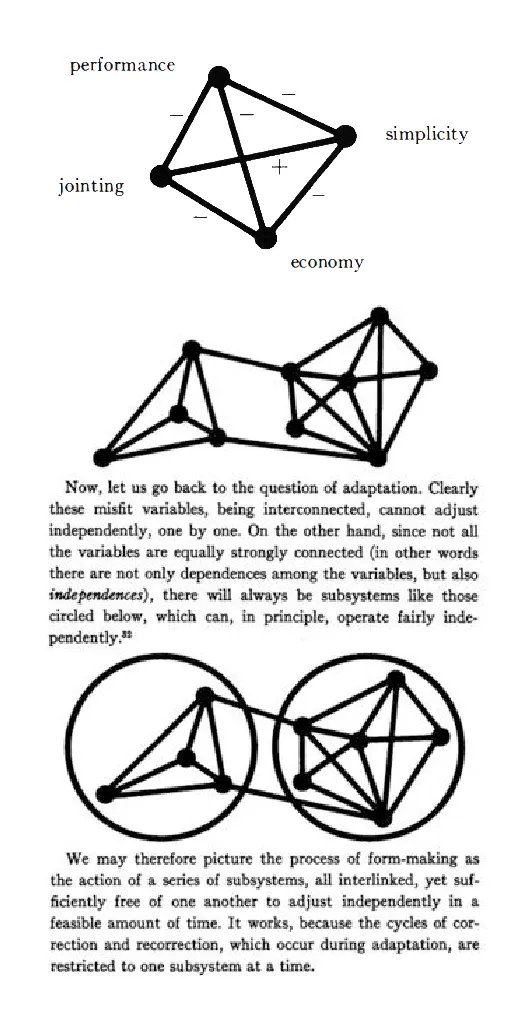
So achieving excellence is like solving of a hyper-dimensional problem. Each level requires a new bundle and a new way of life. It's similar to the way Christopher Alexander describes building a house in Notes on Synthesis of Form. You need to constantly adapt to resolve these internal tensions and enter the next world of skill.
So if you're interested in excellence you need to ask: What world do you want to be part of? And what do you need to change? What disciplines do you need to take on?
There are probably more transformations that are needed than you expect. But if you're willing to do it there's nothing stopping you.
Perhaps if there is something that the most excellent people have it's a willingness to connect with what's real. To be humble before what it actually take to succeed in their given field.
*All reflections on the paper: The Mundanity of Excellence: An Ethnographic Report on Stratification and Olympic Swimmers by Daniel F. Chambliss
We're trying to find the best posters for specific topics on X, so we can suggest those accounts to new users.
Reply with the top 5-7 accounts for a niche. If we choose yours, we'll send you a year of X Premium for free.
What books would you recommend for a smart high school senior who wants a basic introduction to:
1) fundamental investing (yeah, yeah, I know)
2) trend following
3) stat arb
@bennpeifert Honestly I would start with Fooled By Randomness and A Random Walk Down Wall Street because ***very*** importantly they are readable, aren’t full of equations, and provide the right starting mindset (it’s hard to make money trading and it’s easy to fool yourself)
[MASTER THREAD] - Resources, frameworks and mental models for fundamental equity analysts and traders
---
7/22/2025: "L/S EQUITY & FINTWIT: ASSORTED THOUGHTS" - thread on fund mgmt, analyst vs PM, self-mastery, drawdowns, Mental Capital + other underdiscussed parts of the game. https://t.co/p8GF4MrTHG
8/26/25: "STOCK PITCH THREAD" - for jr/mid-level analysts, or IB/PE going into L/S equity, or "outsiders" trying to get a seat - a handful of "live" investment pitches from back when I was interviewing for HF analyst roles - there is a lot in here that may be of use to you, take what you need." https://t.co/ZPk9OeT5DK
9/3: "STOCK PITCH FOLLOW-UP" - Q&A, process vs outcome, discipline, career advice I wish I'd gotten earlier. https://t.co/EdDJ5Oiuyn
9/8: "PROTECTING MENTAL CAPITAL" - risk mgmt thread, drawdowns, self-mastery, attitude, humility, more Q&A. https://t.co/0VwcBVcBJs
9/12: "SELL DISCIPLINE" - risk mgmt continued, stop-losses, removing emotion from your process, position sizing, and cognitive biases. https://t.co/UEuwtgpxZR
9/16: "FUNDAMENTAL L/S TIPS AND TRICKS" - potential sources of edge & pockets of alpha + sustainable & AI-resistant areas where one can hope to pull dollars out of the mkt + unit economics/modeling + primary rsch. "Translating qualitative input to quantitative output." https://t.co/DvTcrGYSEC
9/22: "READING THE TAPE" - thread on market pragmatism + non-fundamental variables in L/S and markets + "Bearish and long" + misc arcana, mindset adjustments and daily research process. https://t.co/iguOwZFUhB
9/29: "SIGNAL VS NOISE" + "Return on Time" for an analyst + figuring out WHAT MATTERS. Critical/independent thinking + predictive power, sample size, macro considerations, frameworks and mental models. https://t.co/tVORoZEDMp
10/6: "BE A CONSISTENT WINNER" - trading psychology, emotional volatility, boom-and-bust P&L cycles, common trading errors, humility, patience, discipline, and equanimity. https://t.co/Zws5uGj8I7
10/8: "BLENDING FUNDAMENTALS & TECHNICALS" - Portfolio Construction - CHART FIRST - Lazy thinking in long/short equity - FY2 vs DCF - Capital velocity, duality, humility and arrogance. "SUCCESS CLOUDS THE MIND." https://t.co/y1YzeRPblZ
10/15: "PRESSING WINNERS," the most important and most difficult part of the game + walking thru the cognitive dissonance, mental incongruence and various thinking errors that get in the way of "riding a multi-year winner in size." https://t.co/7hxFNnIYTW
---
NOTES:
• Most threads end w/ "FURTHER READING" and link out to years' worth of classic investing texts + advice from legendary investors. If you genuinely want to improve, spend less time reading twtr and more time on these links.
• Much is aimed at jr/mid-level, but I have also gotten a fair amt of "I'm 20 years senior to you and I learned something new" - truth is that investing is an APPRENTICESHIP GAME (especially L/S), I've had excellent mentors, and their influence leaks out in these threads
• Even at a senior level, a lot is written there in a way designed to challenge your priors - you may disagree yet also question whether your own worldview/philosophy is stale, invalid, able to withstand public scrutiny, or just in need of a refresh
---
"The greatest gift you can give a man is to help him think differently" - good luck to all and never stop learning
Thread on "reading the tape"...market pragmatism...thinking about non-fundamental variables in L/S and markets..."Bearish and long"....miscellaneous arcana, tips and tricks, mindset adjustments...daily research process. Long thread, as usual.
Thread on fundamental L/S analyst "tips and tricks," potential sources of edge & pockets of alpha, sustainable & AI-resistant areas where one can hope to pull dollars out of the mkt...unit economics/modeling, primary rsch, and translating qualitative input to quantitative output.
“YOU CANNOT CONTROL WHAT THE MARKET DOES. THERE IS ONLY ONE THING YOU CAN CONTROL, AND THAT IS YOUR RISK.”
Another thread on SELL DISCIPLINE – risk mgmt, protecting mental capital, stop-losses, humility, removing emotion from your process, position sizing, and cognitive biases.