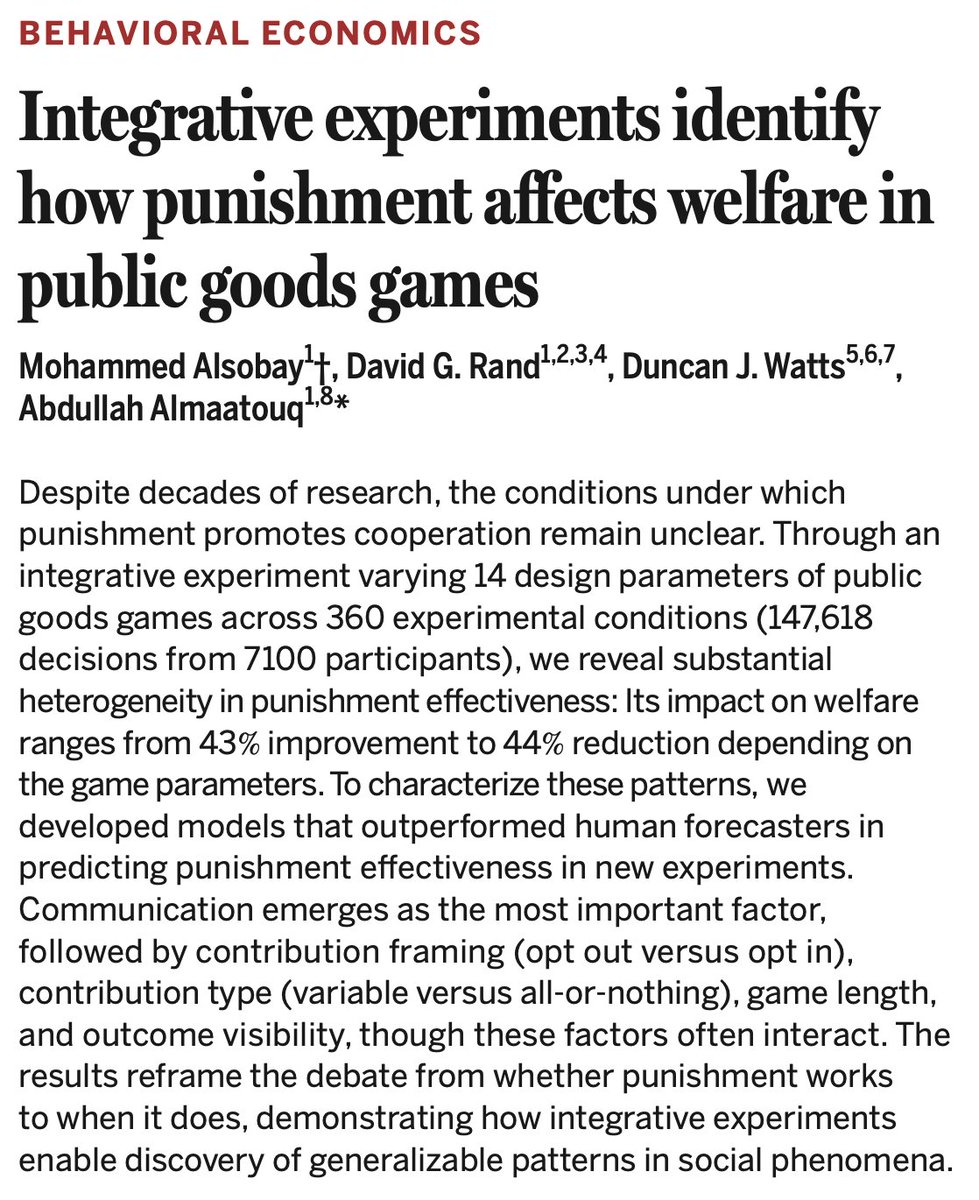
🚨 Out in Science this week, with @DG_Rand@duncanjwatts and Abdullah Almaatouq 🚨
We apply an integrative approach to a classic question in behavioral econ and cooperation research: *when* does peer punishment help or hinder collective welfare?
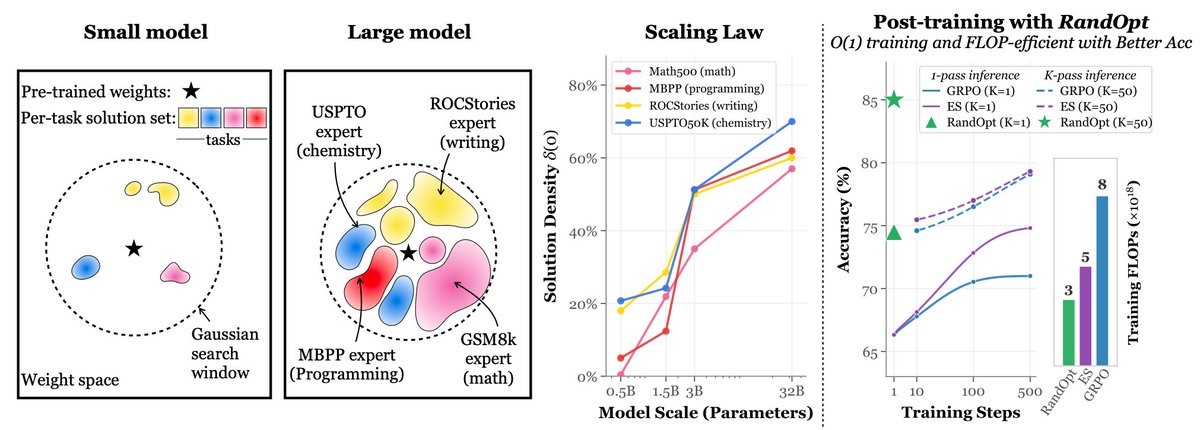
Simply adding Gaussian noise to LLMs (one step—no iterations, no learning rate, no gradients) and ensembling them can achieve performance comparable to or even better than standard GRPO/PPO on math reasoning, coding, writing, and chemistry tasks. We call this algorithm RandOpt.
To verify that this is not limited to specific models, we tested it on Qwen, Llama, OLMo3, and VLMs.
What's behind this? We find that in the Gaussian search neighborhood around pretrained LLMs, diverse task experts are densely distributed — a regime we term Neural Thickets.
Paper: https://t.co/rFJz2kVEOA
Code: https://t.co/HAmonfpXIA
Website: https://t.co/QZ6AMIsKCw
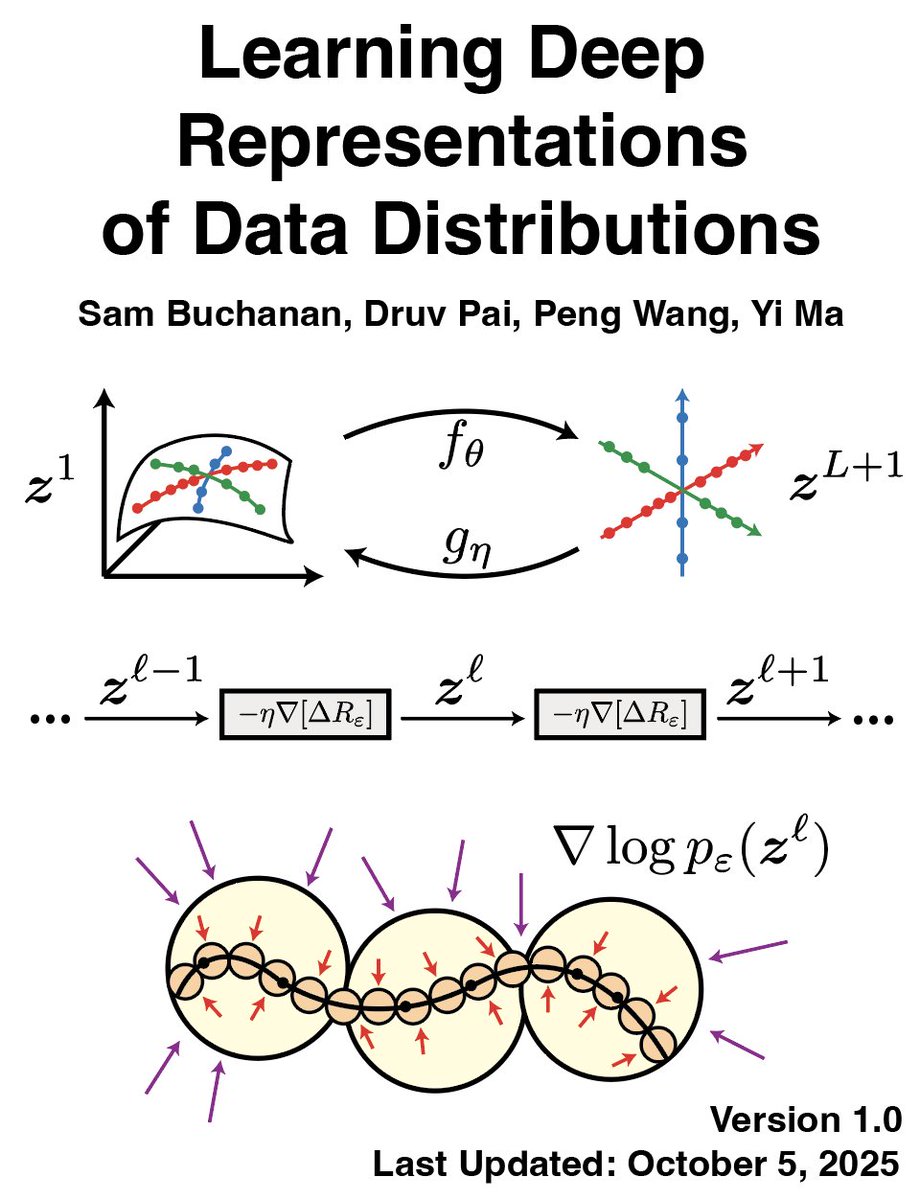
🚨 We wrote a new AI textbook "Learning Deep Representations of Data Distributions"!
TL;DR: We develop principles for representation learning in large scale deep neural networks, show that they underpin existing methods, and build new principled methods.
What aspects of human knowledge do vision models like CLIP fail to capture, and how can we improve them? We suggest models miss key global organization; aligning them makes them more robust. Check out @lukas_mut's work, finally out (in @Nature!?) + our new blogpost! 1/4
🧵🎉 Our mega-paper is finally published in TMLR! We're "Getting Aligned on Representational Alignment" - the degree to which internal representations of different (biological & artificial) information processing systems agree. 🧠🤖🔬🔍 #CognitiveScience#Neuroscience#AI
To make neural networks as modular as brains, We propose brain-inspired modular training, resulting in modular and interpretable networks! The ability to directly see modules with naked eyes can facilitate mechanistic interpretability. It’s nice to see how a “brain” grows in NN!
The Big Data fallacy 😱
Research by Vosgerau et al suggests decision-makers tend to interpret correlational relationships as causal when sample sizes are large (vs small)—even when given experimental evidence showing no or opposite causal effect:
https://t.co/AtD0w8AfQm
Here is our best thinking about how to make world models. I would apologize for it being a massive 40-page behemoth, but it's worth reading. https://t.co/9szuaMBdqN
We are recruiting two postdoctoral scholars for a research project in human collective intelligence and creativity at UC Davis and Cornell. Joint project with @enfascination,@norijacoby,@daltonconley, & Ofer Tchernichovski. Please forward this thread to relevant people. 1/n
We’re hiring two postdocs at UC Davis and Cornell for research on collective intelligence and creativity. This project will use large-scale online experiments to study how groups become smarter and more creative through self-governance. ⅓
Paper alert! 🚨 We investigate Bluesky from an invitation only platform with a few thousands of users to reaching 30 million users in terms of user activity and network.
📄 Full paper: https://t.co/PJqEA4QinI
💻 Codes: https://t.co/6KM6mn0kuT
💾 Dataset: https://t.co/rlOhCZVhKU
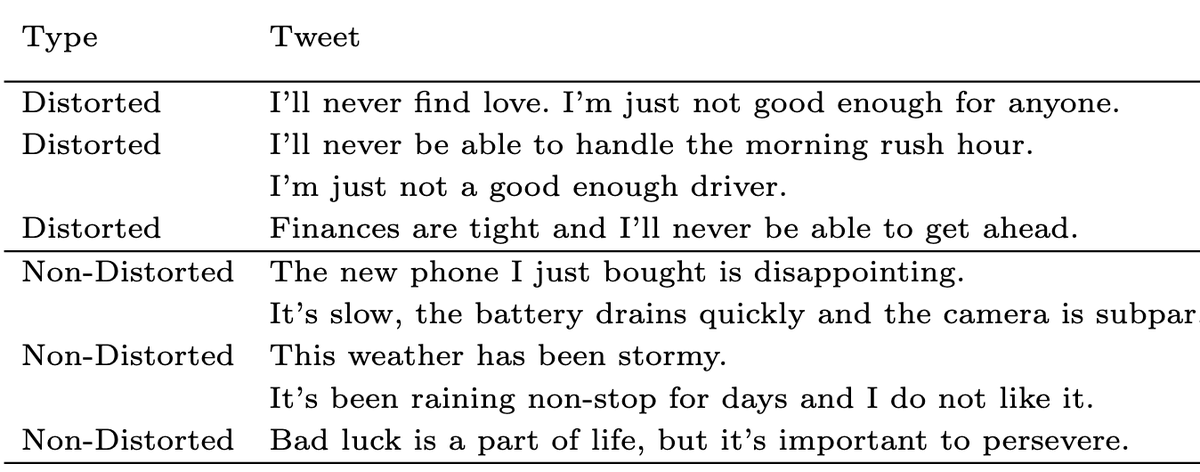
Depressed people can experience unrealistic negative thoughts. Social media can spread such cognitive distortions, but a short training on how to identify distorted posts drastically reduces interactions with distorted content. In PNAS Nexus: https://t.co/JLKw12Qg33
We've relaunched @turingtestlive with a 3-party format where you speak to a human and an LLM at the same time.
See if you can tell the difference between a human and an AI here: https://t.co/ptJtrpKIjg
📊✨ How does presentation format impact multiattribute decision-making? 🤔
(with @TruebloodJS, Yanjun Liu, and Nicole Owens)
🎉 Read more in our freshly published paper! 📄👇
🔗 https://t.co/huvwMtQsfJ
(1/n)
We think that attentional dynamics might explain our findings. Presentation formats might change the comparisons that are being made. For example, adjacent options might be compared to each other. See (https://t.co/qOdahTrQpF) and (https://t.co/auUAyIjzoq) (9/n)