Macro risk matters more than indicators right now.
Over the past couple of weeks I have been watching Treasuries, Japan, banks and rates much more closely.
When I started tracking this setup, I did not see a major autumn market flush as the base case.
Today I see it as one of the main risks for the market.
Several things are starting to line up at the same time.
The US economy is still strong enough to let the Fed stay restrictive while inflation remains above target.
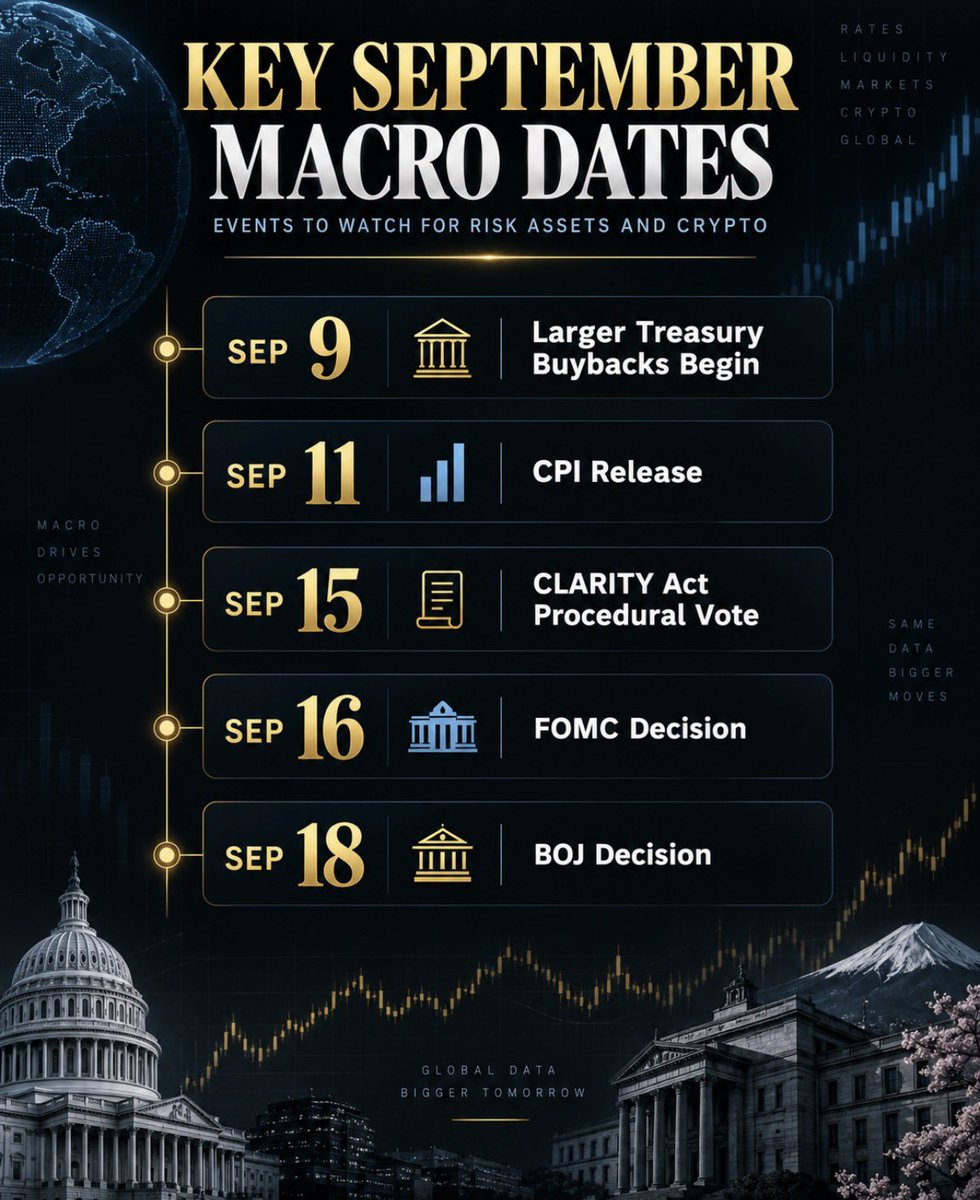
The next major test is CPI on September 11.
But the bond market concerns me even more.
The US 10 year yield is around 4.8% and the 30 year is above 5.2%.
Treasury has already increased long end buybacks, yet yields quickly moved back up.
To me that says the pressure has not disappeared.
Then there is Japan.
Japanese yields are at levels we have not seen in decades.
That gives domestic capital more reason to stay home and creates another risk for global bonds.
At the same time, higher Japanese rates and a stronger yen increase the risk of a carry trade unwind.
Crypto would not be immune to that kind of deleveraging.
The good news is that I still do not see clear signs of a banking crisis.
So this is not a financial accident yet.
It is a macro and sovereign debt risk.
And this is why I am still not ready to call the Bitcoin bottom fully confirmed.
Several indicators I have posted recently are showing signals that historically appeared around major cycle bottoms.
Onchain data has improved too.
But if the bond market breaks, the carry trade unwinds or real credit stress appears, macro can overwhelm every technical signal on the chart.
Bitcoin may be forming a bottom.
But first the market has to survive September.
I've noticed a gradual shift in the crypto market's latest cycle: We're going from dubious projects with outrageous token promises receiving grand investments, to serious and thought-out companies with real business models. It's finally happening.
We're entering a stage where mainstream blockchain adoption is becoming a reality. Something I've been dreaming of since I first installed bitcoin-core back in 2011, since I started doing full-time professional research in blockchain and cryptography back in 2015 and throughout my PhD in 2020 and post-doc in 2023.
THE MAJOR INSTITUTIONS OF THE WORLD ARE ADOPTING DLT TECHNOLOGIES. We are moving real money, real capital, real assets behind the scenes. The business model is no longer "token go up", but we are asking concrete questions such as: How does decentralization help reduce counter-party risk in the eyes of the regulators, and can this be used to reduce cost of capital by reducing long-term collateral lockups? How much interest can I earn on this newly available liquidity? Can I move money between my Estonian for-profit OÜ company, my Greek for-profit IKE or EE, and a Cayman non-profit organization on the weekends, in seconds, without having to wait for (unknown delay) human approval on Monday? How much more quickly can we run payroll if we do that, and how does this manifest in interest paid to us, and to hours saved by our finance team? Can we ensure no claw backs, no holdups, no money lockups that traditional banking sometimes has to effect due to risk?
Decentralization is no longer a romantic political story, but a concrete way to reduce counter-party risk, repurpose previously illiquid capital, contain risk of insolvency, and improve automatic enforcement of civil legal contracts, often bypassing sluggish courts or arbiters. Companies all over the world want that. And, yes, even commercial banks and clearing houses want disintermediation and reduction of liability. They want to provide 24/7 access to money movement, programmability, standardization, cross-border payments, and <T+1 (or even 2-seconds!) settlement, because their customers are DEMANDING it and WILL move to other banks if they're not offering it. And central banks all over Europe (where we're based), including the Greek, Italian, Austrian, German, Franch, and Macedonian central banks are looking for CBDC-style solutions because dollarization (as opposed to the use of the EUR for settlement) is a matter of (inter)national security with very real monetary repercussions that translate to the lives of ordinary people everywhere.
All of this is happening behind the scenes while a lot of crypto companies are dying in the foreground. Blockchains are becoming a BORING, trustworthy technology powering the backend interbanking links of the world. This is where we want to be.
We're here to deploy these technologies, to help build the new pipes that are being built. We're plumbers. We're helping move money, capital, real-world assets, ensure commercial relationships, and protect from risk through blockchains and related inventions. This will take years. Perhaps a decade. Traditional institutions move slowly. I see a lot of investment and interest reappearing in 2027, but not on the same frontlines as it did in 2018 (ICO) or 2021 (DeFi) or 2022 (NFT) or 2024. There's a lot more to be discussed with TradFi investors rather than tech VCs.
Many questions have been re-posited. Privacy is a necessity, but not an absolute, and we may be able to use simpler technologies to hide less than "everything". We need a paradoxical combination of privacy and transparency to satisfy regulators. As for real assets that will be moving around en masse first with these technologies, beyond stablecoins, there's a lot to be said about tokenized deposits/portfolio positions.
I'm working with my team at @commonprefix on a couple of very interesting directions on the concrete tokenization of real-world investments and movement of capital, some of which we're launching in collaboration with our partners already this year. These tokenized assets will touch new chains such as @circle's Arc, which have strong interoperability with institutions. They will also be movable through @axelar so that they can also interoperate and integrate with more decentralized ecosystems such as the XRP Ledger @XRPLF and its many upcoming DeFi opportunities. We're integrating them tightly to make the pipes invisible.
I feel a different kind of excitement for the next years. We're building the boring, trustworthy technologies of the future. Ledgers that move quickly, atomically, work all of the time and everywhere, and leave no ambiguity. People will be wondering how it could have ever been any different.
XRP Ledger Bridge Faces Potential Shutdown
Ripple (@Ripple) is recommending that the XRP Ledger ripple:native COMMUNITY withdraw the long running XLS-38 amendment.
The proposal was designed to enable native cross chain bridging across XRPL networks.
Ripple says its main use case is now better served by Axelar. Axelar supports more than 50 blockchain networks with over 75 validators.
The company also says developer demand for XLS-38 remains limited. Removing the implementation could eliminate more than 10,000 lines of code.
The decision could still change if developers demonstrate compelling use cases.
Circle President Offloads $31M In CRCL Shares Despite Long Term Bet
Circle President Heath Tarbert has sold about $30.8 million worth of CRCL shares across 10 transactions since June 2025, according to SEC filings.
The sales included stock disposals and option exercises.
Tarbert still owns roughly 503,000 CRCL shares, with no disclosed open market purchases.
Tarbert previously said Circle remains focused on long term execution rather than short term stock price moves.
Coinbase just launched $AXL trading in New York.
@coinbase, as announced by @CoinbaseMarkets, has now made @axelar's native token available to trade in one of the world's hardest jurisdictions to get listed.
At time of writing, $AXL has a market cap of just ~$67 million, well-suppressed below former highs of some $1.34 billion.
Interchain Amplifier combined with Axelar's hub-and-spoke topology makes it possible to connect any blockchain, regardless of programming language or consensus mechanism.
🔥 HUGE: Mastercard launches a Crypto Partner Program, bringing together 85 crypto companies to develop cross-border transfers, B2B payments and global payouts.
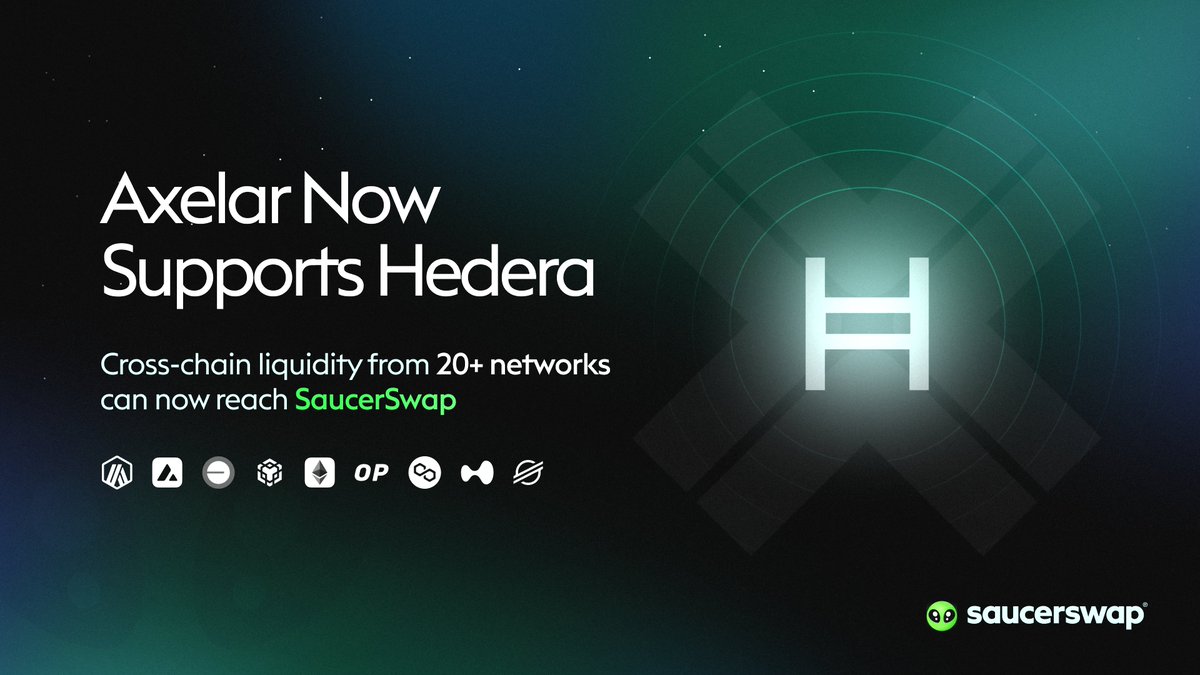
Cross-chain is live on SaucerSwap.
Powered by @Axelar + @squidrouter, the SaucerSwap Bridge page connects @Hedera to 20+ blockchains — including Base, Optimism, BNB Chain, and Avalanche.
Read the full breakdown: https://t.co/MB1deWenMA