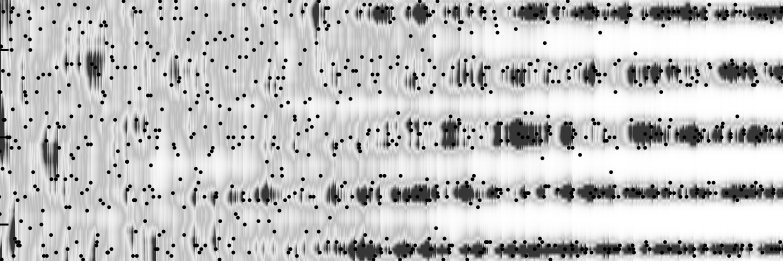
Interactions among individuals are mediated by the exchange of physicochemical signals. These signals travel through space and establish scale-dependent feedbacks that will drive the population's spatial organization. 1/4
Alan Turing first described how regular patterns found in living things, such as the stripes of zebras, appear. A collaborative study between IFISC and @PrincetonUPress proposes an alternative mechanism to explain this #pattern formation.
https://t.co/EBeI2jfqFU
From flocking birds to eusocial insects, nature is the ultimate complex system! 🐝
At the CRAB satellite, we bring together #ethology, #cognition & #ecology to decode collective animal #behavior. Discover the evolutionary rules of coordination at #CCS2026 !
More on collective behavior: Our new Annual Review of Biophysics piece - with the stellar Danielle Chase - explores how animals sense, share information, and make group decisions. In honeybees and beyond 🐝
https://t.co/UcuG35gUu5
Colocando em números o que ja se sabia em principio. A contribuição das áreas protegidas na Amazônia para a produção rural no Brasil.
https://t.co/q9zjSADoHa
Hi UK, here they come!
Huge start of bird migration from the Waddensea westwards. Currently an bird migration traffic rate of 9000 birds per km per hour. Enjoy 😉
Congratulations to Daniel Bonn, Antoine Deblais, Tess Heeremans and Sander Woutersen! They won an Ig Nobel prize for their research in which they investigate the behaviour of drunk worms as a particular form of active matter. https://t.co/NXrPeub9Y2
Join us this November in São Paulo if you are interested in pattern formation and self-organization in biological systems! Apply by September 8th at https://t.co/aTfJfbJ4dE !
Recently at JSTAT: with colleagues from @IFISC and @CASUS, we account for interaction signals that affect individual mobility and show that while pulsed signals lead to patterns (e.g. animal calls), persistent signals don't (e.g. vision, olfactory cues).
Editors' suggestion: Behavioral transition of a fish school in a crowded environment, Bruno Ventéjou, Iris Magniez- -Papillon, Eric Bertin, Philippe Peyla, and Aurélie Dupont #CollectiveBehavior@smoubi10@liphy_lab@CnrsAlpes@UGrenobleAlpes https://t.co/fnq1pJfqL2
Have you ever thought that large animal groups look like an animate fluid? In our latest paper we explore the hydrodynamics of locust swarms in Kenya. https://t.co/TxHrHLvOiF
Excited to share our preprint on “traveling networks” – connected systems that move through space due to dynamic rearrangements.
https://t.co/iyKNU3HVC5
After 40+ years, I still am not sure what is claimed in the "biology isn't like physics" discussions. The physics of spin glasses (in which every one of the n^2 interactions among n components can be different) is different than the physics of ordinary magnets. 1/5
The scale of the fires currently burning across northern Australia is pretty unfathomable.
This animation visualises just the last two months of fire captured by #DEAHotspots - for context, the map covers an area larger than France, Spain and Germany combined...