MidJourney can create stunning images.
But it will cost you minimum $10/month.
Here are the best free AI tools for generating images:
[🔖 Bookmark for later]
🚨 BIG LEAK: Google's secret AI tool codenamed 'Stubbs' was just exposed.
Plus, huge announcements from NVIDIA, Etsy, Nightshade, YouTube, 3 new AI jobs, and 10 new AI tools.
Here's the rundown of everything going on in AI right now:
You can create AI chatbots without any coding skills.
AI ChatBots can help you earn $2,000/mo.
Here's 4 step guide to create and sell Chatbots like ChatGPT:
[🔖Bookmark for later]
Top ML Papers of the Week (Oct 2 - Oct 8):
- StreamingLLM
- Analogical Prompting
- The Dawn of LMMs
- Neural Developmental Programs
- LLMs Represent Space and Time
- Retrieval meets Long Context LLMs
...
----
1/ LLMs Represent Space and Time - discovers that LLMs learn linear representations of space and time across multiple scales; the representations are robust to prompt variations and unified across different entity types; demonstrate that LLMs acquire fundamental structured knowledge such as space and time, claiming that language models learn beyond superficial statistics, but literal world models.
https://t.co/pX76NvZPLa
2/ Retrieval meets Long Context LLMs - compares retrieval augmentation and long-context windows for downstream tasks to investigate if the methods can be combined to get the best of both worlds; an LLM with a 4K context window using simple RAG can achieve comparable performance to a fine-tuned LLM with 16K context; retrieval can significantly improve the performance of LLMs regardless of their extended context window sizes; a retrieval-augmented LLaMA2-70B with a 32K context window outperforms GPT-3.5-turbo-16k on seven long context tasks including question answering and query-based summarization.
https://t.co/WYi90n0ULH
3/ StreamingLLM - a framework that enables efficient streaming LLMs with attention sinks, a phenomenon where the KV states of initial tokens will largely recover the performance of window attention; the emergence of the attention sink is due to strong attention scores towards the initial tokens; this approach enables LLMs trained with finite length attention windows to generalize to infinite sequence length without any additional fine-tuning.
https://t.co/Lima0M4Ctc
4/ Neural Developmental Programs - proposes to use neural networks that self-assemble through a developmental process that mirrors properties of embryonic development in biological organisms (referred to as neural developmental programs); shows the feasibility of the approach in continuous control problems and growing topologies.
https://t.co/jr6gwRv0N3
5/ The Dawn of LMMs - a comprehensive analysis of GPT-4V to deepen the understanding of large multimodal models (LMMs); it focuses on probing GPT-4V across various application scenarios; provides examples ranging from code capabilities with vision to retrieval-augmented LMMs.
https://t.co/57QsPVoGJe
6/ Training LLMs with Pause Tokens - performs training and inference on LLMs with a learnable <pause> token which helps to delay the model's answer generation and attain performance gains on general understanding tasks of Commonsense QA and math word problem-solving; experiments show that this is only beneficial provided that the delay is introduced in both pertaining and downstream fine-tuning.
https://t.co/0fJVAGXIMw
7/ Recursively Self-Improving Code Generation - proposes the use of a language model-infused scaffolding program to recursively improve itself; a seed improver first improves an input program that returns the best solution which is then further tasked to improve itself; shows that the GPT-4 models can write code that can call itself to improve itself.
https://t.co/Vzy2Db2VuL
8/ Retrieval-Augmented Dual Instruction Tuning - proposes a lightweight fine-tuning method to retrofit LLMs with retrieval capabilities; it involves a 2-step approach: 1) updates a pretrained LM to better use the retrieved information 2) updates the retriever to return more relevant results, as preferred by the LM Results show that fine-tuning over tasks that require both knowledge utilization and contextual awareness, each stage leads to additional gains; a 65B model achieves state-of-the-art results on a range of knowledge-intensive zero- and few-shot learning benchmarks; it outperforms existing retrieval-augmented language approaches by up to +8.9% in zero-shot and +1.4% in 5-shot.
https://t.co/iz7LogfqVK
9/ KOSMOG-G - a model that performs high-fidelity zero-shot image generation from generalized vision-language input that spans multiple images; extends zero-shot subject-driven image generation to multi-entity scenarios; allows the replacement of CLIP, unlocking new applications with other U-Net techniques such as ControlNet and LoRA.
https://t.co/uoaSKN8yti
10/ Analogical Prompting - a new prompting approach to automatically guide the reasoning process of LLMs; the approach is different from chain-of-thought in that it doesn’t require labeled exemplars of the reasoning process; the approach is inspired by analogical reasoning and prompts LMs to self-generate relevant exemplars or knowledge in the context.
https://t.co/T88jFFUBDo
Drop everything you are doing!!
Alex Graves pushed a paper on arXiv, so nothing could be more important than reading it. First thing I did was go look for any comments in the TeX file. Unfortunately, it’s all been scrubbed.
https://t.co/FMwqm8OYzA
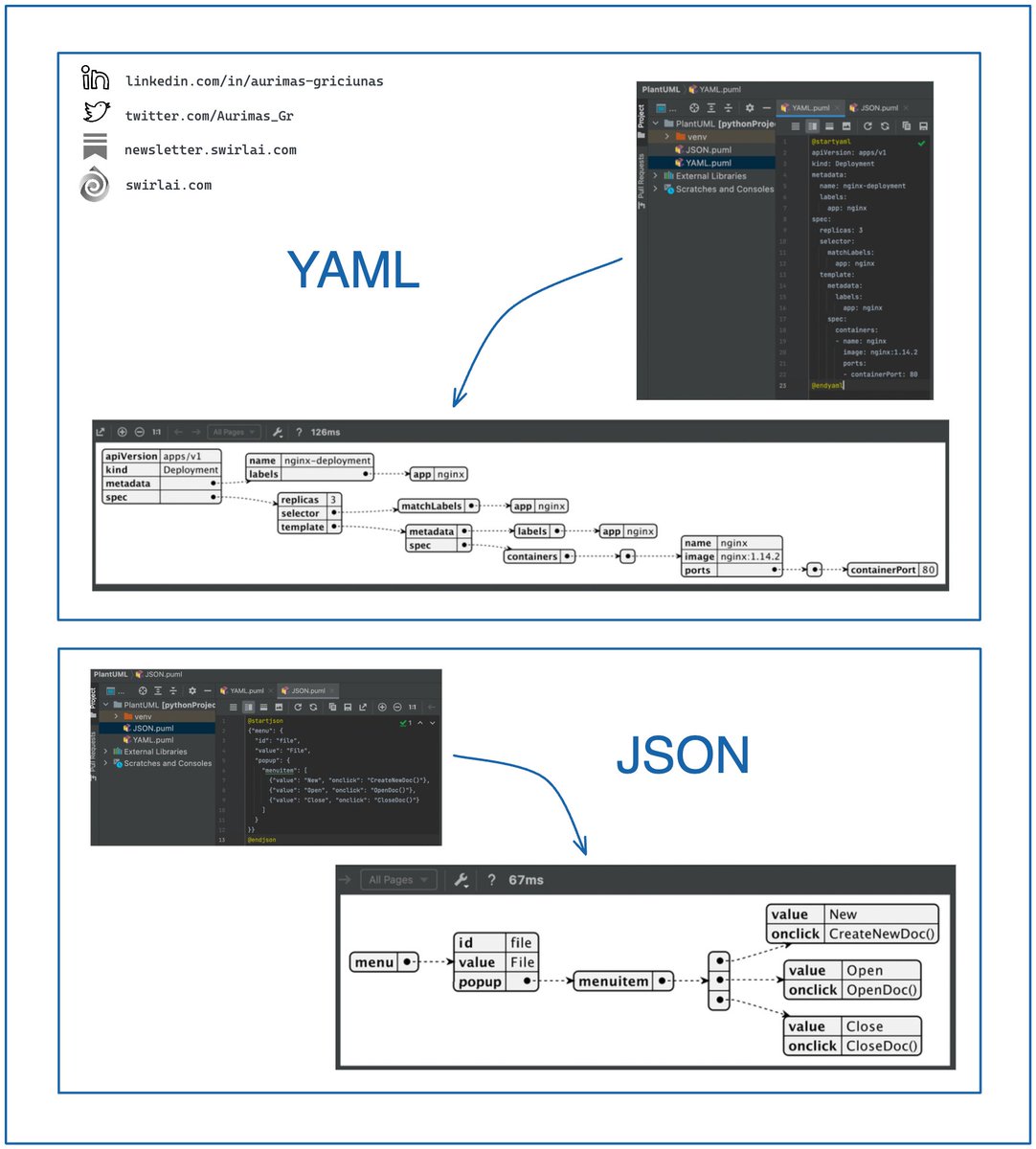
Did you know that you can visualize YAML, JSON and Data of many other formats in comprehensive and easy to navigate graphs directly in your favorite 𝗜𝗗𝗘 or in an 𝗼𝗻𝗹𝗶𝗻𝗲 𝗲𝗱𝗶𝘁𝗼𝗿?
Check out PlantUML.
Here is how you can take advantage of the tool:
➡️ Install PlantUML extension in your favorite 𝗜𝗗𝗘 - it supports 𝗣𝘆𝗖𝗵𝗮𝗿𝗺, 𝗜𝗻𝘁𝗲𝗹𝗹𝗶𝗝, 𝗩𝗦𝗖𝗼𝗱𝗲 and many more.
➡️ Create a file with .𝗽𝘂𝗺𝗹 extension.
➡️ Add 𝗬𝗔𝗠𝗟/𝗝𝗦𝗢𝗡 content or one of many other supported formats enclosed in a specific decorators. e.g. @𝘀𝘁𝗮𝗿𝘁𝘆𝗮𝗺𝗹 <𝗰𝗼𝗻𝘁𝗲𝗻𝘁> @𝗲𝗻𝗱𝘆𝗮𝗺𝗹 for yaml.
➡️ See your diagram created and changed in real time as you type!
𝗧𝗵𝗲𝗿𝗲 𝗶𝘀 𝗺𝗼𝗿𝗲:
➡️ The graphs are interactive, each time you press on an object in the graph you get the source code representing the object highlighted and ready to be edited!
➡️ You can style the output graph using code!
➡️ You can save the graph as a picture in different formats making it easy to be used as part of documentation!
➡️ There is an online editor as well, link in the comment section.
𝗡𝗲𝘃𝗲𝗿 𝗴𝗲𝘁 𝗹𝗼𝘀𝘁 𝗶𝗻 𝘁𝗵𝗲 𝗬𝗮𝗺𝗹 𝗝𝘂𝗻𝗴𝗹𝗲 𝗮𝗴𝗮𝗶𝗻!
--------
Follow me to upskill in #MLOps, #MachineLearning, #DataEngineering, #DataScience and overall #Data space.
Also hit 🔔to stay notified about new content.
𝗗𝗼𝗻’𝘁 𝗳𝗼𝗿𝗴𝗲𝘁 𝘁𝗼 𝗹𝗶𝗸𝗲 💙, 𝘀𝗵𝗮𝗿𝗲 𝗮𝗻𝗱 𝗰𝗼𝗺𝗺𝗲𝗻𝘁!
Join a growing community of Data Professionals by subscribing to my 𝗡𝗲𝘄𝘀𝗹𝗲𝘁𝘁𝗲𝗿: https://t.co/qgNCnGtF4A
Tree-based ML algorithms - why they are the most popular models in the real world
90% of all machine learning models in the real world are tabular data models and tree-based algorithms such as XGBoost, Random Forest, and Catboost are the most common.
These models can handle both numerical and categorical (text) inputs and can capture complex non-linear patterns and are a great choice for a wide number of predictive modeling problems.
There are different classes of tree-based algorithms including:
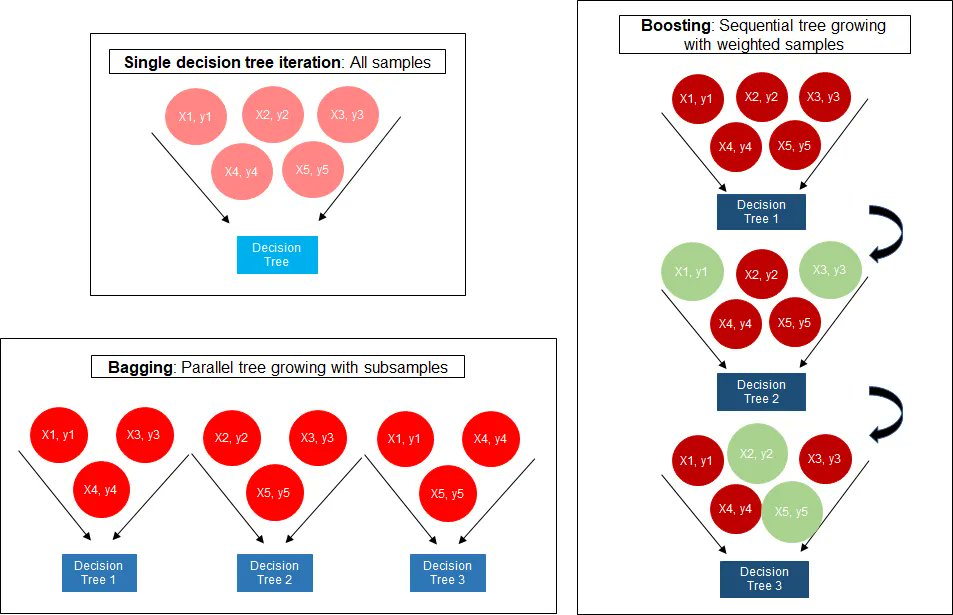
Decision Trees: Think of a flowchart where each node tests a feature, and you follow the branches down to get your answer. You're doing what a decision tree does in real life. They're simple and can be visualized easily. Anyone can look at them and get what's happening. One big negative with decision trees is they sometimes tend to overfit data.
Random Forest: Random Forest consists of a large number of individual decision trees that operate as an ensemble. Each individual tree in the random forest gives a prediction, and the class with the most votes or the average (in the case of regression) becomes the model's prediction.
Random forests use randomness to make each tree a bit different. They're more robust and less prone to the overfitting issues that decision trees suffer from
Gradient Boosting Machines (GBM): This is the most powerful and accurate.
GBM combines the predictions of multiple "weak learners" (usually shallow decision trees) in a sequential manner. Each subsequent learner attempts to correct the errors made by the combined ensemble of existing learners.
The super popular XGBoost, LightGBM, CatBoost are specific implementations of gradient boosting and are like GBMs on steroids.
Adaptive Boosting (AdaBoost): Another boosting method that focuses on the training instances that the previous trees got wrong. It's like having a tutor who makes you focus on your worst subjects. AdaBoost is adaptive (hence the name). It learns from its mistakes, and so it often does well in practice.
Given the effectiveness of these tree-based algorithms. I recommend training an array of these algorithms on your dataset and picking the best model for your task. This can be easily achieved by using an end-to-end MLOps platform like https://t.co/dJ2B4Jig2U. In fact, we will train a few NNs alongside all these tree algorithms, so you have the best of both worlds. This technique of picking the best algorithm is often times referred to as AutoML
In summary, these algorithms especially GBMs like XGBoost can easily be applied to several real-world predictive problems like fraud detection, spam classifiers, and ad-scoring and their ability to perform well with relatively unprocessed data make them a popular choice among AI and machine learning practitioners.
More reading and pic credit: https://t.co/3D0VB1PqsT
Prompt Engineering is a $335,000 career
But most people are stuck in beginner mode
Here are 5 resources that will transform you into a Prompt Engineering master:
(All Free) 🧵


![CodeByPoonam's tweet photo. MidJourney can create stunning images.
But it will cost you minimum $10/month.
Here are the best free AI tools for generating images:
[🔖 Bookmark for later] https://t.co/ca2cOGd4lS](https://pbs.twimg.com/media/F9Nkl1ebkAAVHTy.jpg)




![CodeByPoonam's tweet photo. MidJourney can create stunning images.
But it will cost you minimum $10/month.
Here are the best free AI tools for generating images:
[🔖 Bookmark for later] https://t.co/ca2cOGd4lS](https://pbs.twimg.com/media/F9NkmiJaUAAX8dQ.jpg)