The effort to understand the universe is one of the very few things that lifts human life a little above the level of farce, and gives it some of the grace of tragedy.
- Steven Weinberg
Daniel Dennett argues that the danger of religion is not simply that people believe things.
It is that faith can become an excuse to stop questioning.
To stop thinking.
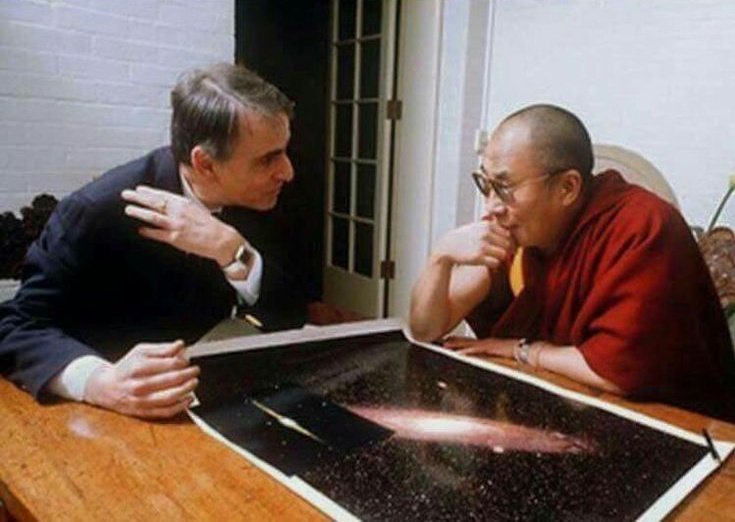
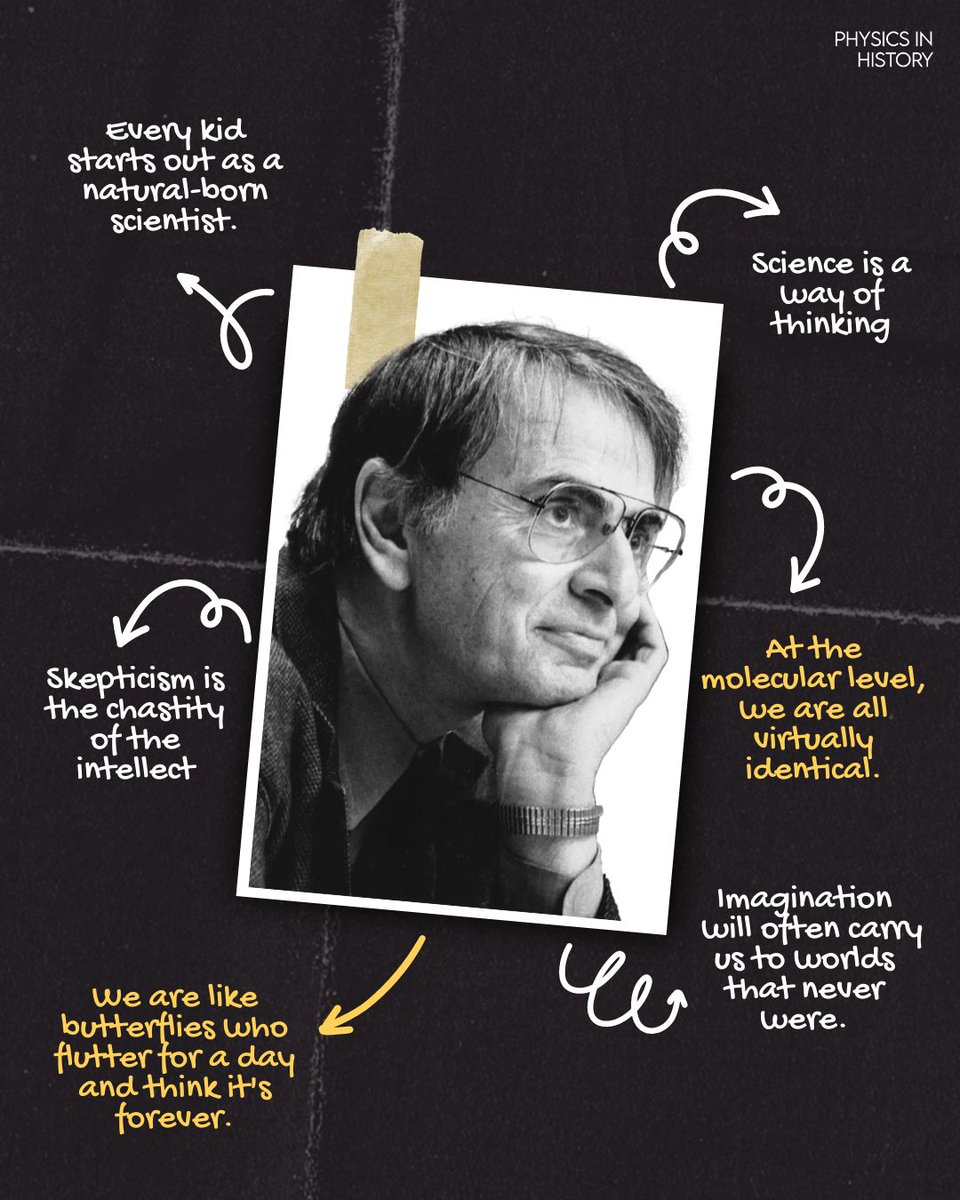
Carl Sagan once asked the Dalai Lama what he would do if a central tenet of Buddhism was definitively disproven by science. The Dalai Lama's response was that they would have to give up the belief, stating, "If through thorough investigation things become clear, only then is it time to accept and believe". He later clarified that Buddhists should accept careful scientific findings over scriptural accounts if they conflict, citing how he stopped believing in the traditional Buddhist flat-world cosmology after learning about modern astronomy.
( 📷 Carl Sagan and the Dalai Lama, who met in 1991 at Cornell University.)
"No matter how isolated you are and how lonely you feel, if you do your work truly and conscientiously, unknown allies will come and seek you."
- Carl Jung
Two physicists, Arnab Priya Saha and Aninda Sinha from the Indian Institute of Science, inadvertently discovered a new formula for calculating π while working on string theory. Their findings were published in Physical Review Letters in January 2024.
This formula generates an infinitely long sum. What's remarkable is that it depends on a factor λ, which is a freely adjustable parameter.
Since there are infinitely many possible values for λ, Saha and Sinha have effectively discovered an infinite number of formulas for π. Interestingly, when λ approaches infinity, the equation corresponds to Madhava's formula discovered more than 600 years ago.
Finally we shall place the Sun himself at the center of the Universe. All this is suggested by the systematic procession of events and the harmony of the whole Universe, if only we face the facts, as they say, "with both eyes open."
- Nicolaus Copernicus
But when a person of that sex, that, because of our mores and our prejudices, has to encounter infinitely more obstacles and difficulties than men in familiarizing herself with these thorny research problems, nevertheless succeeds in surmounting these obstacles and penetrating their most obscure parts, she must without doubt have the noblest courage, quite extraordinary talents and superior genius.
- Carl Friedrich Gauss' letter to Sophie Germain (30 April 1807)
📷 Portait by Christian Albrecht Jensen (1792–1870)
Born today in 1776:
In an era when women were often denied formal education in mathematics, Sophie Germain made significant contributions to number theory and elasticity theory under the pseudonym Monsieur LeBlanc. Her works on Fermat's Last Theorem laid the groundwork for future mathematicians, and the Sophie Germain primes are named in her honor.