@AnujaDhakras21 In the middle of a lathi charge, every voice matters. So does reaching it. Because the truth is worth the climb.
Thank you for your fearless reporting ⚡️
From the $INTC call. Particularly the last sentence.
FINALLY they said it lol.
"We made the decision in Q2 to fully committed to high volume ramp in 2028"
"Our early work on Intel 14A continues to make good progress. We continue to build out and validate the IP portfolio for Intel 14A as we position the 14A family for broad adoption across a wide range of customers.
I'm pleased to see the increasing momentum in customer engagements for Intel 14A, and I'm increasingly confident that 14A will be a highly competitive process technology across the key vectors of performance, power, density, cost, and schedule.
With encouraging progress from external customers and increasing demand from our internal product teams, we remain on track for Intel 14A risk production for internal products in the second half of 2027 and we made the decision in Q2 to fully committed to high volume ramp in 2028"
@sptomlinson325 $AMD and $TSM which are there two closest comparables on the CPU and foundry side both trade at EV/Sales ratios of 17x and 12x respectively vs $INTC which is under-earning but improving rapidly as you can see by their results & guidance which trades at 9x.
$INTC vs consensus reported ~2x the EPS & beat revs by 12%. They raised capex (18%) much like their customers did yesterday but unlike their customers their Q3 EPS is going up by ~40%. I like infrastructure beneficiaries w/ expanding margins of all that spend, not the spenders.
Your brain turns repeated avoidance into fear. The first time you avoid a task, it feels like relief. The fifth time, the same task feels scary. Avoidance trains fear to grow.
The memory shortage is not going away anytime soon and this chart proves it's about to get a lot worse (Save this).
Deutsche Bank and Gartner, shows demand outstripping supply for DRAM, the memory chips used in everything from AI servers to PCs, every single year from 2026 through 2030.
The shortfall starts at 110% demand to supply in 2026, meaning demand exceeds supply by 10%, then widens to 121% in 2027 and peaks at 129% in 2028, before easing slightly to 118% in 2029 and 111% in 2030, but never actually returning to balance.
In raw terms, that's a shortfall of 210,000 wafer starts per month in 2026 that balloons to a shortfall of nearly 795,000 wafer starts per month in 2028, the worst point in the forecast.
The core driver is HBM, or high bandwidth memory, the specialized memory that goes directly into AI accelerators like Nvidia GPUs.
HBM demand is expected to grow by as much as 56% to 67% year over year between 2026 and 2028, and because HBM takes up so much more wafer capacity per bit than standard memory, its share of total DRAM manufacturing capacity is projected to jump from just 18% in 2025 to 35% by 2028.
That means memory makers have to dedicate an increasing chunk of their existing factories just to HBM, which directly squeezes how much regular DRAM, the kind used in phones, laptops, and normal servers, they can produce at the same time, and building new fabs takes years, so supply simply can't catch up quickly.
Micron is one of only three companies in the world, alongside Samsung and SK Hynix, that actually makes DRAM and HBM at scale, so it sits directly inside an industry where demand outpaces supply every single year through 2030, giving it unusually durable pricing power.
Because this shortage is structural driven by AI accelerators needing far more memory per chip than the industry can currently build, Micron doesn't need AI spending to keep accelerating from here, it just needs the current trajectory to hold for prices and margins to stay elevated for years.
The 2028 peak shortfall of nearly 795,000 wafer starts per month suggests the tightest pricing environment is still ahead rather than behind, meaning the bullish case for Micron isn't about chasing a rally that already happened, it's about a supply demand imbalance that's still getting worse for at least two more years.
Micron's HBM business specifically benefits from the trade ratio effect shown in the data where each unit of HBM produced consumes far more manufacturing capacity than standard DRAM, so as HBM's share of the business grows from 18% to 35% of total output, Micron's revenue mix shifts toward its highest margin, highest demand product line almost automatically.
I remain bullish on Micron and Milk Road Pro members are up massively on these trades, come join Milk Road Pro to get our entire thesis for just a dollar using the link below!
BofA’s Vivek Arya made an excellent point, which I’d like to share.
Is open-source AI bearish for memory?
Closed models amortize global demand across shared HBM pools concentrated in a handful of data centers, whereas open models create a new memory footprint with every deployment. If 10,000 companies self-host the same open model, the model weights must be replicated across 10,000 separate HBM pools, with each deployment also requiring its own KV cache. As 128K–1M token contexts become commonplace in 2026, the KV cache alone can exceed 40GB per active session.
Low-cost Chinese APIs drive greater inference demand, broader enterprise self-hosting, and more memory sockets worldwide. In short, closed models concentrate memory demand, while open models multiply it.
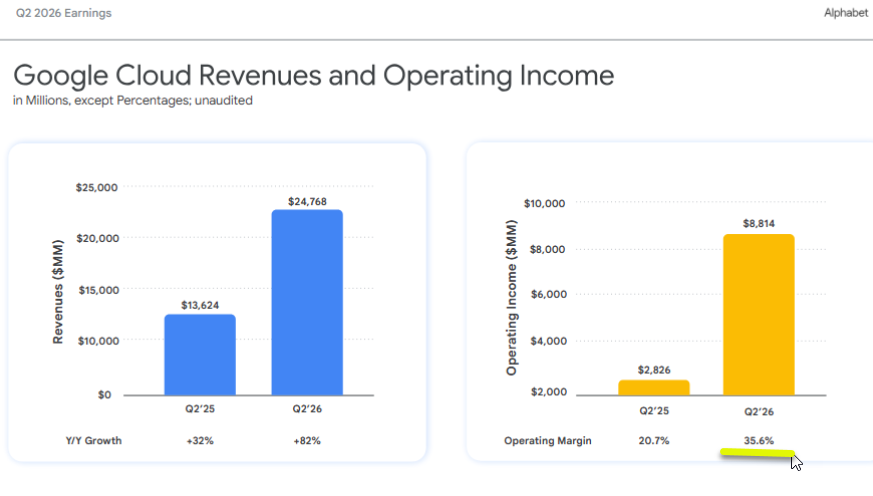
Google grew its cloud business by 82% YoY.
An almost $100 billion revenue business grew 82% in a single year.
Just absurd numbers, AI is creating an earnings explosion.
GS: How China Is Buffering the Global Energy Supply Shock
Coal and Oil Effective Destocking and Higher Renewables Usage Helped Buffer China's Negative Fossil Fuel Import Shock
Morgan Stanley: "But we spent last week talking to several of our purchasing contacts in the data center space, and the intensity of the shortages in that part of the business show no signs of abating. We see prices up at least 25% on a like-for-like basis from 2q to 3q, above our estimates and above 3rd-party estimates. As importantly, the longer-term concerns that the memory shortage will intensify in 2027 and again in 2028 are still as strong as ever. There isn't enough memory vs. AI requirements, and we just don't see that changing."
तुम्हाला जसा त्रास आणि वैताग होतोय कारण कोणीही तुमचे म्हणणे ऐकत नाही आणि त्यांना सर्व काही त्यांच्याच पद्धतीने करायचे असते.तसाच त्रास त्यांनाही होतोय आणि म्हणूनच तेही तुमच्यासारखीच तक्रार करत आहेत. ते तुमच्यापेक्षा वेगळे नाहीत. ज्या खऱ्या शत्रूने तुम्हा दोघांनाही या परिस्थितीत आणले आहे, तो मात्र तुम्ही एकमेकांवर दोषारोप करत असल्याचे पाहून मज्जा घेत आहे.
A mentor once told me this: Reduce the amplitude of the wave. Never get too high on the wins. Never get too low on the losses. Emotional stability is the real cheat code for adapting to the inevitable uncertainty of life.