Being a European today basically means having a pretty excellent day until around 5 pm when the White House starts posting the dumbest shit you've ever had the misfortune to read.
Every. Damn. Day.
See nädal ilmnes, et @Riigikogu ei teosta õigusloome käigus elementaarset kvaliteedikontrolli (testi oma töö vastu LLMi!).
Loovkoodisin paari tunniga veidi süsteemsema lahenduse prototüübi: "Apsakaleidja"...
@RichardHanania NATO is an obstacle to Putin. NATO does not threaten Russia but its plans to invade. The rest are fabricated excuses for invasion: not a country, not a real country, brotherly nation, nazis, demilitarization, protection of russians, etc.
There’s this recurring trope that Europe is overregulated and the US is this sort of free-wheeling world where anything goes.
As with everything, the reality is far more nuanced. I used to believe this trope myself… until I actually lived in Europe and experienced it.
In Europe, regulation often operates at the collective level.. think healthcare, labor protections, food standards, infrastructure. These regulatory frameworks are heavy by design in that they create stability by increasing broad citizen-level confidence in them actually functioning.
But at the individual level, daily life can be far looser. There are playgrounds in Europe that would be illegal in the US due to their “danger.” People rarely wear helmets.. not even toddlers.. on bicycles in many places. Kids climb trees higher and parents barely care or even notice. Farms are open.. kids can climb all over haystack mountains and nobody asks if their farmer is insured.
There is a playground in the NL of *literal* piles of discarded shipping pallets and construction debris with rusty jagged nails sticking out everywhere… and little kids climb all over them with hammers connecting random pieces together. One false step and you’re slicing an artery or losing an eye. Yet there is barely any adult supervision, parents don’t care, and nobody is signing any paperwork or waiving liability.
We bring American friends there and they literally cannot believe what they’re seeing. And they don’t let their kids.
Activities proceed on the assumption that risk is visible, understood, and partly if not mostly your responsibility.
Menanwhile… in the US we paradoxically flip this culture.
Collectively, we resist broad social regulation writ large. Individually, though, life is wrapped in micro-regulation everywhere… liability waivers, warning labels, signage, insurance restrictions, endless legal disclaimers. Every activity sees to have some paperwork. Everyone is covering for something.
This is a cultural thing. The US actually uses the legal system as a cover for social risk-sharing.
In much of Europe, the downside of injury or bad luck is partially absorbed by healthcare systems, disability supports, and social insurance. The cost of risk is basically capped for you. The system carries some of the shock.
In the US, harm can be financially catastrophic. When something goes wrong, someone has to pay, and courts become the primary mechanism for redistributing that risk after the fact… not “the government.”
The you had to layer in contingency-based personal injury law and jury trials, and blaming someone else for your problems becomes economically logical. There’s little downside to suing, meaningful upside if you win, and enormous unpredictability for defendants.. hence why insurance costs have become comically absurd.
So what happens…. Businesses respond long before anything reaches court by engineering out risk in daily life… more warnings, more forms, fewer “at your own risk” type playgrounds or other environments.
So Europe can feel more regulated on paper… but in actual lived experience that matters to your day to day existenxe, in the US we are often navigating a far narrower acceptable window of risk.
In many ways, the US is the most highly regulated place in the entire world, by far, it’s just not “the government” doing the regulating.
The US gov says the EU Commission is “censoring” X by imposing a DSA fine on Musk. This is absurd. Here is what the fine is actually about:
1.Misleading “verified accounts”
X sells blue checkmarks as “verified”. But DSA Art. 26 bans deceptive design. These are paid badges anyone can buy (like myself). Users can’t know if an account is trustworthy or just paying. It is not about banning speech. It’s about more transparency of business practices.
👉Where is censorship here? There is no censorship here!
2.Missing ad transparency
DSA Art. 39 requires a public, searchable ad repository. For VLOPs like X, Art. 42 sets even stricter rules to detect manipulation. This isn’t policing speech. It’s documenting past ads. Even in the US, commercial speech can be regulated (Central Hudson 1980). It is not about current ads, it’s about transparency for the cemetery of dead ads. To make clear that manipulation like Cambridge Analytics do not happen easily.
👉Where is censorship here? There is no censorship here!
3.Blocking researchers’ access
The Commission found that X “effectively undermines research into systemic risks” by restricting access to public (!) data.
It’s not about banning someone say something, it’s about allowing someone to learn something.
👉Where is censorship here? There is no censorship here!
So, if you want to criticize, find the right arguments.
If you dislike the EU find the right points to dislike it.
Don’t invent things.
And then we talk.
Just like they taught us at @YaleLawSch, right, @JDVance@VP ;)?
The history Russians pretend does not exist. Telegram No. 300 from the Ambassador of Germany in the Soviet Union Schulenburg to the Ministry of Foreign Affairs of Germany, September 8, 1939:
“Very urgent!
I have just received the following telephone message from Molotov:
‘I have received your communication regarding the entry of German troops into Warsaw. Please convey my congratulations and greetings to the German government. — Molotov.’
Schulenberg”
It’s not like they don’t have its translation, which we found when the Russian archives briefly opened after the end of the Cold War (see attached).
Oh, and if you thought the bromance was only about Poland, think again. Here’s Schulenburg next year, after Norway was captured by Wehrmacht, Telegram No. 1167, June 17 1940:
“Molotov summoned me this evening to his office and expressed the warmest congratulations of the Soviet Government on the splendid success of the German Armed Forces. Thereupon, Molotov informed me of the Soviet action against the Baltic States. He referred to the reasons published in the press and added that it had become necessary to put an end to all the intrigues by which England and France had tried to sow discord and mistrust between Germany and the Soviet Union in the Baltic States.”
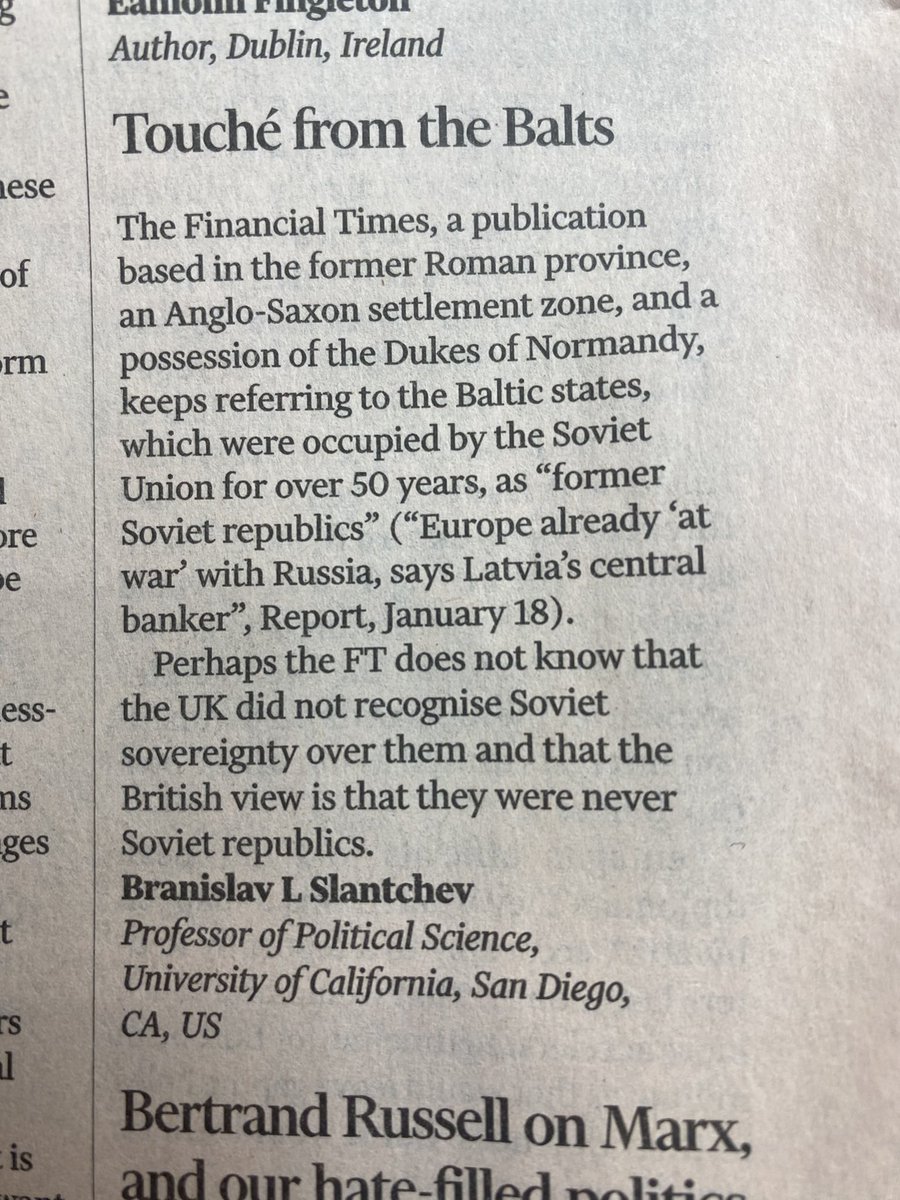
I am especially fond of how the USSR put an end to all “discord and mistrust” between Moscow and the Baltics by conquering and occupying them.
Nothing ever changes with these rapacious scoundrels. Not their unlimited appetite, not their methods, and not how they dress them up.