📢New paper📢 out #OpenAccess with @lieberman_amy (@BUWheelock) and Julie Mitchiner (@GallaudetEDU)!
“Hearing parents as sign language learners: describing and evaluating the ASL skills of parents learning ASL with their deaf children”
https://t.co/GVWS8GvjKb (1/3)
We realized that there was little documentation of hearing parents' sign language skills. So we analyzed parents’ expressive and receptive ASL skills and found that parents can achieve intermediate signing skills, which would allow them to communicate with their deaf child (2/3)
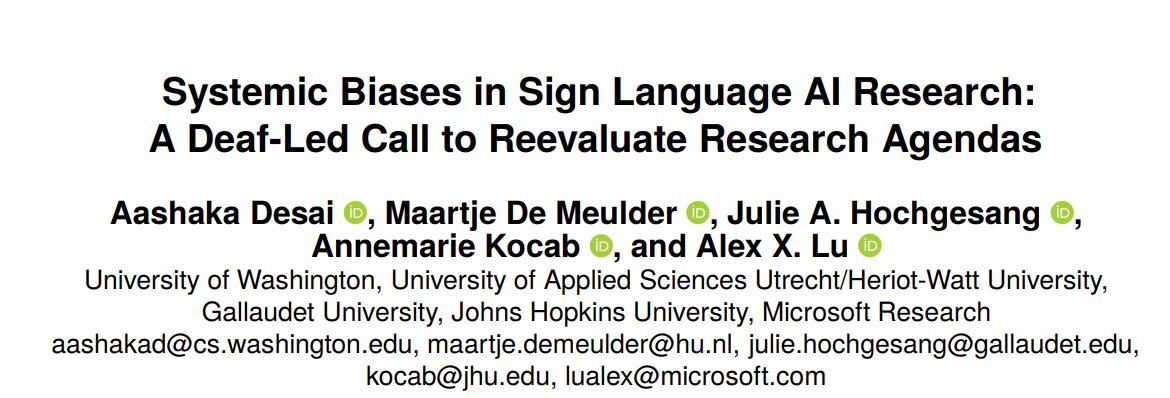
Sign language AI is dominated by hearing, non-signing researchers. What kinds of systemic biases does this introduce in the field's collective direction?
To find out, read our preprint, with @aashaka_desai@mdemeulder @jahochcam and Annemarie Kocab!
https://t.co/xuUejxU1q2
The DeafYES! team (with @RainbowOmma) worked for two years on developing a critical resource not just for hearing nonsigning healthcare professionals, but also for anyone who works with deaf, deafblind, hard-of-hearing and late-deafened people. https://t.co/kinrFij2FM
‼️ Sign, share & SUPPORT this petition
@acludelaware retract the discriminatory lawsuit that denies Deaf children full lang access!
➡️ https://t.co/hIM3zql84Y
@aclu_nationwide-lawsuit is rife w/ misleading info & ignores their oral-only approach contributes to lang deprivation.
After many years, revisions, headaches, and rejections, and headaches with @DeafHistorian the original paper that started the Crip lx movement is finally published.
https://t.co/SNEVFX8e65
New OA paper "10 things you should know about sign languages" focussing on why their study is important to science. RT to reach a broad audience! https://t.co/tnutV73dHk
The PLAY and PAW labs are open for studies--if you are a family with a #deaf#hardofhearing child between 6 months and 6 years of age, connect with us here:
https://t.co/kS6XDia3k5
New paper! “Learning a Sign Language does not Hinder Acquisition of a Spoken Language.” This study provides evidence that families with deaf children can pursue ASL without concern of negative impact on spoken English development. 🧵
https://t.co/0tkQKqb6CK
It’s important to acknowledge that asking how ASL impacts spoken English inherently privileges spoken English. This is not our intention. We thought this study was worthwhile because spoken language is often a consideration in decisions about what language(s) deaf kids learn.